What's inside
As an Amazon Associate I earn from qualifying purchases. This post may contain affiliate links at no extra cost to you.
Overhead racks are useful when floor and wall space are already spoken for. They can hold empty storage bins, seasonal supplies, sanding discs, drop cloths, light clamps, and other items that do not need daily access. They are a poor choice for heavy hardware, cast-iron tools, dense lumber, or anything that could cause serious damage if it falls.
The best rack depends less on its advertised weight rating than on your ceiling construction, how often you need the contents, and whether the rack includes a real way to keep bins from sliding. Before shopping, mark the joist direction, measure the available height, and decide whether you can safely reach the rack with a step ladder.
As an Amazon Associate we earn from qualifying purchases at no extra cost to you.

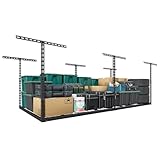


What to Look For in an Overhead Rack
For a typical home workshop, a rack with a 2-by-4-foot or 4-by-4-foot platform is easier to install and use than a very large shelf. A 2-by-4-foot rack is usually enough for a few lightweight totes and leaves more room around lights, garage doors, and dust-collection ducting. Larger racks provide better capacity but are harder to level and place greater demands on the ceiling structure.
Check the rack’s distributed load rating, not just its maximum capacity. A rating of 250 to 600 pounds may sound generous, but that weight must be spread across the shelves. A single heavy box in one corner can twist the frame or overload one ceiling connection. For lightweight supplies, keeping the working load below about half the stated rating is a sensible margin, especially if the rack is suspended from a wood-framed ceiling.
Look for a steel frame, positive fasteners, and a mesh or wire deck with a raised lip. The lip matters: vibration from a garage door or an accidental bump can move a smooth plastic tote toward the edge. Some racks include adjustable-height brackets, which help when the ceiling is crowded with conduit, lights, or dust-collection pipe.
Overhead Rack Types Compared
| Rack type | Best use | Advantages | Limitations |
|---|---|---|---|
| Ceiling-mounted wire rack | Bins and infrequently used supplies | Good airflow, visible contents, usually affordable | Requires accurate joist fastening; awkward to reach |
| Wood platform on ceiling cleats | Very light items and custom spaces | Cheap, easy to size, can fit around obstructions | Less adjustable; plywood can sag or split if poorly supported |
| Heavy-duty steel shelf | More bins or moderately heavier supplies | Stiffer frame and better long-term durability | Heavier, costlier, and less forgiving of weak mounting |
| Motorized lift rack | Frequent access without a tall ladder | Convenient lowering mechanism | Expensive, mechanically complex, still needs secure ceiling support |
For most workshops, a fixed wire rack is the practical starting point. A ceiling-mounted garage storage rack is generally a better buy than a lift system if the supplies come down only a few times each month. A lift rack makes more sense for someone who cannot safely use a ladder, but it adds cables, pulleys, or a motor that require inspection.
Installation and Load Limits
Fasten the rack into ceiling joists, not drywall, plaster, or a thin layer of ceiling sheathing. Use a stud finder to locate the joists, then confirm their position with a small pilot hole. In a conventional wood ceiling, the mounting hardware should pass into solid wood for a substantial depth; follow the rack manufacturer’s fastener requirements rather than substituting short screws.
Do not assume that four mounting points are enough. A rack rated for several hundred pounds may require six or more connections, with brackets positioned over multiple joists. If the joists run the wrong direction, use a properly sized cross-support attached to several joists, or choose another location. Do not hang a rack from a single joist with drywall anchors.
After installation, push up and sideways on the empty rack. It should not rock, pull away from the ceiling, or make cracking sounds. Load it gradually, placing the heaviest permitted items near the center and keeping the total weight balanced. Recheck the hardware after loading and again after a few weeks. A sagging frame, bent bracket, loose screw, or widening crack is a reason to unload it immediately.
Good and Bad Items to Store Overhead
Overhead storage works well for empty containers, spare shop towels, packaging materials, seasonal decorations, light extension cords, spare filters, and rarely used jigs made from thin plywood. Put these items in lidded bins so dust from sanding and sawing does not settle inside them. Clear bins are useful for identification, while opaque bins protect light-sensitive finishes and adhesives.
Avoid storing paint, solvents, propane cylinders, aerosol cans, batteries, and other hazardous materials overhead unless local rules and the product labels specifically allow it. Temperature swings in an unconditioned garage can damage finishes and batteries. Do not place sharp blades, routers, heavy hand tools, or dense fasteners in a rack intended for lightweight supplies. A falling 40-pound box is a serious hazard even if the rack itself is rated for it.
Keep at least 12 to 18 inches of clearance around garage-door tracks, opener mechanisms, light fixtures, and sprinkler heads where applicable. Never block a required access panel or cover a light fixture with stored material. If a rack sits above a workbench, position it so a dropped bin cannot land on someone’s normal standing area.
Access, Bins, and Organization
Use containers that fit the rack with a little room to spare. A shelf packed tightly from edge to edge is difficult to inspect and encourages overloading. Label two sides of each bin—the side facing the aisle and the side facing the wall—so the contents remain identifiable after the bin is moved.
A step ladder is safer than standing on a workbench or reaching from a rolling chair. If the rack is above about 8 feet, keep a dedicated ladder nearby and leave a clear landing area. For daily-use supplies, choose wall cabinets, drawer storage, or a low shelf instead. Overhead storage saves floor space, but every retrieval adds a lifting and balance risk.
When comparing lidded plastic storage bins, prioritize straight sides, stackable lids, and a published weight capacity over decorative features. The cheaper bin is fine for empty boxes or rags. For abrasive supplies, small hardware, or anything used often, stronger bins with reinforced rims are less likely to crack when pulled from a high shelf.
When a Cheaper Rack Is Fine
A basic rack is adequate when the ceiling is sound, the load stays below roughly 50 to 100 pounds, and the contents are light and infrequently accessed. You do not need a thick commercial frame to store empty totes and seasonal cloths. You do need accurate joist fastening, a safety lip, and enough clearance to inspect the rack.
Spend more on a heavier frame, adjustable brackets, or a lift system when the rack must span an awkward area, carry several full bins, or be lowered frequently. If you cannot verify the ceiling structure or safely install the rack, hire a qualified installer. The cost of professional mounting is small compared with repairing a damaged ceiling—or treating an injury caused by a falling load.