What's inside
As an Amazon Associate I earn from qualifying purchases. This post may contain affiliate links at no extra cost to you.
Chisels are easy to store badly. Toss them in a drawer and their cutting edges strike screwdrivers, plane irons, and one another. The result is usually a nicked edge, a split handle, or a hand reaching into a pile of sharp steel. A good chisel rack keeps each tool separated, visible, and supported without taking over the workbench.
The best rack depends on how many chisels you own, whether they are bevel-edge or socket chisels, and how much wall space is available. For most woodworking shops, an open wall rack or a shallow bench rack is a better choice than a deep drawer organizer. It lets you identify the size immediately and keeps the cutting ends away from hard surfaces.
As an Amazon Associate we earn from qualifying purchases at no extra cost to you.

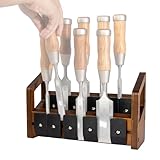
What a Chisel Rack Needs to Do
A rack should keep cutting edges from touching anything except air or a soft support. The simplest useful design has individual slots or holes spaced far enough apart that adjacent blades cannot collide. For common bench chisels, 1-1/4 to 1-1/2 inches between slot centers is a practical starting point. Wider tools and heavy handles may need 2 inches.
The rack also needs positive retention. A horizontal shelf with open slots is convenient, but a chisel can fall out when the bench is bumped. A shallow front lip, angled slots, or a vertical wall-mounted design prevents this. Avoid any rack where a chisel rests on its edge. The cutting edge should either point downward into a clearance gap or point upward into a protected slot, never directly onto the rack itself.
Wood, plywood, and hardwood-faced racks are gentle on polished tools. Plastic racks are easy to clean and resist glue, but some molded designs have rough edges or slots that are too narrow for thick blades. Bare steel racks are durable but should have smooth, rounded contact points and a finish that will not scratch the tools.
The Best Chisel Rack Types
| Rack type | Best for | Advantages | Limitations |
|---|---|---|---|
| Wall-mounted slotted rack | Most workshops | Excellent visibility, saves bench space, easy to expand | Requires wall mounting and careful slot sizing |
| Bench-top rack | Small tool collections and renters | Portable, simple installation, keeps tools close | Uses valuable bench space and can be knocked over |
| Drawer insert | Clean, enclosed storage | Protects tools from dust and leaves the wall clear | Tools are hidden, and blades can contact dividers if poorly fitted |
| Magnetic strip with guards | Lightweight specialty chisels | Very quick access and flexible placement | Not ideal for heavy chisels; exposed edges remain a hazard |
For a typical bench setup, start with a woodworking chisel rack that mounts to the wall or the side of a cabinet. A rack holding six to twelve chisels is enough for many hobby shops. If you have framing chisels, slicks, or unusually wide blades, check the slot dimensions rather than relying on the product photo.
Why Wall-Mounted Racks Usually Win
Wall storage keeps chisels out of the dust and clutter around the bench. Mount the rack just above or beside the sharpening area, but not directly over the main work surface. A dropped chisel is less likely to damage a project when it falls beside the bench rather than onto it.
Mounting height matters. The lowest chisel handle should sit high enough that it cannot catch on clothing or a passing board. Leave at least 3 inches below the rack for the blade clearance and at least 6 inches above the bench for comfortable removal. Screw the rack into studs, cabinet sides, or a plywood backer. Small wall anchors are acceptable for a very light rack, but a full set of steel chisels can easily weigh 10 pounds or more.
Open racks need some dust control. In a shop with a table saw or router, dust will settle on exposed blades and mix with humidity to encourage rust. Wipe chisels occasionally with a dry cloth and apply a very light corrosion inhibitor to the steel. Do not coat the cutting edge with a sticky oil that can transfer to wood. If the shop is especially dusty, a rack inside a cabinet with a shallow drawer or door is worth the reduced visibility.
When Bench or Drawer Storage Makes Sense
A bench-top rack is fine when you own four or five chisels and use them constantly. Choose a broad base, rubber feet, and a low center of gravity. A rack that is 12 inches tall but only 3 inches deep is likely to tip when one end is empty. A simple hardwood block with drilled holes can work well if each hole has enough clearance around the blade and a relief underneath the cutting edge.
Drawer inserts are the better option when the shop has limited wall space or you want protection from abrasive dust. Use individual channels lined with thin felt, leather, or soft plastic. Leave at least 1/4 inch of clearance around the cutting end so a tool can be lifted without dragging the edge across a divider. Do not store loose chisels in a drawer, even if they are wrapped in a rag; the rag compresses and allows tools to migrate into one another.
For a drawer solution, compare woodworking tool drawer organizers with dedicated chisel racks. The cheaper organizer is fine if you add dividers and the drawer does not move rapidly. A dedicated rack is worthwhile for expensive Japanese chisels or tools that are sharpened to a delicate, thin edge.
Buying and Building Details That Matter
Measure the thickest blade and handle before buying. A rack advertised for “12 chisels” may fit only narrow bench chisels, not mortising chisels with 1-inch-thick handles. Check the total width too: twelve slots at 1-1/2-inch spacing require roughly 18 inches before adding side margins.
Inspect the rack for sharp slot corners, loose mounting hardware, and unsupported blades. Felt or leather pads help, but they are not a substitute for proper spacing. If building one, round the front edges with a 1/8-inch router bit or sandpaper, drill a 1/4-inch relief below each cutting edge, and seal the wood with two coats of polyurethane or hardwax oil. This prevents end grain from absorbing moisture and makes glue cleanup easier.
A wall-mounted woodworking tool rack can also hold marking knives and small screwdrivers, but do not overcrowd it. Leave enough space to remove one chisel without rubbing against the next. Labeling slots by size is useful when several tools have similar handles.
Safe Use and Maintenance
Store chisels clean and dry, with the cutting edge facing away from the normal path of your hands. Keep a separate place for damaged or recently sharpened tools so a nicked edge does not disappear into the regular set. Check screws and wall mounts every few months, especially if the rack is attached to a vibrating cabinet.
The cheaper rack is perfectly adequate when it has smooth supports, secure mounting, and enough room between tools. Spending more mainly buys better fit, stronger construction, and easier access. Those features matter when the rack is used daily, but they cannot compensate for poor placement or careless loading.