
What's inside
As an Amazon Associate I earn from qualifying purchases. This post may contain affiliate links at no extra cost to you.
Best Roller Stands for Table Saws and Long Stock
The best roller stand for table saw use is one that sets flush with your saw’s table surface, holds at least 250 lbs without flexing, and folds flat enough to live against a shop wall — for most shops, a pedestal-style stand like the WEN MS011 covers the job, while the heavier HTC PM-5080 suits anyone regularly breaking down full plywood sheets solo. Below is what actually separates a useful outfeed support from a wobbly hazard, and which models fit which situations.
What a Roller Stand Actually Needs to Do
A table saw roller stand exists to solve one problem: keeping long boards and sheet goods level as they exit the blade. When a 6-foot board or a half-sheet of plywood overhangs the table, gravity pulls the far end down, which tips the near end up and can cause binding, burn marks, or a dangerous kickback moment at the blade. A properly set stand keeps the workpiece riding at table height all the way through the cut.
As an Amazon Associate we earn from qualifying purchases at no extra cost to you.
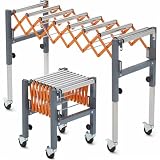


Three stand types cover nearly all use cases:
- Single-roller pedestal stands — one roller on an adjustable post, cheapest and most compact, best for boards and rip cuts.
- Multi-roller or wide-roller stands — 2–3 rollers or one wide roller head, better for wide sheet goods that need support across their width.
- Flip-top or combination stands — a roller that converts to a flat support surface, useful when feeding narrow stock that could fall between rollers.
Decision Criteria: What to Check Before Buying
Height range
Measure your table saw’s table height from the floor — most cabinet and jobsite saws sit between 34 and 37 inches. Your stand’s adjustment range must include that number with room to spare. Many budget stands top out around 44–46 inches, which is fine for standard saws but can come up short under contractor saws or a saw mounted on a rolling base, which can push the table past 39 inches.
Roller design
Rollers come in three materials. Steel ball-bearing rollers roll the smoothest and resist flat-spotting under heavy loads, but they dent thin sheet goods like melamine. Polyurethane rollers are kinder to finished surfaces and quiet. Galvanized steel tube rollers (the cheapest) roll fine for rough lumber but can corrode and seize if the shop gets humid. Ball-transfer heads — a grid of small steel balls — let you shift stock laterally mid-feed, which some people love for fence alignment and others find too free-moving.
Weight capacity
A 4×8 sheet of ¾-inch plywood weighs roughly 60–70 lbs, and a pair of stands shares that load. Anything rated under 150 lbs is only suitable for light trim work. For sheet goods and hardwood boards, 250 lbs and up is the sensible floor.
Footprint and stability
Stability is about the base, not the post. A wide tripod or H-frame base resists tipping when a heavy board lands on the roller at an angle — which happens constantly when feeding solo. Narrow round bases tip. Look for a base spread of at least 18–20 inches.
Folding storage
In a two-car garage shop, a stand that doesn’t fold is a stand that’s always in the way. The best designs collapse the base legs and drop the post in under 10 seconds, going flat enough to hang on a wall hook or slide under the saw.
Top Picks by Situation
Best all-around for a garage or home shop: WEN MS011. The pedestal design adjusts roughly 28–45 inches, the base folds flat, and it’s rated around 250 lbs. The single roller handles boards cleanly; for sheet goods you’d buy two, which stays cheap given these run in the $40–70 range.
Best for heavy sheet goods and frequent use: HTC PM-5080. A sturdier frame, higher capacity (HTC rates it around 500 lbs), and a wider roller. The heavier base makes it noticeably less tippy when a plywood sheet drops onto it mid-feed. Expect to pay more — typically $90–130 — but it’s the pick if you break down sheet goods weekly.
Best value workhorse: Bora Portamate PM-5090. Similar pedestal format, generous height range, decent capacity, and a wide roller head. It splits the difference between the WEN and the HTC on price and heft.
Best when the saw itself needs to move: a mobile base or rolling saw stand. If your real problem is a movable table saw stand rather than outfeed support, the fix is wheels on the saw, not more roller stands. Rolling saw stands like the Bosch GTA50W or DEWALT DW7440RS put the saw on wheels for table saw stand mobility — the saw rolls to the middle of the shop, then you park roller stands at the infeed and outfeed. Some DIYers retrofit wheels for table saw stand bases using universal mobile bases; that works for heavier contractor and cabinet saws the folding jobsite stands can’t carry.
Spec Comparison
| Model | Type | Height Range | Rated Capacity | Folds Flat? | Typical Price |
|---|---|---|---|---|---|
| WEN MS011 | Single roller, pedestal | ~28–45 in | ~250 lbs | Yes | $40–70 |
| Bora Portamate PM-5090 | Wide roller, pedestal | ~27–43 in | ~300 lbs | Yes | $60–90 |
| HTC PM-5080 | Wide roller, heavy base | ~26–46 in | ~500 lbs | Yes | $90–130 |
| Bosch GTA50W | Rolling saw stand (saw mount) | Fixed deck height | ~250 lbs saw limit | Folding frame | $120–170 |
Note: verify current specs with the manufacturer — heights and capacities are revised between production runs.
How Many Stands Do You Need?
A quick sizing check: one stand supports roughly the first 4 feet of overhang. Work backwards from your cuts:
- Ripping 8-ft boards on a jobsite saw: the table supports ~2 ft, so ~6 ft overhangs — two stands (outfeed + secondary) or one stand plus an outfeed table.
- Crosscutting 4×8 sheet goods: support infeed and outfeed — two stands minimum, ideally with wide rollers.
- Short boards under 4 ft: one stand is fine; the table carries most of the load.
Cost math favors buying right the first time: two mid-grade roller stands for table saw support (~$150 total) outlast three replacements of a $35 stand whose base bent the first time a plywood sheet leaned on it.
Setup and Ownership Realities
Set the roller about 1/16 inch below the table surface, not perfectly flush — a roller that’s slightly high catches the stock’s leading edge and fights your feed. Check by sliding a straightedge off the saw table onto the roller.
What wears first, in order: the height-lock mechanism (friction knobs strip or slip — keep the post clamp tight but not reefed), the roller bearings (spray with dry lubricant; avoid oily sprays that attract sawdust), and the base feet (plastic caps crack on concrete). Roller stands themselves have no real consumables — a decent one lasts a decade of hobby use.
Common mistakes: setting the stand too close so the board pivots off it as it tips; positioning it too far so the workpiece end drops between table and stand; and using a roller stand to support the side of a rip on wide panels, where a ball-transfer head or second person works better.
Which to Buy: Quick Decision Matrix
| Your situation | Pick |
|---|---|
| Occasional hobby cuts, tight budget | WEN MS011 — buy two over time |
| Weekly plywood breakdown, solo | HTC PM-5080, pair of them |
| Balance of capacity and price | Bora Portamate PM-5090 |
| Saw needs to move, not the stock | Rolling saw stand (Bosch/DEWALT type) or universal mobile base |
| Permanent shop, saw doesn’t move | Build an outfeed table; keep one roller stand for infeed |
For most readers, one or two table saw roller stands in the $50–90 range, set just below table height, will transform long-stock cutting more than any blade upgrade ever will.