
What's inside
- VEVOR CNC router models compared
- What the price usually includes
- Head-to-head: which VEVOR size fits the job?
- Materials a VEVOR CNC router can realistically cut
- Decision matrix for choosing a VEVOR CNC router machine
- Setup demands and software reality
- Ownership costs and common failure points
- Final verdict
- Related Guides
As an Amazon Associate I earn from qualifying purchases. This post may contain affiliate links at no extra cost to you.
The best VEVOR CNC router for most beginners is a 3018-class machine, while a 4030 or 6040 model makes more sense when you need larger signs, repeated production, or thicker stock; the extra work area also brings greater cost, weight, noise, setup time, and space requirements.
As an Amazon Associate we earn from qualifying purchases at no extra cost to you.

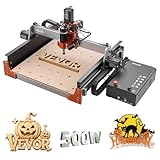


VEVOR CNC router models compared
VEVOR sells several machines under similar names, and specifications can vary between revisions and listings. The figures below describe the common configurations rather than promising that every individual bundle is identical. Check the exact product page for the included spindle, controller, and accessories before buying.
| Model family | Typical usable work area | Typical spindle | Approximate machine weight | Best suited to |
|---|---|---|---|---|
| 3018 / 3018 Pro | 300 × 180 × 45 mm | 775 spindle, about 200 W | 15–20 kg | Learning, small signs, engraving, light hobby work |
| 3018 Pro Max | 300 × 180 × 45 mm, approximately | 775 spindle, commonly 200 W | 15–22 kg | Beginners wanting a more enclosed or upgraded 3018 bundle |
| 4030-class | 400 × 300 × 80 mm, approximately | 300–500 W, depending on bundle | 35–50 kg | Medium plaques, larger reliefs, occasional production |
| 6040-class | 400 × 600 × 80 mm, approximately | 800 W to 1.5 kW, depending on version | 70–110 kg | Large signs, furniture components, frequent cutting |
| 1212-class | 300 × 300 mm or about 400 × 400 mm, depending on version | Typically 500 W to 800 W | 40–70 kg | Compact workspaces needing a squarer cutting envelope |
“Work area” means the tool’s travel, not the outside dimensions of the machine. A 3018 machine may occupy roughly 500–600 mm in width once its frame, stepper motors, cables, and clearance are considered. Leave additional room for dust extraction and access to the emergency stop.
What the price usually includes
A VEVOR CNC router machine normally includes the frame, lead screws or ball screws, stepper motors, a spindle or trim-router-style motor, power supply, control box, spoilboard or work surface, collets, clamps, and a basic set of engraving bits. Many bundles also include a USB cable, emergency-stop switch, offline controller, limit switches, and a small selection of V-bits and flat end mills.
The included cutters are useful for confirming that the machine works, but they should not be treated as a complete tooling set. You may still need quality 1/8-inch and 1/4-inch end mills, a surfacing cutter, a touch-off probe, stronger workholding, and a dust shoe. A 3018 bundle may cost roughly $180–$350, a 4030 approximately $400–$800, and a 6040 or similar larger machine commonly $800–$1,600 or more, depending on motor, enclosure, shipping, and accessories. These are broad market ranges, not fixed quotations.
Head-to-head: which VEVOR size fits the job?
3018: the least expensive way to learn
The 3018 is attractive because it fits on a sturdy bench and has a relatively low entry price. It is suitable for nameplates, small decorative panels, PCB engraving, inlays, lettering, and shallow relief carving. Its compact frame also makes it easier to shield from dust.
Its limitations are significant. The small spindle has limited torque, the frame can flex if the cut is aggressive, and the standard work area is too small for many cabinet parts or sign blanks. It is best used with shallow passes and modest feeds. A 3018 can machine softwood and some hardwood, but it is not a practical production machine for thick oak slabs.
4030: the useful middle ground
A 4030-class machine provides a meaningful increase in usable length and width without reaching the footprint and weight of a 6040. It is a better choice for medium signs, guitar components, box parts, and repeated small-batch work. Depending on the version, it may have a more rigid frame, a stronger spindle, and a larger spoilboard.
Do not assume that a larger frame automatically makes it industrial-grade. Check whether the frame is supported by aluminum extrusion or a heavier steel structure, whether the axes use lead screws or ball screws, and whether the spindle mount and gantry remain rigid near the ends of travel.
6040: choose it for capacity, not simply power
A 6040-class VEVOR router is the logical choice when the work itself is too large for a 3018 or 4030. The longer X-axis can handle sign blanks and multiple small parts in one setup. Higher-power versions are also more capable of maintaining cutting speed in hardwood and plastics.
The trade-off is ownership complexity. These machines can require a dedicated stand, a larger electrical circuit, improved dust collection, and two-person handling during installation. A large router also magnifies alignment errors: a small squareness problem at one end of the gantry becomes visible across a long sign.
Materials a VEVOR CNC router can realistically cut
- Softwood and plywood: All of the model families can engrave and cut these materials, though a 3018 should use shallow passes and avoid forcing the bit.
- Hardwood: A 3018 can manage thin stock with conservative settings. A rigid 4030 or 6040 is more appropriate for repeated cuts or thicker boards.
- Plastics: Acrylic, HDPE, and similar plastics are workable when the cutter geometry and chip evacuation are correct. Melting usually indicates excessive spindle speed, inadequate feed, or poor chip clearance.
- Aluminum: Small machines can engrave aluminum and make very light cuts with lubrication, rigid fixturing, and a sharp single-flute cutter. They are not substitutes for a rigid metal-milling machine.
- Steel and stainless steel: These are outside the realistic cutting envelope of the common hobby VEVOR routers. Engraving may be possible in limited circumstances, but structural rigidity and spindle capacity are the main obstacles.
As a sizing example, a 3018’s nominal 300 × 180 mm travel is about 70% smaller in area than a 400 × 300 mm 4030. If your sign blanks are 250 mm wide, a 3018 leaves little room for clamps, registration, or a decorative border. The 4030 provides much more practical working margin even when the design itself is not dramatically larger.
Decision matrix for choosing a VEVOR CNC router machine
| Your situation | Recommended direction | Why |
|---|---|---|
| Under $350, first CNC, small projects | 3018 or 3018 Pro | Lowest cost and simplest learning platform |
| Limited bench space, occasional engraving | 3018 with enclosure or dust shield | Small footprint and easier chip containment |
| Medium signs or several parts per job | 4030-class machine | More travel and rigidity without a full-size footprint |
| Weekly production or large sign blanks | 6040-class machine | More capacity and stronger spindle options |
| Mostly aluminum work | Most rigid 4030 or 6040 configuration available | Rigidity and workholding matter more than nominal travel |
| No room for a permanent stand or dust collector | Delay the purchase or choose a 3018 | Larger machines are difficult to use safely on a temporary surface |
Setup demands and software reality
Expect assembly rather than instant operation. On a 3018, assembly and basic alignment may take several hours. Larger machines can require a full day or more, particularly when checking gantry squareness, cable routing, limit switches, spindle wiring, and table flatness.
Before the first cut, tighten every frame fastener, confirm that each axis moves freely, square the gantry to the table, and measure the actual spindle runout. Install the controller and verify that the emergency stop disables motion. Then surface the spoilboard with a shallow cutter pass. This step gives you a reference plane and often improves workholding more than adding another low-cost accessory.
Software compatibility is another buying consideration. Many VEVOR machines are supplied for common GRBL-based workflows, while larger machines may use a separate controller and different control software. Confirm that your computer can send the required G-code and that the machine supports the functions you need, such as homing, probing, and tool-length offsets.
Ownership costs and common failure points
The purchase price is only part of the budget. Allow roughly $50–$150 for better cutters, $30–$100 for clamps and spoilboard materials, and substantially more for a dust shoe, shop vacuum, cyclone separator, or dedicated dust collector. A larger spindle may also require a water-cooling setup or additional electrical planning.
The first parts likely to need attention are sacrificial spoilboards, collets, cutting tools, lead screws, and dust-exposed bearings. Clean chips from the lead screws after every session, lubricate them according to the manufacturer’s guidance, keep the controller away from fine dust, and inspect cables for rubbing at the end of travel. Replace dull cutters rather than compensating with excessive feed pressure; forced cuts increase deflection, chatter, and the risk of losing steps.
Common beginner mistakes include cutting without securing the workpiece, assuming nominal travel equals usable cutting space, plunging too deeply, and routing wood without adequate dust control. For a first project, use a flat piece of softwood or plywood, take shallow passes, measure the actual cut, and change only one setting at a time.
Final verdict
The 3018 is the sensible VEVOR CNC router for learning, engraving, and small woodworking projects, provided you accept slow cutting and limited travel. Choose a 4030 when the extra work area will be used regularly, not merely because the specification looks better. Move to a 6040 when large signs, repeated production, or thicker material justify the extra stand, dust collection, alignment work, and maintenance. The best value is the smallest model that provides enough work area, rigidity, and spindle capacity for the jobs you will actually make.