
What's inside
As an Amazon Associate I earn from qualifying purchases. This post may contain affiliate links at no extra cost to you.
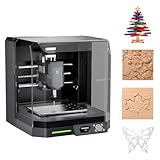
The best desktop CNC cutter for most small woodworking shops in 2026 is the Carbide 3D Nomad 3: it fits on a standard workbench, cuts hardwoods and soft metals accurately to about ±0.003″, and ships with genuinely beginner-friendly software. But “best” depends on what you cut, so below we rank compact machines by work area, material capability, footprint, software, and detail accuracy — plus the ownership costs nobody lists on the product page.
As an Amazon Associate we earn from qualifying purchases at no extra cost to you.


How We Compared the Machines
For a small shop, a desktop CNC lives or dies on five criteria:
- Work area — determines whether you can cut joinery-sized parts or just coasters.
- Spindle power and rigidity — separates “wood only” engravers from machines that handle aluminum and brass.
- Setup footprint — includes clearance for the gantry, dust hose, and computer, not just the base.
- Software chain — free bundled CAD/CAM vs. subscriptions changes the true cost.
- Detail accuracy — matters for inlays, small lettering, and dovetail-style joints.
Desktop CNC Cutters Ranked
| Machine | Work Area (XYZ) | Spindle | Materials | Footprint Needed | Typical Price Range |
|---|---|---|---|---|---|
| Carbide 3D Nomad 3 | 8″ × 8″ × 3″ | ~70W brushed | Wood, aluminum, brass, plastics | ~18″ × 20″ bench | $2,500–2,800 |
| Bantam Tools Desktop CNC Milling Machine | 7″ × 9″ × 3.5″ | 250W, up to 28k RPM | Aluminum, wood, PCB, tooling board | ~20″ × 22″ bench | $3,500–4,000 |
| SainSmart Genmitsu 3018-PROVer | 11.8″ × 7.1″ × 1.8″ | 775 DC motor | Soft/hardwood, acrylic, thin aluminum | ~16″ × 16″ bench | $250–350 |
| Sainsmart Genmitsu 4040-PRO | 15.7″ × 15.7″ × 3.1″ | 775 DC motor | Woods, MDF, plastics, light aluminum | ~24″ × 24″ bench | $500–700 |
| OpenBuilds Lead CNC (1010-class, smallest desktop-friendly size) | ~29″ × 29″ × 4″ | Router mount (user-supplied) | All woods, sheet goods, aluminum | ~40″ × 40″ dedicated table | $1,500–2,000 |
1. Carbide 3D Nomad 3 — Best Overall for Small Shops
The Nomad 3 is the rare desktop machine that’s both enclosed and accurate. Its 8×8″ work area handles coasters, small boxes, knife scales, inlay work, and aluminum fixtures. The bundled Carbide Create and Carbide Motion software remove the usual CAM learning wall, and the enclosure keeps dust and noise contained — a real benefit in shared or garage spaces. Weakness: the modest spindle means slow feed rates in hardwood; plan on shallow passes.
2. Bantam Tools Desktop CNC — Best for Metal and PCB Detail Work
If your shop does fine joinery prototypes, engraving, or aluminum brackets alongside wood, the Bantam’s stiffer frame and faster spindle produce the best surface finish in this class. The probe-based tool measurement makes repeat jobs nearly automatic. It’s the priciest per square inch of work area, but for mixed-material detail work nothing else here competes.
3. SainSmart Genmitsu 3018-PROVer — Best Entry-Level Pick
The 3018-PROVer is where most hobbyists should start. Offline controller, limit switches, and a huge user community make troubleshooting easy. It engraves and cuts small parts in wood and acrylic well; it will shave aluminum slowly with patience. Expect to spend a weekend assembling and traming it, and budget extra for better bits and a dust shoe.
4. Genmitsu 4040-PRO — Best Budget Work Area
Once you outgrow the 3018, the 4040-PRO roughly triples the work area for not much more money. Sign-sized projects, cutting boards, and small cabinet parts become feasible. Rigidity is still the limiting factor — keep aluminum cuts conservative.
5. Open-Frame Router-Based Machines — Best If You Have the Space
Kits like the Lead CNC or similar belt/leadscrew open-frame machines blur the “desktop” line, but if you can dedicate a small table, you get sheet-goods capacity no enclosed desktop unit offers. You supply the router (a compact trim router works), so noise and dust management are on you.
Which One Fits Your Situation
| Your Situation | Recommended Pick | Why |
|---|---|---|
| First CNC, under $400, learning fundamentals | Genmitsu 3018-PROVer | Cheap mistakes, huge community support |
| Selling small wood products (coasters, signs, boxes) | Nomad 3 | Enclosed, repeatable, minimal babysitting |
| Mixed wood + aluminum + PCB work | Bantam Tools | Rigidity and probing for fine detail |
| Signs and larger flat work on a budget | Genmitsu 4040-PRO | Biggest cutting area per dollar |
| Occasional furniture parts, have floor space | Open-frame kit | Sheet capacity; accept more setup work |
Ownership Realities Listings Don’t Mention
- Bits are the real consumable. Budget $10–30/month in end mills; a 1/8″ downcut and a 1/4″ flat end mill cover most wood work. Dull bits, not the machine, cause most “accuracy” complaints.
- What wears first: on brushed-motor machines (Nomad, 3018), brushes go after roughly 500–1,000 hours of spindle time. Belt-driven axes stretch; check belt tension quarterly. Leadscrew nuts develop backlash over years.
- Dust extraction isn’t optional. Fine MDF dust kills linear bearings. A $40 dust shoe plus a shop vac adds 3–4″ to your required depth clearance — plan for it in the footprint.
- Common beginner mistake: cutting too deep per pass. As a rule of thumb on these small machines, keep depth of cut under half the bit diameter in hardwood — 0.06″ for a 1/8″ bit. Slower but square beats fast and tapered.
- Workholding is half the battle. A sacrificial MDF spoilboard, surfaced flat in-machine, plus painter’s-tape-and-CA-glue or low-profile clamps, fixes most part-movement failures.
Cost Per Project, Rough Math
A Nomad 3 at ~$2,600 running two sellable cutting-board inlay jobs per week amortizes to about $0.50/job over five years of machine cost — but add ~$0.75/job in bits and spoilboard stock, so plan ~$1.25 of machine cost into each piece’s pricing. On a $300 3018, that drops to under $0.30/job, which is why the entry machine often wins purely on ROI even at lower quality.
FAQ
Can a desktop CNC cut joinery accurately enough for furniture?
Yes for small joints — box joints, dados for small casework, inlays. For full-size mortise-and-tenon furniture work, you need a larger-format machine.
How loud are these machines?
Enclosed units like the Nomad 3 run roughly conversation-plus level; open-frame router machines are loud enough to want hearing protection in the room.
Do I need CAD experience first?
No. Bundled tools like Carbide Create or Easel-style web apps handle 2.5D wood projects with a few hours of learning. Fusion 360 is the common next step for complex parts.