
What's inside
As an Amazon Associate I earn from qualifying purchases. This post may contain affiliate links at no extra cost to you.
The Oliver benchtop planer is a strong choice for a demanding small shop that values a clean finish, solid construction, and predictable feeding more than the lowest purchase price, although its noise level and limited 13-inch capacity still make it a compact-shop compromise.
As an Amazon Associate we earn from qualifying purchases at no extra cost to you.

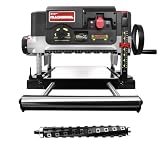


Oliver Benchtop Planer: Key Specifications
Oliver’s benchtop planer is aimed at serious hobbyists, furniture builders, and small professional shops that need portable thicknessing without moving up to a floor-standing machine. The commonly listed configuration uses a 13-inch cutting width, a 15-amp motor, a two-knife cutterhead, and a maximum stock thickness of approximately 6 inches. Check the identification plate and current manual before ordering, because Oliver has revised product details and accessory packages over time.
| Specification | Oliver benchtop planer | Typical 13-inch benchtop planer | Why it matters |
|---|---|---|---|
| Maximum planing width | 13 inches | 12.5–13 inches | Handles most table, cabinet, and shelving components |
| Maximum stock thickness | About 6 inches | 5–6 inches | Useful for thick legs and glued-up parts |
| Motor | 15 amps, 120 volts | 13–15 amps, 120 volts | Requires a suitable dedicated circuit in many shops |
| Maximum cut depth | Up to 1/8 inch, depending on stock width and species | 1/16–1/8 inch | Deep passes are slower and more likely to cause tear-out |
| Cutterhead speed | Approximately 10,000 rpm | 8,000–10,000 rpm | Influences cut quality and noise |
| Feed rate | Approximately 16 feet per minute | 15–26 feet per minute | Balances finish quality against production speed |
| Operating weight | Approximately 70–75 pounds | 65–80 pounds | Heavy enough to resist movement, but still movable by one person |
These figures describe the machine’s working class rather than a guarantee of performance on every board. A wide piece of dense maple, a heavily figured board, and a narrow pine strip place very different demands on the cutterhead and feed rollers.
Finish Quality and Tear-Out Control
The Oliver’s main appeal is its ability to produce a usable finish without requiring excessive sanding. With sharp knives, a clean cutterhead, and a properly supported workpiece, it should leave a consistent surface suitable for normal furniture preparation. The final result depends at least as much on setup and grain direction as on the planer itself.
Two-knife cutterheads are relatively simple to maintain and can produce good results when the knives are aligned correctly. They are less forgiving than a helical or segmented insert cutterhead when planing reversing grain. On figured maple, curly birch, walnut around knots, and other difficult stock, reduce the depth of cut to roughly 1/32 inch or less and feed the board with the grain whenever possible.
A practical finishing sequence is to remove material with cuts of 1/16 inch, then make a final pass of 1/32 inch. If a board is 13 inches wide, a full-width finishing pass removes 13 × 1/32, or about 0.406 square inches of material across its face; the actual motor load is governed by board length, species, moisture, and feed resistance rather than this area alone. The calculation illustrates why shallow final passes are preferable: they reduce strain and leave less pronounced knife marks.
Feed Consistency and Snipe
Feed consistency is good only when the machine is installed on a stable surface and the infeed and outfeed tables are aligned. Benchtop planers commonly produce snipe—a slightly deeper cut at the first or last few inches of a board—when the board’s weight tips the cutterhead assembly as it enters or exits.
To reduce it:
- Support boards at the same height as the planer tables.
- Keep the board flat against the bed during entry and exit.
- Plane several boards in sequence instead of repeatedly changing the depth setting.
- Leave extra length on parts that can be trimmed after planing.
- Do not push down hard on the board immediately beneath the cutterhead, since that can alter the cut.
The Oliver’s relatively moderate feed rate favors surface quality and control over throughput. That is appropriate for a small furniture shop, but less attractive for a business processing large batches of identical boards.
Build Quality and Long-Term Durability
The machine’s useful durability comes from its substantial benchtop format: a rigid base, metal work surfaces, and a heavy cutterhead assembly are preferable to a lightweight planer that shifts under load. The approximate 70-plus-pound weight is inconvenient when storing the machine, but it helps reduce vibration during ordinary planing.
The parts most likely to need attention are not the main frame. Expect wear at the knives, feed rollers, drive belt, elevation mechanism, and dust-extraction path. Knives are consumables; their life depends heavily on glue, embedded grit, painted lumber, and reclaimed wood. A board that looks clean can still contain staples or mineral deposits that damage an edge immediately.
Before each work session, inspect the knives and check that the cutterhead is free of resin buildup. After use, vacuum chips from the bed, roller area, and motor ventilation openings. Do not blast packed dust deeper into the machine with compressed air. Keep the elevation columns clean and apply only the lubricant specified by the manual, since excessive oil attracts abrasive dust.
Noise, Dust, and Shop Comfort
Like nearly all portable planers, the Oliver is loud enough to require hearing protection. The high-speed motor, cutterhead, and chip ejection create a sharper and more penetrating sound than many stationary woodworking machines. A dust collector or high-flow extractor is strongly recommended: chip buildup can obstruct the hood, reduce visibility, and increase cleanup time.
Noise control is best handled at the source and through work habits. Bolt or clamp the planer to a stable stand, avoid hollow temporary tables that amplify vibration, and plan several boards in one session rather than starting the machine for isolated cuts. Hearing protection remains necessary even when the machine is connected to dust extraction.
Which Shops Should Buy It?
| Your situation | Fit | Reason |
|---|---|---|
| Occasional weekend projects and a tight budget | Conditional | A less expensive 12- or 13-inch planer may provide similar capacity if use is infrequent. |
| Furniture work several times per month | Good fit | Build quality and controlled feed rate matter more than maximum production speed. |
| Small professional shop with limited floor space | Good fit | It supplies useful capacity without the footprint of a floor-standing planer. |
| Heavy daily production | Limited fit | A spiral-head or floor-standing machine with faster throughput will be more suitable. |
| Frequent figured hardwood work | Conditional | Expect careful grain selection, shallow passes, and more sanding than with a helical insert head. |
| Shop with no dust collection or hearing protection | Poor fit | Noise and chip discharge make basic protective equipment essential. |
Setup and Ownership Costs
Allow time for setup rather than treating the planer as ready-to-use straight from the carton. Check table alignment, confirm the knives are seated evenly, tighten the stand or mounting hardware, and test dust collection before running valuable stock. A replacement knife set, cleaning supplies, and a stable mobile stand should be included in the ownership budget. In the 2026 market, machines in this class generally sit in the mid-range price category, while insert-head and industrial floor models cost substantially more.
A simple value calculation helps clarify the decision. If a planer costs $700 and is used 70 times per year for five years, the machine cost is about $2 per use before knives, electricity, and maintenance. At only ten uses per year, the same machine costs about $14 per use. The Oliver makes more financial sense when its durability, available capacity, and repeatable setup will actually be used.
Verdict
The Oliver benchtop planer is best viewed as a durable, quality-oriented 13-inch machine for small shops that need reliable thicknessing but cannot justify a full-size planer. It offers a sensible balance of finish quality, feed control, and footprint, with enough capacity for most furniture components. Its limitations are equally clear: it is loud, it is not a production planer, and its two-knife cutterhead demands more care on figured or reversing grain than a helical insert design.
Choose it when stable construction and repeatable small-shop work matter more than the lowest price or fastest feed rate. Choose a lower-cost portable planer for occasional rough stock, or a floor-standing helical-head machine for daily production and difficult hardwood.