
What's inside
As an Amazon Associate I earn from qualifying purchases. This post may contain affiliate links at no extra cost to you.
The best benchtop planer thicknesser for most small workshops is the DeWalt DW735X, because its 318 mm width, two-speed feed, three-knife cutterhead and effective chip-ejection system make it the most capable all-rounder; choose the lighter Makita 2012NB when portability and lower noise matter more.
A benchtop planer thicknesser is a thickness planer: it makes one face of a board parallel to the opposite face and brings stock to a consistent thickness. It does not flatten a twisted or cupped board unless one face has first been jointed or secured to a flat sled. The rankings below focus on realistic small-workshop capacity rather than maximum specification alone.
As an Amazon Associate we earn from qualifying purchases at no extra cost to you.
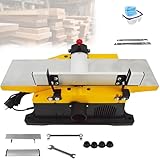


Best benchtop planer thicknessers ranked
1. DeWalt DW735X — best overall for frequent use
The DW735X is the strongest choice for a workshop that regularly processes hardwood, wide panels or batches of furniture parts. Its 318 mm cutting width and 152 mm maximum thickness leave useful capacity for cabinet components, table parts and glued-up panels. The two feed speeds are particularly valuable: the faster setting removes material efficiently, while the slower setting gives a cleaner finish.
Its three-knife cutterhead and disposable double-edged knives help maintain predictable results, and the fan-assisted chip ejection is better suited to dust extraction than many inexpensive machines. The trade-offs are substantial weight, high noise and a comparatively large footprint. At roughly 42 kg, it is portable only in the sense that two people can move it or it can sit on a mobile stand.
- Best for: frequent use, hardwood, wide boards and repeatable production.
- Watch for: high noise, heavy lifting and ongoing knife costs.
- Realistic capacity: a dedicated bench or mobile cart, with dust extraction always connected.
2. Makita 2012NB — best portable premium option
The Makita 2012NB is narrower at 304 mm but notably easier to store and move, weighing about 28 kg. Its compact design, relatively controlled vibration and low-profile footprint suit a workshop where the machine must be carried out only when needed. Makita’s automatic head-locking arrangement is intended to reduce movement during the cut, helping thickness consistency and reducing snipe when the infeed and outfeed supports are correctly set.
It has a 3.2 mm maximum cut at shallow settings, but deep passes should be reserved for softer material or rough stock. Like every benchtop machine, it performs more consistently when the final passes remove only a small amount. It is still loud enough to require hearing protection, but its sound and handling are generally less punishing than larger high-output models.
- Best for: shared garages, mobile workshops and careful one-board-at-a-time work.
- Watch for: less width and throughput than the DeWalt.
- Realistic capacity: small furniture projects and occasional batches, rather than continuous production.
3. RIDGID R4331 — best value when available
The RIDGID R4331 offers a 330 mm width, a three-knife cutterhead and a 152 mm maximum stock thickness, putting its basic capacity alongside the DeWalt. It is an attractive choice when the purchase price is more important than ultimate refinement. The built-in depth-stop system is useful for repeat dimensions, while foldable tables reduce storage demands.
The limitation is not its headline capacity but ownership support and finish consistency. Availability, replacement knives and service arrangements vary by country, so confirm that consumables can be obtained locally before buying. Expect more setup refinement than with a premium machine: carefully align the tables, check the head lock and use a gradual final pass to control snipe.
- Best for: budget-conscious users who need a full 13-inch class machine.
- Watch for: regional availability and less predictable after-sales support.
- Realistic capacity: occasional furniture work and moderate weekend batches.
4. WEN PL1326 — best entry-level capacity
The WEN PL1326 provides a 330 mm cutting width and a 3.2 mm maximum depth of cut, making it appealing when capacity per dollar matters. Its spiral-style cutterhead uses many small inserts rather than a small number of long knives. This can produce a quieter cutting action and makes a damaged insert inexpensive to rotate or replace individually.
It should be regarded as a light-duty benchtop planer thicknesser rather than a production machine. Feed rate, dust extraction and sharp inserts matter greatly, especially in dense hardwood. It is a sensible choice for a beginner processing softwood, prepared boards and occasional hardwood, but a frequent user may soon value the stronger feed system and better support network of the DeWalt or Makita.
- Best for: limited budgets, hobby projects and moderate throughput.
- Watch for: slower progress on difficult hardwood and the need to check insert tightness.
- Realistic capacity: a few boards per session, with cooling and cleaning between batches.
Head-to-head comparison
| Model | Maximum width | Maximum thickness | Maximum cut | Weight | Cutting system | Workshop character |
|---|---|---|---|---|---|---|
| DeWalt DW735X | 318 mm | 152 mm | 3.2 mm | About 42 kg | 3 disposable knives | High-output, heavy and loud |
| Makita 2012NB | 304 mm | 155 mm | 3.0 mm | About 28 kg | 2 disposable knives | Portable and comparatively refined |
| RIDGID R4331 | 330 mm | 152 mm | 3.2 mm | About 36 kg | 3 disposable knives | Good capacity for the money |
| WEN PL1326 | 330 mm | 127 mm | 3.2 mm | About 30 kg | Spiral insert cutterhead | Budget-friendly, lighter-duty |
Published specifications can vary slightly by market and revision. The practical figures are more important than the last millimetre: these machines are generally happiest taking 0.5–1.5 mm per pass in hardwood, with the deepest cuts reserved for short, straight-grained stock. A 330 mm machine does not mean every 330 mm board will feed comfortably; cupping, knots, resin and limited outfeed space reduce the usable working width.
Which one fits your workshop?
| Your situation | Best choice | Reason |
|---|---|---|
| Beginner, occasional softwood, lowest sensible cost | WEN PL1326 | Full-width capacity without premium-machine pricing |
| Frequent hardwood and furniture production | DeWalt DW735X | Two feed rates, robust feed system and strong chip removal |
| Machine must be carried or stored after every use | Makita 2012NB | About 14 kg lighter than the DeWalt |
| Need 13-inch-class width on a tighter budget | RIDGID R4331 | 330 mm capacity and three-knife head |
| Very noise-sensitive shared space | Makita 2012NB, with extraction and hearing protection | Lower apparent harshness, although none is quiet |
Snipe, consistency and noise: what matters in practice
Snipe is the shallow dip at the beginning or end of a board. It is caused mainly by the board levering the cutterhead as it enters or leaves, not simply by a defective machine. Support the board at the same height as the planer table, keep the leading and trailing ends level, and feed a second board immediately behind the first when appropriate. Do not press down directly over the cutterhead, because that can create a tapered board.
For consistent thickness, measure at several points, lock the cutterhead or depth mechanism, and make the final pass in one direction with the same face down. Keep the board moving at a steady rate. A 0.2 mm variation across a board can be more noticeable than a slightly rough surface, so consistency is usually improved by lighter final cuts rather than maximum depth.
All four machines are loud enough that hearing protection is sensible. The motor, cutterhead and air blast combine to produce a noise level that is uncomfortable in a small enclosed room. Extraction reduces airborne chips but does not remove the need for hearing protection. If noise is a deciding factor, choose the machine you can use with the doors open, vibration isolated and scheduled for reasonable hours; no compact thickness planer is genuinely quiet.
Ownership costs and maintenance
Budget for more than the machine. A typical 13-inch benchtop planer thicknesser commonly sits in the broad market range of about £350–£800 or US$400–$900, depending on cutterhead, region and promotions. Add a stable stand, extraction adaptor, spare knives or inserts, hearing protection and dust extraction. Premium disposable knives may cost more per change but save sharpening time; insert cutters cost more initially but can reduce waste when only one edge is damaged.
Clean the rollers and table after each session. Resin on the infeed roller causes slipping, while dust packed around the cutterhead or elevation screw creates inconsistent depth. Wax the table with a suitable non-silicone paste or manufacturer-approved lubricant so boards feed smoothly. Inspect knives for nicks before chasing a mysterious ridge or repeating line.
The first parts to wear are usually knives or inserts, drive belts, feed rollers and the elevation mechanism. Feeding dirty, wet or heavily resinous timber accelerates wear. Never plane painted, embedded-metal or unknown reclaimed wood; a hidden nail can destroy knives and create a serious hazard.
Bottom line
Choose the DeWalt DW735X if capacity, speed and repeat work outweigh portability. Choose the Makita 2012NB for a smaller workshop where the machine must be moved and stored. The RIDGID R4331 makes sense when local support and consumables are confirmed, while the WEN PL1326 is the economical route into benchtop planing. Whichever model you buy, a rigid stand, accurate table support, sharp cutters and effective extraction will influence finished boards more than a small difference in headline specifications.