
What's inside
- Best combination jointer planers by workshop situation
- What a combination machine must do well
- Head-to-head: compact, mid-size, and premium options
- Cutterhead options: knives versus helical inserts
- Dust collection and footprint are buying criteria, not accessories
- Changeover time and ownership realities
- How to choose the best combination jointer planer
- Related Guides
As an Amazon Associate I earn from qualifying purchases. This post may contain affiliate links at no extra cost to you.
The best combination jointer planer for a small workshop is usually an 8- or 10-inch machine with a helical cutterhead, a planer capacity of at least 6 inches, and a changeover that takes only a few minutes; the right choice depends more on available floor space and timber size than on maximum horsepower.
As an Amazon Associate we earn from qualifying purchases at no extra cost to you.

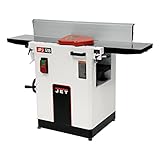

Best combination jointer planers by workshop situation
| Workshop situation | Best fit | Why | Main compromise |
|---|---|---|---|
| Very limited floor space or occasional use | 8-inch benchtop combination machine | Small footprint, commonly available on 120 V, and adequate for furniture parts and narrow boards | Shorter beds, less stability, and limited stock width |
| Serious hobbyist making cabinets and tables | 10-inch floor-standing combination machine | Better support, wider boards, stronger feed systems, and more useful planer capacity | Usually needs a dedicated circuit and costs more |
| Frequent hardwood work | 12-inch machine with a helical or spiral cutterhead | Handles wider panels and reduces tear-out and knife-changing interruptions | Heavy, expensive, and difficult to move into a small shop |
| Maximum accuracy in minimum length | European-style combination machine | Long cast-iron tables and integrated guarding can deliver excellent jointing accuracy | Premium pricing and, on some models, less convenient North American availability |
What a combination machine must do well
A combination jointer planer, also called a combination planer jointer or planer jointer combination, combines two operations around one cutterhead. In jointer mode, the machine flattens one face and squares one edge. In planer mode, it brings the opposite face parallel to the reference face and controls final thickness.
The arrangement saves considerable floor space, but it does not make the two machines interchangeable. A jointer needs long, accurately aligned infeed and outfeed tables. A planer needs a rigid bed, reliable feed rollers, and enough clearance above the cutterhead. A good machine balances both requirements rather than advertising a large motor alone.
Jointer width and bed length
Width determines the maximum practical board width: an 8-inch jointer is suitable for many furniture components, while a 10-inch model gives noticeably more freedom for table aprons, shelves, and wider cabinet parts. A 12-inch jointer is more capable, but its mass and price can be excessive for a one-car workshop.
Bed length is equally important. Short benchtop beds can flatten short pieces accurately, but long boards are harder to control. If you regularly joint stock longer than about 1.5 metres, prioritize long tables and a stable stand over a slightly wider cutterhead.
Planer capacity and depth
Planer capacity is the maximum thickness the machine can accept, not the thickness it can remove in one pass. A machine advertised with an 8-inch planer capacity may accept a thick beam, but it will still work best when removing modest amounts per pass. For ordinary furniture work, a 6-inch or greater capacity is comfortable; 8 inches or more is useful for substantial solid-wood projects.
Check the minimum thickness as well. Some combination machines leave a relatively tall minimum setting, which can be inconvenient when making thin drawer parts or slats.
Head-to-head: compact, mid-size, and premium options
| Machine or class | Jointer width | Planer capacity | Typical electrical requirement | Approximate mass | Changeover reality |
|---|---|---|---|---|---|
| JET JJP-8BT | 8 in | About 4 1/2 in | 120 V class | About 150–200 lb | Roughly 5–10 minutes once familiar |
| JET JJP-10BT | 10 in | About 6 in | Typically 120/240 V depending on configuration | About 500–600 lb | Roughly 5–10 minutes |
| Grizzly G0634XP | 12 in | About 8 in | 220 V class | About 900–1,000 lb | Usually several minutes, with substantial table and guard handling |
| Hammer A3 26 | About 10 1/4 in | About 8 in | Commonly 230 V class | About 700–800 lb depending on configuration | Designed for relatively quick integrated conversion |
| Hammer A3 31 | About 12 1/4 in | About 8 in | Commonly 230 V class | About 900–1,100 lb depending on configuration | Quick for its size, but not a lightweight machine to rearrange |
Dimensions, motor configurations, guards, and mass can vary by production revision and market, so confirm the specification sheet before ordering. The table is intended to show the practical separation between a portable 8-inch unit, a substantial 10-inch shop machine, and heavy 12-inch equipment.
JET: the practical middle ground
The JET JJP-8BT is the more plausible choice when a small shop has ordinary household power and limited storage. It is appropriate for narrower boards and intermittent use, but its shorter work surfaces make careful support and shallow passes important. It is a space-saving tool, not a replacement for a long industrial jointer.
The JET JJP-10BT is more attractive for a dedicated workshop. Its 10-inch width is a useful step up, and its floor-standing format provides better stability than a benchtop combination jointer planer. It still requires the owner to plan for substantial weight, dust extraction, and safe access around both sides of the tables.
Grizzly: capacity for a fixed shop
The Grizzly G0634XP is aimed at owners who want 12-inch capacity without buying separate machines. It offers a large working envelope and a spiral-style cutterhead configuration, making it better suited to wider hardwood stock than a compact machine. The trade-off is clear: it is a fixed installation requiring serious floor strength, 220-volt power, and a dust collector that can keep up with a wide cutterhead.
Hammer: premium conversion and finish
Hammer’s A3 26 and A3 31 occupy the premium European combination-machine category. Their appeal is not simply width. Long tables, refined adjustment systems, robust guards, and optional cutterhead configurations can make repeated jointing and planing more predictable. The A3 26 is the more manageable choice for a compact professional or serious hobby shop; the A3 31 makes sense when 12-inch-class capacity will be used often.
These machines can cost several times as much as an entry-level model. That premium is easier to justify when the machine will run weekly, when accuracy matters, or when purchasing separate high-quality machines would consume more space and electrical capacity.
Cutterhead options: knives versus helical inserts
Traditional straight knives usually cost less initially and leave a clean finish when sharp and correctly aligned. They also make sharpening or replacement relatively simple. Their weaknesses are greater sensitivity to knots and grain reversal, plus the need to align knives accurately after servicing.
Helical or spiral heads use many small carbide inserts. They tend to reduce tear-out, run more quietly, and keep working after rotating a damaged insert. The inserts are consumable parts, however, and a complete replacement head can add substantially to the purchase price. For a small workshop processing figured or abrasive hardwood, the reduced interruption can be worth more than the initial saving from straight knives.
Dust collection and footprint are buying criteria, not accessories
Planing creates a large volume of chips. A small shop should generally pair a combination machine with a collector capable of roughly 800 to 1,200 cubic feet per minute at the machine, using a short, smooth hose run and a properly sealed hood. A shop vacuum may cope with light jointing on a compact machine, but it is often inadequate for sustained planing.
Measure more than the machine’s listed footprint. Add space for an operator, infeed and outfeed support, chip-hose routing, and opening the cutterhead guard. A useful layout calculation is:
Required length = machine length + longest board + approximately 1 metre of handling space.
For example, a 1.5-metre machine handling 2-metre boards needs roughly 4.5 metres of clear operating length, even though its stored footprint may be much shorter. Folding supports or mobile bases can help, but a machine that must be moved every time it is used is less likely to receive careful setup.
Changeover time and ownership realities
Manufacturers often describe conversion as quick, but the real time includes disconnecting dust hoses, moving or locking tables, repositioning the fence, fitting the planer guard, and checking that nothing can contact the cutterhead. A five-minute conversion is useful when dimensioning a batch of boards; it is frustrating if every board requires a different setup.
The parts that commonly need attention first are cutter inserts or knives, drive belts, feed rollers, table wax or lubricant, and dust-hood seals. Keep spare inserts or knives, clean resin from tables, and inspect the feed path regularly. Never force twisted stock through the planer: it can overload the feed system and may leave the board unsafe or inaccurately dimensioned.
How to choose the best combination jointer planer
- Choose 8 inches if most stock is narrow and storage or 120-volt power is the limiting factor.
- Choose 10 inches if you want one machine for regular furniture work and can provide a permanent installation.
- Choose 12 inches only when you routinely buy wide boards or panels and have the electrical, dust-collection, and moving arrangements to support it.
- Select a helical or spiral head for frequent hardwood work, figured grain, or lower maintenance interruptions.
- Prefer long cast-iron tables and rigid adjustment over a larger motor that cannot be supported by your dust collector or circuit.
- Confirm service availability and replacement cutterhead parts before buying an unfamiliar brand.
For most compact workshops, the best balance is a 10-inch floor-standing machine such as the JET JJP-10BT, provided its footprint and power requirements fit the room. The JET JJP-8BT is the sensible space-saving answer for occasional work, while the Grizzly G0634XP and Hammer A3 machines are better reserved for fixed installations where their extra width, mass, and cutterhead options will be used often.