
What's inside
- What the Craftsman 6-1/8-inch jointer planer actually does
- Table length matters more than the 6-1/8-inch label
- Fence rigidity: adequate for edges, not forgiving of poor technique
- Cutterhead speed and realistic flattening capacity
- Decision guide: which user should buy it?
- Setup and ownership details that affect results
- What about the “Craftsman 4-1/8-inch” and “Craftsman planer” searches?
- Final verdict
- Related Guides
As an Amazon Associate I earn from qualifying purchases. This post may contain affiliate links at no extra cost to you.
The Craftsman jointer planer is best treated as a compact face-and-edge jointer for boards up to about 6 inches wide—not as a thickness planer, wide jointer, or production machine.
That distinction answers the main buying question. A current-style Craftsman 6-1/8-inch benchtop jointer can flatten one face and square one edge of small and medium stock, but its short tables, light fence, limited cut depth, and modest dust collection make it a poor choice for wide panels, badly twisted slabs, or frequent cabinet-shop production.
As an Amazon Associate we earn from qualifying purchases at no extra cost to you.

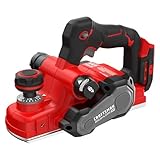


What the Craftsman 6-1/8-inch jointer planer actually does
The commonly discussed machine is the Craftsman CMEW020-style 6-1/8-inch benchtop jointer. Despite searches for “craftsman 6 1 8 jointer planer” and “craftsman 6 1/8 jointer planer,” this is a jointer rather than a true combination jointer-planer. It flattens a reference face and straightens an adjoining edge. It does not automatically make the opposite face parallel or bring a board to a precise final thickness.
Its roughly 6-1/8-inch maximum width is useful for common 1x and 2x lumber, narrow hardwood boards, shelf parts, rails, and small furniture components. A board wider than the cutterhead must be flattened in overlapping passes, which is possible in principle but difficult to control accurately on a short benchtop machine.
| Specification or practical limit | Craftsman 6-1/8-inch benchtop class | What it means in the shop |
|---|---|---|
| Maximum jointing width | 6-1/8 inches | Suitable for narrow boards; not a panel jointer |
| Maximum cut depth | About 1/8 inch | Use shallow passes on warped or figured stock |
| Table length | About 28-1/2 inches combined | Short support limits accuracy on long boards |
| Motor | 10 amps, corded | Enough for ordinary hardwood work with sensible feed pressure |
| Cutterhead speed | About 12,000 rpm, commonly specified at about 20,000 cuts per minute | Produces a fine cut pattern, but does not replace proper feeding |
| Fence | Approximately 4-1/4 inches high, tilting to 45 degrees | Useful for edge jointing; limited support for tall stock |
| Machine weight | About 40 pounds | Portable, but light enough to shift unless firmly mounted |
| Typical market range | Roughly $250–$400 new, depending on availability and configuration | Leaves room in the budget for a stand, dust hose, and replacement knives |
Specifications can vary by production run and regional listing, so confirm the manual for the exact model number before buying replacement parts. The practical conclusions remain similar across this benchtop class.
Table length matters more than the 6-1/8-inch label
The cutter width tells you the maximum board width, but table length determines how well the machine can correct a board. With only about 28-1/2 inches of combined infeed and outfeed support, a long board can rock as it crosses the cutterhead. That makes it easy to create a shallow hollow or an unintended taper.
For a 36-inch cabinet rail, the Craftsman can be perfectly serviceable if the board is only slightly bowed and you support the work consistently. For an 8-foot board, the same machine requires auxiliary infeed and outfeed support, careful registration against the infeed table, and several test passes. A jointer does not flatten the entire length merely because the cutterhead reaches it; the tables must support the board at the correct height while each section passes over the knives.
A useful rule is to treat this machine as comfortable for parts under about 4 feet and increasingly dependent on external support beyond that. That is a practical handling limit, not a published capacity.
Fence rigidity: adequate for edges, not forgiving of poor technique
The fence is the second major constraint. Its height is sufficient for ordinary edge jointing, but the light benchtop construction gives it less resistance to pressure than the cast-iron fence on a full-size floor jointer. If the fence moves slightly while you push a board, the resulting edge will no longer be square.
Before use, check the fence with a reliable square at both the front and rear of the tables. Lock it, apply moderate hand pressure, and check again. If it shifts, tighten the adjustment hardware or improve the mounting before jointing valuable stock. Do not compensate for a moving fence by pushing harder; that usually increases the error.
For a 3/4-inch board, the fence is easy to use. For a 2-inch-thick board, it remains workable if the edge is reasonably straight. Tall, narrow pieces are less comfortable because the 4-1/4-inch fence provides limited lateral support. A tall auxiliary fence can help, but it also increases leverage against the adjustment mechanism, so it must be rigidly attached and used with light, controlled pressure.
Cutterhead speed and realistic flattening capacity
The advertised speed—approximately 12,000 revolutions per minute and roughly 20,000 cuts per minute—is high enough to leave a smooth surface when the knives are sharp and the feed rate is steady. It does not mean the machine can remove large amounts of material without strain.
For ordinary hardwood, start with a cut around 1/32 inch or less. A full 1/8-inch cut is best reserved for short, stable stock and limited situations. On twisted boards, heavy cuts can overload the motor, increase snipe-like transitions at the ends, and make the workpiece difficult to control.
Consider a board that is 5-1/2 inches wide and 48 inches long with a 1/16-inch hollow across its face. Removing the entire hollow from one face would require considerable material removal and may leave the board too thin. Instead, take shallow passes until two opposite high areas establish a stable reference, then continue only until the face is flat enough for the project. If the final thickness matters, use a separate thickness planer after one face is true.
The machine is therefore well suited to:
- Flattening narrow rough-sawn boards with moderate bow or cup.
- Squaring one edge for table-saw or router-table work.
- Preparing drawer parts, face-frame stock, rails, stiles, and small shelves.
- Cleaning up recycled lumber after nails, paint, and grit have been removed.
It is poorly suited to:
- Flattening dining-table panels wider than 6-1/8 inches.
- Processing long boards without added support.
- Removing deep twist from thick hardwood efficiently.
- Continuous production work where heat, vibration, and setup time accumulate.
Decision guide: which user should buy it?
| Your situation | Recommendation | Reason |
|---|---|---|
| Beginner with limited space and occasional projects | Good fit | Portable and capable of learning face and edge jointing |
| Budget-conscious hobbyist making small furniture | Good fit with a thickness planer | The pair covers most narrow-board preparation at lower cost than a large jointer |
| Regular work with 6- to 8-foot hardwood | Conditional | Requires sturdy support tables and careful handling |
| Frequent wide-panel or slab work | Choose another method | Width and table length are the limiting factors |
| Professional or high-volume production | Choose a heavier floor machine | More mass, longer tables, stronger fences, and faster setup justify the cost |
Setup and ownership details that affect results
Mount the jointer to a rigid bench or dedicated stand. A 40-pound machine is convenient to move but too light to ignore vibration. Add a dust hose with the correct adapter, because chips left around the cutterhead can interfere with the workpiece and increase cleanup.
Inspect knives regularly. Dull or nicked knives are usually the first consumable to affect surface quality, especially when jointing reclaimed wood. Disconnect power before opening the cutterhead area, and remove every fastener or embedded metal fragment from recycled stock before cutting. Keep the tables waxed with a suitable non-silicone surface treatment so boards slide without excessive downward pressure.
Common mistakes include starting with the concave face down when the board rocks, pressing down on the outfeed side before enough material has crossed the cutterhead, and trying to correct a bowed edge by forcing it against the fence. Begin with the most stable reference surface, use light pressure on the infeed table, and transfer pressure gradually to the outfeed table once the jointed section reaches it.
What about the “Craftsman 4-1/8-inch” and “Craftsman planer” searches?
Searches for “craftsman 4 1 8 jointer planer” often reflect confusion with other compact jointers or incomplete model descriptions. The commonly referenced Craftsman benchtop format is 6-1/8 inches, not a current mainstream 4-1/8-inch Craftsman jointer specification. Likewise, “Craftsman jointer and planer” may describe a desired two-machine setup rather than a single combination machine.
If you need both functions, budget separately for a jointer and a thickness planer. The jointer establishes a flat face and square edge; the thickness planer makes the opposite face parallel and sets thickness. That combination is far more useful than expecting a compact jointer to perform both jobs.
Final verdict
The Craftsman jointer planer is a reasonable budget benchtop jointer for narrow stock, small furniture, and occasional face-and-edge preparation. Its approximately 28-1/2-inch table length, light fence, and 6-1/8-inch width define its real limits more than its cutterhead speed does. Buy it when compact storage and moderate cost matter, and plan for a rigid stand, external support, dust collection, and a separate thickness planer. Skip it for wide panels, large slabs, or production workloads where longer tables and greater mass will save more time than the initial purchase price.