
What's inside
- RIDGID jointer planer options at a glance
- What each RIDGID machine can—and cannot—do
- Which setup suits your shop?
- Board-width limits are the deciding factor
- Alignment and setup matter more than the brand badge
- Dust collection and limited floor space
- Ownership realities: knives, snipe, and maintenance
- Is the RIDGID approach right for a small shop?
- Frequently asked questions
- Related Guides
As an Amazon Associate I earn from qualifying purchases. This post may contain affiliate links at no extra cost to you.
If you are searching for a RIDGID jointer planer, the key fact is that RIDGID does not offer a true combination jointer-planer: its practical small-shop pairing is the RIDGID JP0610 6-1/8-inch jointer for flattening one face and squaring one edge, plus the RIDGID R4331 13-inch thickness planer for bringing boards to a consistent thickness.
That two-machine approach can work well in a compact workshop, but it is not equivalent to a single benchtop combination machine. The jointer has a limited board width, the planer does not flatten a twisted board by itself, and both machines need careful dust and alignment planning.
As an Amazon Associate we earn from qualifying purchases at no extra cost to you.


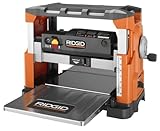

RIDGID jointer planer options at a glance
| Machine | Primary job | Working capacity | Motor / power | Approximate weight | Best fit |
|---|---|---|---|---|---|
| RIDGID JP0610 | Face flattening and edge jointing | 6-1/8-inch maximum width; about 45-inch tables | 1/2 HP induction motor; 120 V | About 75–90 lb, depending on configuration | Small and intermediate boards, furniture parts, cabinet components |
| RIDGID R4331 | Thickness planing | 13-inch maximum width; approximately 6-inch maximum thickness | 15-amp universal motor; 120 V | About 80–90 lb | Reducing rough stock to a repeatable thickness |
Specifications can vary slightly by production year, packaging, and whether a machine is new, refurbished, or previously sold through a different retail channel. Check the plate and manual for the particular unit before building a permanent stand or electrical setup.
What each RIDGID machine can—and cannot—do
JP0610 jointer
The JP0610 is the relevant RIDGID choice when the job is to create a flat reference face or a straight, square edge. Its 6-1/8-inch capacity handles common boards for tables, shelves, boxes, face frames, and small furniture. It cannot joint a board wider than its cutterhead capacity, even if the board would fit through a thickness planer.
This distinction matters because a 13-inch planer does not replace a wide jointer. If a rough board is 10 inches wide and twisted, the R4331 can feed it through, but it will generally reproduce the twist rather than remove it. Flattening a face requires a jointer, a sled, or a carefully prepared router-sled setup.
The JP0610’s relatively long infeed and outfeed tables are helpful for straightening ordinary stock, but the machine still benefits from an outfeed support stand. Short tables or an incorrectly aligned fence can cause a board to dip at the end of a cut, producing taper or a concave edge.
R4331 thickness planer
The R4331 is the more useful RIDGID machine for a shop that buys rough lumber but has little room for a full-sized planer. Its 13-inch opening accommodates much wider boards than the JP0610, and its three-knife cutterhead is designed for repeated thicknessing rather than face flattening.
A thickness planer needs one reasonably flat reference face. Feed a twisted board directly into it and the pressure rollers can press the defects flat temporarily; once the board exits, much of the original deformation remains. For badly cupped or twisted stock, attach the board to a rigid planer sled, shim the low areas, and remove the sled after the first flat face is established.
The R4331 is portable compared with a stationary woodworking planer, but “portable” does not mean effortless. Its motor, table extensions, and dust hood make it awkward to carry alone. A mobile cart with locking casters is usually more practical than repeatedly lifting it onto a bench.
Which setup suits your shop?
| Your situation | Most sensible choice | Why | Important compromise |
|---|---|---|---|
| Mostly dressed lumber; occasional thickness changes | R4331 alone | It covers thicknessing and takes less permanent floor space | You must buy stock with a flat reference face or flatten it another way |
| Rough boards up to 6 inches wide; regular furniture work | JP0610 plus R4331 | Provides the complete face-joint, edge-joint, and thickness sequence | Two machines require more storage, setup, and dust hoses |
| Wide tabletops or panels are common | R4331 plus a sled, router sled, or wider jointer | The planer handles width; the sled addresses face flattening | Sled flattening is slower and requires careful shimming |
| Very limited floor space | One mobile R4331, with a separate flattening method | The planer can be stored vertically or rolled under a bench | It is not a complete rough-lumber preparation system by itself |
| Frequent production milling | A heavier dedicated jointer and planer | More mass, longer tables, and faster material handling reduce interruptions | Higher cost, power demands, and floor-space requirements |
Board-width limits are the deciding factor
The most common buying mistake is comparing the R4331’s 13-inch capacity with the JP0610’s 6-1/8-inch capacity and assuming the planer makes the jointer’s width irrelevant. It does not. The jointer width determines the maximum width of a board that can be face-jointed in one pass.
For example, a 7-1/4-inch rough board cannot be fully face-jointed on the JP0610. You could joint one portion, reposition the board, and attempt to blend the tracks, but that is difficult to do accurately and is not a substitute for a wider jointer. A board intended for a 30-inch tabletop may need to be flattened with a sled, hand planes, or a wider machine before it reaches the thickness planer.
The planer has its own practical limits. Although a board may fit within 13 inches, very wide stock places greater demand on the cutterhead and feed rollers. Take lighter cuts, support long boards, and inspect grain direction to reduce tear-out.
Alignment and setup matter more than the brand badge
Before regular use, spend time checking both machines. On the JP0610, place a reliable straightedge across the infeed and outfeed tables, verify that the tables are coplanar, and confirm that the fence is square to the table. A fence that is only slightly out of square can create an edge that looks straight but will not form a clean panel glue joint.
On the R4331, check that the table extensions are level with the main table. If an extension is high or low, a board can enter or leave at an angle, causing snipe or uneven thickness. Use sacrificial leader and follower boards when practical, especially with short or valuable stock.
A useful setup sequence is:
- Place each machine on a rigid, level surface or a braced mobile stand.
- Check table, fence, and extension alignment before adjusting knives or cutterhead components.
- Connect dust collection before making a test cut; chips left around the work area can interfere with accurate support.
- Make a shallow test cut on scrap and measure both ends and both edges.
- Correct the setup before processing project lumber.
Dust collection and limited floor space
Both machines produce chips too quickly for a small shop to rely on a basic household vacuum. The planer in particular can overwhelm a small extractor, clog the hose, and leave chips packed around the cutterhead. A dust collector with a wide hose and a clean filter is a better match; use the machine’s dust hood and keep the hose run as short and direct as the layout permits.
For a compact shop, place both machines on locking mobile bases, but do not sacrifice rigidity. A stand that flexes while jointing can affect cut quality and create a safety problem. Leave enough clearance to support the longest boards you routinely mill. The machine footprint is only part of the space calculation: a 6-foot board may need more than 12 feet of unobstructed travel when infeed and outfeed space are included.
Ownership realities: knives, snipe, and maintenance
Wear usually appears first at the knives, cutterhead fasteners, feed rollers, and dust-collection path rather than in the motor. Dull or nicked knives increase noise, tear-out, and motor load. Keep replacement knives available, and mark their orientation during removal. Follow the manual’s torque and adjustment procedure rather than guessing at knife height.
Clean resin and chips from the tables regularly. Wax or use an appropriate non-silicone table lubricant to help boards slide, but avoid contaminating surfaces that will later be finished. Inspect belts, cords, switches, and mounting hardware periodically. On the planer, clean feed rollers when stock begins slipping; a dirty roller can look like a motor or depth-adjustment failure.
Snipe at the beginning or end of a planed board is often caused by lifting or pushing the workpiece, misaligned extensions, or insufficient support. Support the board without forcing it upward, and use a light final pass if the project permits. Do not remove the guard or bypass safety features to make setup faster.
Is the RIDGID approach right for a small shop?
Choose the JP0610 and R4331 combination if you work mainly with boards no wider than 6 inches at the face-jointing stage, want to mill rough lumber, and can accept moving two machines into position. It is a capable small-shop workflow, not a compact all-in-one jointer planer.
Choose the R4331 alone if your stock is already reasonably flat, your main need is thickness consistency, or floor space is extremely restricted. Choose a different strategy if wide slabs and large tabletops are routine: the 13-inch planer solves the width problem for thicknessing, but it does not eliminate the need for a method of flattening wide faces.
In short, the best jointer planer RIDGID setup depends less on a model name than on the first operation your lumber requires. If you need to flatten and square rough boards, plan for both jointer-width limits and planer capacity before buying. If you only need repeatable thickness, the R4331 is the more space-efficient RIDGID option.
Frequently asked questions
Does RIDGID make a combination jointer-planer?
Not as a current mainstream RIDGID small-shop machine. The JP0610 and R4331 are separate tools with different jobs.
Can the RIDGID R4331 flatten a twisted board?
Not reliably by itself. Use a rigid sled with shims, a router sled, hand tools, or a jointer to create a flat reference face first.
Can the JP0610 joint a board wider than 6-1/8 inches?
No, not fully in one pass. A wider board requires another flattening method or a jointer with greater capacity.
Is this setup suitable for an apartment-sized or garage workshop?
It can be, provided the machines are mobile, the electrical supply is appropriate, and dust collection is planned. Remember to account for board travel and support space, not just the stored footprint.