
What's inside
As an Amazon Associate I earn from qualifying purchases. This post may contain affiliate links at no extra cost to you.
Standing desks turned walking during work hours from a novelty into a reasonable daily habit, and the market responded with dozens of compact machines designed to slide under a desk or collapse into a closet. The problem is that listings in this category look almost identical at a glance — the same specs, similar motor wattage claims, overlapping weight limits — yet owners report wide gaps in real-world noise, handlebar sturdiness, and whether the belt actually stays centered during use. Figuring out which of these machines is genuinely usable for more than a week is the reason buyers keep circling.
What separates the best walking exercise machines from the disappointing ones in this price tier comes down to four things: whether the speed range matches your goal (casual under-desk walking versus real cardio), whether a handlebar is present and fixed (critical for anyone over 50 or with balance concerns), how loud the motor is at higher speeds according to owner reports, and whether the unit folds or stores in a way that suits your floor plan. Specs get you close to a shortlist; owner feedback on long-term durability breaks the tie.
As an Amazon Associate we earn from qualifying purchases at no extra cost to you.



Quick Picks
| Product | Best for | Price |
|---|---|---|
| MCRG Walking Pad with Incline | Stable handlebar + incline on a budget | $89.98 |
| Folding Walking Pad with Handle Bar | Small-space storage without losing the handlebar | $89.98 |
| Sunny Health & Fitness Smart Air Walk | Low-impact elliptical-style stride at 30 inches | $149.99 |
| 16% Incline Walking Pad (3-in-1) | Incline-specific training under the lowest price | $59.99 |
| Slim Walking Pad with Remote | Under-desk speed control with a wide belt | $69.99 |
| Foldable Treadmill for Home (6.2 MPH) | Walk-to-run versatility in a foldable frame | $99.99 |
| Terluxra Walking Pad | Compact foldable with fixed handlebar | $79.99 |
| KEY2FUN Air Walk Elliptical | High weight capacity with adjustable resistance | $159.99 |
How We Picked
We narrowed this list by weighing four criteria: usable speed and incline range relative to price, stability features (handlebar type, deck width, max user weight), noise and motor behavior as reported by owners after 30+ days of use, and real-world storage footprint. Products that scored high on one spec but generated recurring owner complaints about the same weakness were excluded from the final eight.
The 8 Best Walking Exercise Machines in 2026
MCRG Walking Pad with Incline
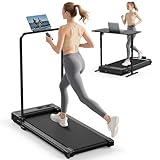
Who it is for: budget-minded home walkers who want an incline and a fixed handlebar for confidence. Pros: The handlebar is a genuine safety feature at this price, and the incline setting adds leg-engagement variety that flat-only pads cannot match. Owner feedback confirms the frame feels solid during low-speed walking. Con: Several owners note a noticeable motor whine once the belt passes the mid-speed range, making it less ideal for open-plan offices or apartments with thin walls. Skip it if: silence is non-negotiable and you plan sustained sessions above walking pace.
Folding Walking Pad with Handle Bar
Who it is for: apartment dwellers with no dedicated workout corner who still want a handlebar. Pros: The fold mechanism lets it lean against a wall or slide under furniture, and the handlebar stays fixed even when the deck folds flat. Owners consistently highlight how much floor space this saves without requiring a second person to set it up. Con: The belt surface is narrower than full-size treadmills, so users with a wider stance report occasionally stepping past the edge. Skip it if: you walk with a broad stride and have zero floor-area constraints.
Sunny Health & Fitness Smart Air Walk Elliptical
Who it is for: anyone with joint concerns who prefers an elliptical motion over a treadmill belt. Pros: The 30-inch stride length closely mimics natural walking mechanics, and the brand’s established reputation gives buyers more confidence in long-term parts availability than generic listings. Owners praise the quiet, smooth motion. Con: It takes up more floor space than the folding pads on this list, and the elliptical style means you cannot use it under a standing desk. Skip it if: your primary goal is desk-side movement during work calls.
16% Incline Walking Pad (3-in-1)
Who it is for: users who prioritize incline training at the absolute lowest cost on this list. Pros: A 16% maximum incline is unusual below $60, and the 3-in-1 design (flat, incline, handlebar modes) offers genuine flexibility. Owners report the incline function working smoothly at low speeds. Con: The 59.99 price point means the motor and belt are entry-grade; owner feedback clusters around durability concerns after several months of daily use. Skip it if: you expect two or more years of daily wear without maintenance.
Slim Walking Pad with Remote
Who it is for: desk workers who want to adjust speed without bending down. Pros: The remote control is a small quality-of-life feature that adds up during long sessions, and the 0.6–4.0 MPH range covers the full spectrum of under-desk walking. The 265-pound weight capacity is above average for this form factor. Con: No handlebar, which means balance-reliant users must depend entirely on the belt’s centering behavior. Skip it if: you are new to walking pads or have any stability concerns.
Foldable Treadmill for Home (6.2 MPH)
Who it is for: users who want one machine that handles both casual walking and light jogging. Pros: The 6.2 MPH ceiling puts it in true jogging territory while remaining foldable, and owners note the motor sustains higher speeds without the stutter some budget pads exhibit. Con: Even folded, it is bulkier and heavier than the dedicated walking pads here, so storage flexibility is reduced. Skip it if: your sole use case is sub-4 MPH desk walking and floor space is tight.
Terluxra Walking Pad
Who it is for: buyers who want the handlebar-plus-fold combination without exceeding $80. Pros: The fixed handlebar and foldable deck together are a rarer pairing at this price, and owner reports describe the frame as more rigid than similarly priced alternatives. Con: The speed ceiling is modest, so it cannot serve as a running substitute if your goals change later. Skip it if: you want headroom to increase intensity over the coming year.
KEY2FUN Air Walk Elliptical
Who it is for: heavier users or anyone prioritizing joint protection with a high resistance ceiling. Pros: The 500-pound weight rating is the most generous on this list, and the 6-level resistance bands let you dial intensity without changing your stride pattern. The LCD monitor adds basic tracking. Con: Assembly takes longer than most pads, and the footprint is large for a home gym with limited square footage. Skip it if: you need something you can stash under a bed or behind a door.
Buying Guide
Speed and Incline: Match the Range to Your Goal
Under-desk walking rarely needs more than 2–3 MPH, so a pad rated to 4.0 MPH is sufficient and often quieter. If you intend this as a standalone cardio source, look for at least 6.0 MPH or an incline option above 10%, which raises heart rate without demanding speed. The 16% incline pad on this list is the outlier for a reason: it compensates for lower top speed with terrain intensity.
Handlebars and Stability
A fixed handlebar is the single most important safety feature for anyone over 50, anyone on medications that affect balance, or anyone using a standing desk for the first time. Folding pads sometimes offer removable or fold-down bars, which are acceptable for experienced users but add a failure point for beginners. When a listing does not mention a handlebar at all, assume there is none.
Noise and Motor Quality
Owner reports are the most reliable signal for noise in this category, because manufacturers rarely publish decibel ratings for budget walking pads. Search reviews for terms like “hum,” “whine,” or “vibration” combined with speed mentions. A pad that sounds acceptable at 1.5 MPH but produces a noticeable drone at 3 MPH will frustrate you during phone calls or early-morning sessions.
Our Verdict
Top pick: The MCRG Walking Pad with Incline gives the best balance of stability, versatility, and price for the largest number of buyers. Budget pick: The 16% Incline Walking Pad at $59.99 is the most affordable entry that still offers meaningful intensity variety. Condition that changes the answer: If your joints cannot tolerate a belt stride, the Sunny Health & Fitness Smart Air Walk is the right machine regardless of its higher price and larger footprint.
FAQ
Can I use a walking pad under any standing desk?
Most walking pads are 4–5 inches tall, so your desk must offer at least that much clearance between its bottom edge and the floor. Check the desk’s adjustable range before ordering; the slim designs here help, but a desk fixed at 43 inches will not accommodate a user who is 6 feet tall.
Do walking pads burn enough calories to matter?
At 2–3 MPH they add roughly 50–100 calories per hour compared to sitting, which is modest but meaningful over a full workday. Adding incline or raising speed into jogging territory can double that figure, which is why the 6.2 MPH and 16% incline options serve different purposes.
Is a folding pad as stable as a non-folding one?
Owner feedback on the folding models here is generally positive, but a folding joint introduces one more point where wobble or flex can develop over months of use. If you plan daily sessions above 30 minutes, a non-folding model with a rigid base is the safer long-term choice.
What weight rating should I look for?
Add 20–30 pounds to your body weight as a buffer, since belt tension and motor load increase when you are near the rated ceiling. The 265-pound pad covers most users comfortably; if you or a household member exceeds 240, the 500-pound-rated elliptical or a full-size treadmill is the more durable option.