What's inside
As an Amazon Associate I earn from qualifying purchases. This post may contain affiliate links at no extra cost to you.
A fitting can help a dust system move air only if it keeps the duct path reasonably smooth and gives chips a clear route. In practice, “Y-fitting” and “wye branch” often refer to the same style of angled junction: one duct splits into two, with the branch entering at an angle rather than at a square tee. The important buying question is less about the label and more about the fitting’s angle, diameter, construction, and fit with the rest of your ductwork.
As an Amazon Associate we earn from qualifying purchases at no extra cost to you.



Terms and what you are buying
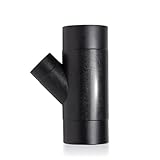
A standard wye has a main run and a branch that joins it at an angle, commonly around 30 or 45 degrees. Some sellers call this a Y-fitting because of its shape. A combination wye and 45-degree elbow can make a tighter turn, but it also changes the airflow path. Check the product drawing rather than relying on the name.
These fittings are used to connect two pickup runs to a common trunk, or to split a trunk toward separate machines. They do not create airflow or compensate for an undersized collector. A collector’s fan, filter loading, duct diameter, total run length, and open gates all affect how much air reaches a tool.
Wye versus tee: the useful comparison
For wood chips and dust, a smooth angled branch is usually preferable to a sharp 90-degree tee. A tee forces air and debris through a sudden turn at the junction. That can increase turbulence and make heavier chips more likely to collect at the branch. A wye gives material a more gradual path into the trunk, especially when its branch points in the direction of airflow.
| Feature | Angled wye or Y-fitting | Square tee |
|---|---|---|
| Branch entry | Angled, typically 30–45 degrees | Near 90 degrees |
| Chip flow | Usually smoother when oriented with airflow | Greater chance of impact and buildup at the junction |
| Space and layout | Needs room for the angled branch | Can fit a compact, perpendicular layout |
| Cost and availability | Often costs more or needs a less common size | Usually inexpensive and easy to find |
| Best use | Main dust-collection branches and chip-carrying runs | Low-velocity, light-duty, or space-limited applications |
A tee is not automatically a problem in every shop. It may be acceptable in a short, low-flow branch carrying fine dust, or where an angled fitting simply will not fit. But for a planer or jointer producing larger chips, an angled branch is generally the safer choice for reducing snag points and deposits.
Choose the angle and diameter
When the layout allows it, a 30-degree branch is a gentle split; a 45-degree branch is more compact and commonly stocked. Neither guarantees good collection on its own. Avoid a branch that faces against the direction of airflow, and avoid stacking several tight fittings together just to make the ducts reach.
Keep the trunk sized for the collector and the machines it serves. Reducing a duct from 6 inches to 4 inches can sharply restrict capacity: the cross-sectional area falls from about 28 to 12.6 square inches, less than half. A reducer may be necessary at a tool port, but place it as close to the machine as practical rather than necking down a long trunk. For a main line or a chip-heavy machine, look for a fitting in the same diameter as the trunk, such as a 6-inch dust-collection wye fitting.
Do not assume fittings advertised for HVAC are suitable for every woodworking system. Thin HVAC fittings can leak, dent, or have seams and edges that catch debris. A properly sized metal dust-collection fitting is a better fit for a permanent chip-carrying line; lighter ducting may still be adequate for a small collector or temporary branch if it is supported well.
Layout and installation matter as much as the fitting
Point the branch downstream so chips merge with the moving air rather than strike a wall. Use short, gradual transitions where possible. A sharp elbow immediately before or after the wye can erase some of the advantage of the angled junction. Support the duct so its weight does not pull joints apart, and seal connections against leaks. A leak on the suction side draws in room air that does not pass through the tool hood.
Install blast gates near the machines, and close unused branches when the collector is running. If two gates are open, the airflow is divided between the runs; the fitting cannot guarantee adequate pickup at both tools. A gate that leaks or a long unused branch left open can also reduce performance at the active machine.
For a small shop using a 4-inch portable collector, a plastic wye can be a reasonable budget option if it matches the hose, is securely supported, and carries mostly light dust. Compare 4-inch dust-collection wyes by actual inside diameter and branch angle; nominal sizes do not always match hose dimensions closely. If the run handles large chips or is part of a fixed main trunk, consider metal instead, such as a metal dust-collection wye.
Common failures to watch for
A wye can still clog if the duct is too small, the airflow is weak, the branch points the wrong way, or a long horizontal run lets chips settle. Fine dust can also escape through loose seams, while a flexible hose stretched across the shop can sag and collect debris. Check the system with the machines you actually use: look for reduced pickup, chips sitting in the branch, loose joints, and a filter that is loading quickly.
Do not solve a blockage by tapping hard on thin duct or reaching into a running system. Shut off and unplug the collector, isolate the affected run, and clear it safely. If buildup returns, check for closed or leaking gates, a clogged filter, excessive flex hose, and undersized duct before buying another fitting.
Which one should you buy?
Choose an angled wye for a permanent branch carrying chips or for a main duct split when the layout has room. Use the largest practical branch size, orient it downstream, and keep the rest of the run smooth. A cheaper tee or plastic wye is fine for a compact, low-demand setup where space and cost matter more than peak airflow. If a machine still has poor pickup after the fitting change, the cause is more likely to be inadequate collector capacity, a restrictive duct run, or a poorly sealed hood than the difference between two fitting names.