What's inside
As an Amazon Associate I earn from qualifying purchases. This post may contain affiliate links at no extra cost to you.
The real choice is visibility or protection
A shadow board puts tools in sight and gives each one a defined outline or spot. Labeled drawers hide tools from dust and keep them out of the way, but you have to open the right drawer to find them. For a small shop, neither system is automatically better: the right choice depends on what you reach for often, how dusty the shop gets, and whether your tools need protection.
Most shops do well with a mix. Keep daily-use tools visible near the bench, and store less-used, delicate, or dusty-prone items in labeled drawers. Before buying anything, take a week to notice which tools you actually reach for. A storage system should follow the work, not force you to reorganize around a neat-looking photo.
As an Amazon Associate we earn from qualifying purchases at no extra cost to you.


How each system works in practice
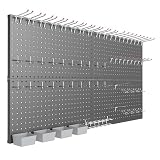
A shadow board can be a painted plywood panel with tool outlines, a perforated hardboard panel with hooks, or a purpose-made holder. Its main advantage is a quick visual check: an empty spot tells you a tool is in use or missing. Its main weakness is exposure. Grinding dust, overspray, and airborne fine dust settle on tools left out in the open.
Labeled drawers can be bought as part of a cabinet or added to a workbench. Labels work best when they name a tool group—“measuring,” for example—rather than a vague category such as “miscellaneous.” Drawers keep contents cleaner, but shallow drawers can become crowded, and a label cannot tell you whether a tool is missing unless you inspect the contents.
At-a-glance comparison
| Factor | Shadow board | Labeled drawers |
|---|---|---|
| Finding a common tool | Fast; tools are visible | Fast if labels and contents stay organized |
| Dust protection | Low; tools are exposed | Better, though drawers are not airtight |
| Space use | Uses wall space and needs clearance | Uses floor or bench space; adds capacity in a small footprint |
| Missing-tool check | Easy to spot an empty outline | Requires opening drawers or using a checklist |
| Best fit | Frequently used, robust tools | Small parts, precision tools, and less-used items |
| Common failure | Hooks loosen or tools collect dust | Drawers turn into mixed, overfilled piles |
Measure the space before choosing
In a narrow shop, wall storage can preserve floor space, but a board above a bench must not interfere with long stock, a raised workpiece, or the swing of a cabinet door. Stand at the bench and test the reach: tools used together should be close enough to grab without leaning over a running machine. Keep heavy tools low enough to lift safely, even if that means putting them in a drawer or on a lower shelf rather than overhead.
Drawers need enough clearance to open fully. Check the aisle with the drawer extended, not just with the cabinet shut. A cabinet that blocks the route to an exit or forces you to step around an open drawer is a poor fit, even if it stores more tools.
When a shadow board is worth it
Choose a board for tools you use repeatedly during one task: common wrenches, screwdrivers, pliers, or hand saws. A dedicated spot saves time only if returning the tool is nearly as easy as setting it down. If the board is across the shop, or its hooks make removal awkward, tools will migrate to the bench.
Use mounting hardware suited to the wall. A loaded board needs secure attachment to studs or appropriate masonry anchors; ordinary drywall anchors are not a safe choice for a heavy panel and tools. Test each hook with the tool’s weight, and avoid placing a sharp blade where a reaching hand can brush its edge. A tool-board hook assortment can make sense for a flexible layout, but the board material and mounting are just as important as the hooks.
One failure mode is treating outlines as a substitute for maintenance. Foam or painted outlines can show an empty spot, but they do not prevent rust or protect precision surfaces. Wipe down tools before storage, especially in a damp shop or after handling metalworking fluids.
When labeled drawers are the better buy
Drawers suit drill bits, layout tools, specialty cutters, and items used only occasionally. They are also a better choice when the shop has sanding or routing dust in the air. A basic cabinet with a handful of drawers is often more useful than a large cabinet full of deep drawers that let small items slide into a heap.
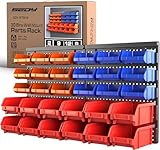
Check drawer depth and load rating before buying. A drawer packed with steel tools can be heavy; if it binds, tips the cabinet, or needs two hands to open, it will not be pleasant to use. Put dense items low, secure a tall cabinet against tipping, and use dividers or shallow trays so small parts do not migrate. A small-parts drawer cabinet is a practical option for screws and fittings, but clear fronts help only if the labels and compartments remain legible.
Do not buy drawers just to hide clutter. If a drawer has no defined contents, it tends to become a catch-all. Start with one drawer per tool group, label it clearly, and leave some spare capacity for new tools.
A practical setup for a small shop
Put the most-used hand tools on a compact board beside the main bench. Store precision tools, spare blades, bits, and small hardware in labeled drawers nearby. Keep heavier tools on lower shelves or in bottom drawers, and reserve high storage for light items used infrequently. This arrangement makes common work quick without leaving every tool exposed.
If budget is tight, plywood and a few well-spaced hooks can serve as a shadow board, and repurposed cabinets can work as drawer storage. Spend first on secure mounting, sensible labels, and dividers—not a matching set. A simple test tells you whether the setup is working: after a week, look for tools left on the bench, hooks that are hard to use, and drawers that take more than a few seconds to search. Change those spots before adding more storage.