
What's inside
- What This Guide Covers
- Table Saw Blade Types
- Tooth Count, Tooth Geometry, and Gullets
- Kerf: Thin Versus Full
- Blade Materials and Coatings
- How to Choose by Material and Cut
- Fit: Arbor, Diameter, and Saw Compatibility
- Safety Essentials
- Care, Cleaning, and Sharpening
- Common Mistakes
- Who Should Choose What
- Buying Checklist
- Frequently Asked Questions
- Conclusion
As an Amazon Associate I earn from qualifying purchases. This post may contain affiliate links at no extra cost to you.
The short answer: the best table saw blade is the one matched to your saw, your material, and the cut you make most often. For a single-blade shop, a quality carbide-tipped combination blade with a moderate tooth count handles ripping and crosscutting acceptably. If you cut a lot of solid hardwood, a dedicated rip blade and a dedicated crosscut blade will outperform it. For plywood and melamine, a higher tooth count with a clean-shearing grind matters more than anything else. Thin-kerf blades suit lower-powered saws, while full-kerf blades suit stronger cabinet-style machines.
Our Top Picks
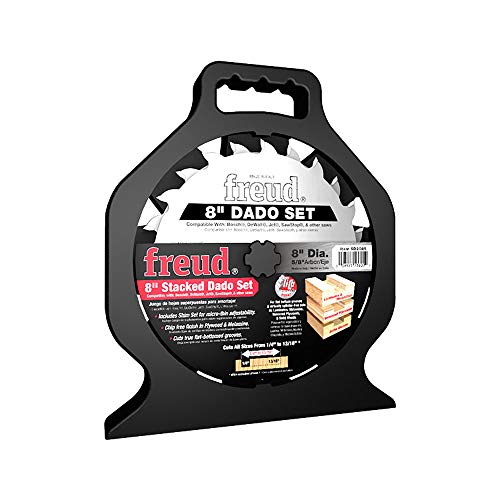 Freud Pro Dado Set with Premium Tico Hi-DensityOne Size2 x 9 x 11.8 inches5.69 poundsCheck on Amazon


What This Guide Covers
- Table saw blade types
- Tooth count, tooth geometry, and gullets
- Kerf: thin versus full
- Blade materials and coatings
- How to choose by material and cut
- Fit: arbor, diameter, and saw compatibility
- Safety essentials
- Care, cleaning, and sharpening
- Common mistakes
- Who should choose what
- Buying checklist
- Frequently asked questions
- Conclusion
Table Saw Blade Types
Most confusion about table saw blades comes from the fact that they are named for the job they do, not for a single feature. Once you understand the jobs, the catalog makes sense. There are really only a handful of families, and each exists because wood behaves differently depending on whether you cut along the grain, across it, or through a manufactured panel.
A rip blade is built to cut along the grain. It has relatively few, large teeth with a flat top, and deep gullets that carry away the long, stringy shavings that ripping produces. Because each tooth takes a big bite, a rip blade feeds quickly and runs cool, but the cut surface can show slight roughness on figured wood. A crosscut blade does the opposite. It has many small teeth with alternating bevels that sever fibers cleanly like a row of tiny knives, leaving a smooth edge across the grain at the cost of slower feeding and more heat.
A combination blade splits the difference with groups of teeth separated by larger gullets, so one blade can rip and crosscut at an acceptable level. A plywood or sheet-goods blade uses a high tooth count and a shallow bite to control tear-out in veneer and laminate. A dado set cuts flat-bottomed grooves and rabbets, either as a stack of outside blades and chippers or as a single wobble-style head. Finally, specialty blades, such as those for non-ferrous metal or plastic, exist but should be used only if your saw and the blade manufacturer explicitly allow it.
| Type | Typical tooth count | Best for | Main trade-off |
|---|---|---|---|
| Rip | Low (roughly 24 to 30 on a 10-inch blade) | Cutting solid wood along the grain | Rougher finish across the grain |
| Crosscut | High (roughly 60 to 80) | Clean cuts across the grain | Slow feed, more heat, can burn when ripping |
| Combination | Moderate (roughly 40 to 50) | General shop use with mixed cuts | Neither best at ripping nor crosscutting |
| Sheet-goods | High (roughly 60 to 80 or more) | Plywood, veneer, melamine | Wears faster in solid thick hardwood |
| Dado set | Varies with the stack | Grooves, rabbets, joinery | Needs a dado-rated saw, insert, and arbor length |
Tooth Count, Tooth Geometry, and Gullets
Tooth count is the number most buyers look at first, and it is useful, but only as a rough guide. More teeth generally means a smoother cut and a slower feed rate. Fewer teeth means faster removal and less friction. The reason is simple: each tooth removes a small chip, and the gullet in front of it must hold that chip until it clears the workpiece. When a blade has too many teeth for a thick board, the gullets fill, heat builds, and you get burn marks and strain on the motor.
Geometry matters just as much as count. A flat-top grind (FTG) has teeth that are squared across the top, which is ideal for raking out rip cuts and for cutting the flat floor of a dado. An alternate top bevel (ATB) grind alternates left and right bevels, giving the shearing action that cleans crosscuts. A steeper bevel angle yields a finer cut on delicate veneers but a more fragile tooth tip. A triple-chip grind (TCG) pairs a chamfered tooth with a flat raker, which holds up well in abrasive or hard materials such as laminate and solid-surface products. Some blades combine ATB teeth with a raker tooth in each group, which is the typical combination-blade design.
Kerf: Thin Versus Full
Kerf is the width of the slot the blade cuts. A standard full-kerf blade on a 10-inch saw typically cuts a slot around one-eighth of an inch wide, and a thin-kerf blade is noticeably narrower, often about three-thirty-seconds of an inch. The difference sounds tiny, but it has real consequences.
Thin-kerf blades waste less wood and demand less power, which helps on a contractor or portable saw. The trade-off is a plate that flexes more in thick hardwood and may wander if the fence is not parallel or the feed is rushed.
Full-kerf blades have a stiffer plate, so they track straighter and tend to run more quietly in a heavy saw. They need more motor power, though, and they pair best with a cabinet saw or a strong hybrid. If you use a thin-kerf blade, confirm that your riving knife is thinner than the kerf and thicker than the blade plate. Using a knife that is too thick will pinch the cut and cause binding. Some thin-kerf blades call for an included stabilizer, so read the blade instructions before installing one.
Blade Materials and Coatings
The plate of almost every modern blade is steel, and the cutting edge is what differs. Carbide-tipped blades have small pieces of tungsten carbide brazed onto each tooth. Carbide stays sharp far longer than plain steel, tolerates the glue in plywood, and can be resharpened several times. Plain high-speed or carbon steel blades exist, but they dull quickly in sheet goods and are mostly found at the very low end of the market.
| Feature | What it does | Good fit | Watch out for |
|---|---|---|---|
| Flat-top grind | Square chisel-like edge that clears material | Ripping, dado floors | Leaves a coarser surface |
| Alternate top bevel | Shearing action that slices fibers | Crosscuts and veneered panels | Delicate tips can chip if abused |
| Triple-chip grind | Chamfered tooth plus flat raker | Laminate, solid-surface, hard materials | Slower, less suited to fine hardwood finish |
| Carbide tips | Long edge life, resharpenable | Almost all shop work | Brittle if dropped or hit on metal |
| Low-friction coating | Reduces pitch and heat | Resinous woods | Wears off; still needs cleaning |
How to Choose by Material and Cut
Start with what you cut most. Solid softwood and hardwood boards ripped to width reward a blade with a flat-top grind and few teeth. If your projects are mostly face frames, furniture parts, and trim, where the edge will be visible, a combination blade with a respectable tooth count gives you acceptable edges without a blade change. When you glue up panels straight off the saw, rip quality matters more, and a dedicated rip blade yields a cleaner glue joint than a cheap combination blade.
For plywood, veneered boards, and melamine, choose a high tooth count with an alternate top bevel. Set the blade to protrude only a little above the material so the teeth exit at a shallow angle. Placing the best face up, since the teeth cut downward at the front of a table saw blade, is the standard way to keep the visible face clean. A zero-clearance insert supports the fibers around the blade and noticeably reduces chipping.
Fit: Arbor, Diameter, and Saw Compatibility
Begin with the diameter printed in the saw manual. Ten-inch blades are the most common on full-size saws, and smaller portable saws often use eight-and-a-quarter inch or similar sizes. Never install a blade larger than the saw is rated to take, because it can strike the guard, the table insert, or the housing, and it can overload the motor.
Next, match the arbor hole. Five-eighths of an inch is the most common size on full-size saws in North America, but you must verify against your own machine. Some blades ship with bushings or knockout rings that adapt the hole, and you must make sure any adapter is fully seated and that the blade is centered without wobble. Check the maximum rated speed printed on the blade and compare it with your saw’s arbor speed. The blade rating must be equal to or higher than the saw’s speed.
Safety Essentials
The first rule never changes: unplug the saw before you change or adjust a blade, and let the blade stop fully. Handle it by the plate, since carbide tips are sharp even when worn.
Keep the blade guard, riving knife, and anti-kickback pawls installed whenever the cut allows. Kickback happens when the workpiece pinches against the back of the blade or twists away from the fence, and the rear teeth throw the board toward the operator. A riving knife that moves with the blade and sits close behind it is the best single defense. Stand slightly to the side of the blade line, not directly behind the workpiece, and use push sticks or push blocks for narrow cuts instead of your hands.
Wear eye protection and hearing protection every time, and use a dust mask or a respirator and dust collection, because fine wood dust is harmful to breathe over time. Do not use a blade that is bent, cracked, missing carbide tips, or running with visible wobble. Do not exceed the blade’s rated speed, and do not cut materials that the blade manufacturer does not approve. Never perform a freehand cut without the fence or miter gauge, and never use both the fence and the miter gauge to guide a crosscut in a way that traps the offcut against the blade, since that is a classic setup for kickback.
Care, Cleaning, and Sharpening
A well cared for blade cuts better, lasts longer, and is safer. The most frequent maintenance task is cleaning. Pitch and resin from the wood bake onto the teeth and plate, which increases friction, causes burn marks, and dulls the effective edge. Remove the blade, following the unplug rule, and soak it briefly in a cleaner designed for saw blades, or use a mild solvent appropriate for resin. Scrub with a brush that is not metal, taking care not to scratch or chip the carbide, rinse, dry fully, and apply a light protective coating to the plate if the manufacturer suggests it.
Common Mistakes
One of the most common errors is using a high-tooth-count crosscut blade for ripping thick hardwood. The gullets clog, the board burns, and the motor works harder, which makes people think the blade is bad when it is simply the wrong tool. Another is leaving the blade set too high. A blade that barely clears the top of the stock, with roughly a tooth’s height showing, cuts more cleanly and is safer than one that towers above the board.
Who Should Choose What
If you have one saw and want one blade, choose a good carbide combination blade with a moderate tooth count, sized correctly for the saw. It is the practical starting point for most hobbyists. If your saw has modest power, make that a thin-kerf version and confirm the riving knife is a match.
If you build furniture from solid hardwood and glue up panels, add a dedicated rip blade for the heavy ripping and keep a crosscut or fine combination blade for finish work. If your projects are cabinets from plywood and melamine, a high-tooth-count sheet-goods blade with an alternate top bevel is the most valuable addition. If you cut joinery such as grooves and rabbets regularly, add a dado set only if your saw is rated for it. Contractors who move between job sites may prefer a durable general-purpose blade and a spare, because downtime is costly.
Buying Checklist
- Read the saw manual and note the blade diameter, arbor size, and maximum arbor speed.
- Confirm the blade’s rated speed is at or above the saw’s speed.
- Decide whether you cut mostly solid wood, sheet goods, or both.
- Match kerf to motor power, and check the riving knife thickness before choosing thin-kerf.
- Choose carbide-tipped blades for general shop work.
- Pick tooth count and grind to suit rip, crosscut, or combination cutting.
- Verify dado compatibility, including the arbor length and the insert, before buying a stack.
- Inspect the blade on arrival for bent plates, missing tips, or damage.
- Plan for cleaning supplies and a sharpening service.
- Buy from a seller with a clear return policy.
If you want to compare current options, browse a selection of carbide-tipped table saw blades and filter by diameter and kerf. For joinery work, see the available dado sets, and for maintenance, look at blade and bit cleaner products. A good set of push sticks and push blocks is also a sensible purchase alongside any new blade.
Frequently Asked Questions
How many teeth should a 10-inch table saw blade have?
It depends on the work. Roughly 24 to 30 teeth suits fast ripping, about 40 to 50 suits general combination work, and 60 to 80 suits fine crosscuts and plywood. Treat these as general ranges, not strict rules.
Is a thin-kerf blade worse than a full-kerf blade?
Not worse, just different. Thin-kerf blades demand less power and waste less wood, which suits lighter saws. Full-kerf blades are stiffer and can track more steadily in thick stock on a powerful saw.
Can I use one blade for everything?
You can use a combination blade for most tasks, and many hobbyists do. You will get better results on specific jobs, such as plywood or heavy ripping, if you swap in a blade designed for it.
How often should I sharpen a table saw blade?
There is no fixed schedule. Sharpen when the blade burns wood after cleaning, needs excess force, or leaves torn edges. Heavy use on abrasive material dulls a blade faster than occasional use on softwood.
Why does my blade burn the wood?
Common causes include a dull or dirty blade, too many teeth for the stock, a feed rate that is too slow, or a fence that is not parallel to the blade. Clean the blade and check alignment first.
Do I need a special blade for plywood?
A standard high-tooth-count alternate top bevel blade works well for plywood. A dedicated sheet-goods blade is not strictly required, but a fine blade reduces tear-out noticeably on veneered panels.
Can I put a larger blade on my saw for deeper cuts?
No. Use only the diameter listed in the saw manual. An oversized blade can hit the guard or housing and can overload the motor, creating a serious hazard.
Is it safe to use a blade with a missing carbide tip?
No. A damaged blade can vibrate, cut unevenly, or throw fragments. Remove it from service and have it professionally inspected or replace it.
Conclusion
Choosing among table saw blades becomes easy once you stop chasing a single winner and start matching features to your saw and your work. Tooth count and grind control how the cut feels and looks, kerf must suit your motor and riving knife, and carbide quality decides how long the edge lasts and how many times it can be resharpened. Pair a sensible blade with correct alignment, a riving knife, and disciplined safety habits, and even a modest saw performs well. Start with one good combination blade, learn what it does well, and add specialized blades only when your projects call for them.
Disclosure: As an Amazon Associate, jd-woodworks.com earns from qualifying purchases made through links on this page, at no extra cost to you.