Key takeaways
- Compare the best sliding bevel gauges and T-bevels for woodworking, from digital readouts to end-locking blades for dovetails, trim, and stair layout.
What's inside
As an Amazon Associate I earn from qualifying purchases. This post may contain affiliate links at no extra cost to you.
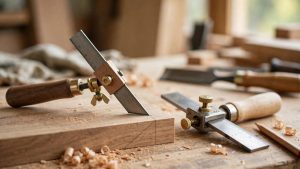
The best sliding bevel gauge for most woodworkers is the O’SKOOL MAM014, a 10-inch stainless T-bevel whose lock sits at the end of the handle, where it tightens without shifting the blade. A sliding bevel, also called a T-bevel or bevel gauge, does one job that no square can do: it copies an angle directly from a workpiece, a wall corner, or a machine setup, locks it, and carries it to the next cut without any numbers in between. Woodworkers who want the angle as a number as well should look at the digital picks from General Tools and Johnson, which read out degrees on an LCD while still locking like a traditional bevel. This roundup compares five confirmed options across the three designs that matter — end-locking analog, digital readout, and classic hardwood stock.
As an Amazon Associate, we earn from qualifying purchases.
Table of Contents
- Quick Picks
- O’SKOOL MAM014 10-Inch Sliding T-Bevel Gauge
- General Tools 828 Digital Sliding T-Bevel Gauge
- Johnson 1920-0800D Digital T-Bevel
- Bonsicoky 9-Inch T-Bevel Sliding Gauge
- O’SKOOL MAM013 7-Inch Sliding T-Bevel Gauge
- How to Choose a Sliding Bevel Gauge
- FAQ
- Conclusion
- Product and ASIN Reference
Quick Picks
- Best overall: O’SKOOL MAM014 10-Inch Sliding T-Bevel Gauge — stainless blade, aluminum stock, and an end-of-handle lock that holds the setting while it tightens.
- Best digital: General Tools 828 Digital Sliding T-Bevel Gauge — reads angles from 0 to 360 degrees at 0.05 degree resolution on an LCD.
- Best digital alternative: Johnson 1920-0800D Digital T-Bevel — flip display and a reverse-angle function for miter work.
- Best budget: Bonsicoky 9-Inch T-Bevel Sliding Gauge — hardwood handle, stainless blade, and a brass lock knob in the classic layout.
- Best compact: O’SKOOL MAM013 7-Inch Sliding T-Bevel Gauge — the shorter blade suits dovetail layout and small parts.
O’SKOOL MAM014 10-Inch Sliding T-Bevel Gauge
The MAM014 gets the top spot because of where its lock lives. On most sliding bevels the wing nut or thumbscrew sits at the pivot, and tightening it tends to nudge the blade a fraction off the angle just captured. O’SKOOL moves the locking mechanism to the end of the handle, so the clamping force travels down the stock instead of twisting at the pivot, and the blade stays where it was set. For fitting scribed trim, matching an existing stair angle, or transferring a dovetail slope, that small design difference is the difference between checking the setting once and checking it three times.
The blade is stainless steel and swings a full 360 degrees, folding back on itself for storage and opening flat for long transfers. At 10 inches it is the longest blade in this roundup, and length is accuracy on a bevel gauge: a small angular error is easier to see, and to correct, at the far end of a long blade. The handle is aluminum, giving the tool enough heft to sit flat against a board edge without the flex of a plastic stock. This is a mid-range pick and the natural default for general furniture and trim work. It reads no numbers, like every analog bevel, so anyone who needs degrees must pair it with a protractor or choose a digital model.
Specs:
- Blade length: 10 inches
- Blade material: stainless steel
- Blade movement: 360-degree adjustable
- Handle: aluminum
- Locking mechanism: end-of-handle lock
- Model: MAM014
General Tools 828 Digital Sliding T-Bevel Gauge
The General Tools 828 answers the one question an analog bevel cannot: what angle is this, in degrees. Its full LCD display reads from 0 to 360 degrees with a resolution of 0.05 degree and a stated accuracy of 0.3 degree, so an angle copied off a workpiece can be written down, matched to a miter saw setting, or reproduced weeks later on a matching part. Four function buttons handle the display modes, and a locking knob still lets the tool work as a manual transfer gauge when the number does not matter.
The blade is 8 inches of stainless steel and the handle is impact-resistant ABS, a lighter build than the aluminum O’SKOOL. Power comes from a single CR2032 lithium battery, included in the box, and an auto shut-off feature stretches battery life between jobs. The trade-offs are the usual digital ones: the tool depends on a battery, and the display housing makes it bulkier in a pocket than a flat analog bevel. It sits in the mid-range tier and suits woodworkers who regularly move between a workpiece and a machine dial — stair builders, trim carpenters setting compound cuts, and anyone matching existing angles on renovation work where the number has to be recorded, not just carried.
Specs:
- Type: digital sliding T-bevel and protractor
- Range: 0 to 360 degrees
- Accuracy: 0.3 degree
- Resolution: 0.05 degree
- Blade: 8-inch stainless steel
- Handle: impact-resistant ABS
- Battery: 1 CR2032 3V lithium, included
- Features: full LCD display, 4 function buttons, auto shut-off, locking knob
- Model: 828
Johnson 1920-0800D Digital T-Bevel
The Johnson 1920-0800D covers the same digital ground as the General Tools 828 with two practical additions. The display can be flipped 180 degrees, which solves the familiar problem of reading an upside-down number when an angle is captured overhead or from the far side of a board. It also offers a reverse-angle function aimed at miter work, showing the complementary setting used at the saw instead of leaving the conversion to mental arithmetic.
Construction follows the same pattern as its rival: an 8-inch stainless steel blade that resists rust in damp site conditions, an impact-resistant ABS handle, an adjustable locking knob that secures the blade at any angle, and a single CR2032 lithium battery, included, with auto power off to preserve it. At 0.75 pounds it is light enough for site work and trim carpentry. Choosing between the Johnson and the General Tools 828 comes down to the display features: the flip screen and reverse miter mode are genuinely useful for installers and stair work, while the 828 is the more established name in the category. Both are mid-range tools, and both still work as plain locked transfer gauges when the battery is flat.
Specs:
- Type: digital sliding T-bevel and protractor
- Range: 0 to 360 degrees
- Resolution: 0.05 degree
- Blade: 8-inch stainless steel
- Handle: impact-resistant ABS
- Battery: 1 CR2032 3V lithium, included
- Features: 180-degree flip display, reverse angle function, hold function, auto power off, locking knob
- Weight: 0.75 pounds
- Model: 1920-0800D
Bonsicoky 9-Inch T-Bevel Sliding Gauge
The Bonsicoky is the traditional option in this roundup: a hardwood handle, a stainless steel blade, and a brass lock knob at the pivot, in the pattern bevel gauges have followed for generations. The 9-inch blade carries metric marks, adding a rough measuring function along the edge for quick length checks. The hardwood stock is the point of the design: it sits warm and solid in the hand and takes knocks without the brittle risk of a plastic handle.
This is the budget pick, and its limits match the tier. The pivot-mounted lock is the classic arrangement, which means the blade can shift slightly as the knob is tightened unless the blade is held firmly against the work while locking — a technique point rather than a defect. There is no readout and no end lock. For occasional angle transfer — matching a baseboard corner, copying a chair leg splay, setting a one-off miter — it does everything the task requires. Shops that transfer angles all day will feel the difference in the end-locking and digital picks, but as a first bevel it covers the fundamentals for the least commitment.
Specs:
- Blade length: 9 inches
- Blade material: stainless steel
- Handle: hardwood
- Lock: brass lock knob at pivot
- Markings: metric marks on blade
- Model: JIAWONG2201060004
O’SKOOL MAM013 7-Inch Sliding T-Bevel Gauge
The MAM013 is the MAM014’s smaller sibling, built on the same design with a 7-inch blade in place of the 10-inch. Everything that earns the larger tool its place carries over: the stainless blade with full 360-degree swing, the aluminum handle, and the end-of-handle lock that clamps without disturbing the setting. What changes is where the tool is comfortable. A 10-inch blade overhangs small work and is awkward inside drawers, boxes, and cabinet carcasses; the 7-inch blade fits those spaces and still spans most furniture-scale angles.
Dovetail work is the clearest case for the shorter bevel. Slopes for dovetail pins and tails are set once and then transferred dozens of times across a drawer or case side, often in tight quarters, and a compact bevel that locks positively earns its keep on every repetition. The honest limitation is reach: for stair stringers, long trim runs, and roof work, the 10-inch blade of the MAM014 shows errors more clearly and bridges longer reference edges. Many shops end up with both sizes, but buyers choosing one for fine furniture work should start with this 7-inch version.
Specs:
- Blade length: 7 inches
- Blade material: stainless steel
- Blade movement: 360-degree adjustable
- Handle: aluminum
- Locking mechanism: end-of-handle lock
- Model: MAM013
How to Choose a Sliding Bevel Gauge
Decide whether the angle needs a number. A traditional sliding bevel copies and carries an angle but cannot say what it is. That is enough for most joinery, where the bevel itself is the template. If the workflow involves setting a miter saw dial or recording angles for later parts, a digital bevel such as the General Tools 828 or Johnson 1920-0800D reads the angle directly and removes the separate protractor step.
Prioritize the lock. The lock is the whole tool. A bevel that creeps after locking quietly ruins every transfer made with it. End-of-handle locks, like the O’SKOOL design, clamp without twisting the blade at the pivot and are the easiest to trust. Pivot knobs work, but the blade should be held firmly against the reference surface while tightening, and the setting checked after locking until the habit forms.
Match blade length to the work. Longer blades, 9 to 10 inches, bridge longer edges and make small angular errors visible at the tip, which suits trim, stairs, and framing layout. Shorter blades, around 7 inches, fit inside carcasses and suit dovetails and small parts. Blade material is simpler: stainless steel resists rust and stays smooth in the slot.
Consider stock material. Aluminum stocks are flat, stable, and durable. Hardwood stocks feel better in the hand and shrug off drops, but can wear at the reference face over years of use. ABS handles keep digital models light and inexpensive, at some cost in rigidity.
Keep the tier in proportion. A sliding bevel is a simple tool, and the budget tier transfers angles perfectly well for occasional use. The mid-range premium buys lock quality, blade flatness, and, in digital models, a readout. Spend on the lock first and the readout second.
FAQ
What is a sliding bevel gauge used for?
A sliding bevel gauge copies an angle from one place and transfers it to another: from an existing corner to a replacement trim piece, from a dovetail template to a drawer side, or from a stair stringer to a tread. It can also be set from a protractor or a known reference and used to lay out that angle repeatedly, which is how it serves in dovetail and chair work.
What is the difference between a sliding bevel and a T-bevel?
Nothing functional. Sliding bevel, T-bevel, sliding T-bevel, bevel gauge, and false square are all names for the same tool: a stock with a slotted blade that pivots, slides, and locks at any angle. Listings use the terms interchangeably, so compare blade length, lock design, and materials rather than the name on the box.
Are digital T-bevels more accurate than analog ones?
They answer a different question. A digital bevel reports the angle as a number, typically at 0.05 degree resolution with accuracy around 0.3 degree, which an analog bevel cannot do at all. For pure transfer work, an analog bevel locked against the original angle is exact by definition, since no reading or conversion step intervenes. Digital models add value when the angle must be recorded, shared, or dialed into a machine.
How can a locked bevel setting be kept from shifting?
Hold the stock firmly against the reference edge and keep light pressure on the blade while tightening the lock, then re-check the blade against the reference before moving the tool. End-locking designs reduce shift because the clamp does not twist the pivot. Storing the bevel folded and avoiding drops keeps it trustworthy.
Conclusion
The O’SKOOL MAM014 is the safest single purchase: a long stainless blade and an end-of-handle lock that respects the setting. Buyers who need angles as numbers should choose between the General Tools 828 and the Johnson 1920-0800D, whose flip display and reverse-angle mode suit installation work. The Bonsicoky keeps the classic hardwood pattern at a budget tier, and the O’SKOOL MAM013 shrinks the winning analog design to the size dovetail and carcass work wants. Across all five, the buying rule is the same: judge a bevel by its lock, then its blade, then everything else.
Related guides
More from Amazon
Programs that pair well with the guide above. Offers and eligibility are set by Amazon and may change.
A free business account with business pricing and bulk-buying tools for work, shop or home office.
Create a business accountFree shipping on eligible items, Prime Video and more. Eligible new members can start with a free trial.
Start a Prime free trialAudiobooks and podcasts to listen to on the go. Eligible new members can start with a free trial.
Try Audible freeAd-free music streaming. Eligible new subscribers can start with a free trial.
Try Music Unlimited freeAs an Amazon Associate we earn from qualifying purchases.