Key takeaways
- Compare benchtop drum sanders with variable conveyor speeds for home woodworking shops, with verified models, key specs and setup advice for small spaces.
As an Amazon Associate I earn from qualifying purchases. This post may contain affiliate links at no extra cost to you.
As an Amazon Associate, we earn from qualifying purchases made through links on this page.
A variable conveyor is what separates a drum sander that merely flattens boards from one that finishes them. In a home woodworking shop, the same machine might level an end-grain cutting board in the morning and take a whisper-light pass over figured maple in the afternoon, and those two jobs want very different feed rates. Slow the conveyor and the drum makes more rotations per inch of travel, which evens out the scratch pattern and reduces burning on dense or resinous stock. Speed it up and light passes on straight-grained boards move quickly without loading the abrasive.
This guide focuses on benchtop-format drum sanders with genuinely adjustable conveyor speeds, sized for a home shop rather than a production floor. Every model below is a current, verifiable product with manufacturer specifications; the comparison is built on drum width, motor size, feed control, and thickness capacity.
What to Look For
- Feed range and control type. Look for a conveyor that adjusts down to a crawl, not just two or three steps. Load-sensing systems that slow the feed automatically when the drum works harder are a real advantage on wide or figured stock.
- Single-pass width versus two-pass width. Open-ended benchtop sanders double their capacity in two passes. Match the single-pass width to your most common panel size so most work stays single-pass.
- Motor size for your stock. A 1 HP motor handles shallow passes on boards within its width; stepping up in motor size matters if you regularly surface wide, dense hardwood panels.
- Thickness capacity and readout. Check the maximum stock thickness against your work — cutting boards and door parts differ — and prefer a machine with a clear height scale or digital readout for repeat settings.
- Dust port size. Drum sanders produce fine dust in volume. A 4-inch port connected to a real dust collector is the expected setup; a shop vacuum is a compromise on the wider machines.
- Abrasive changes. You will change grits often. Toolless or quick-attachment abrasive systems save real time across a project.
The Picks
JET JWDS-1020 Benchtop Drum Sander (723510)
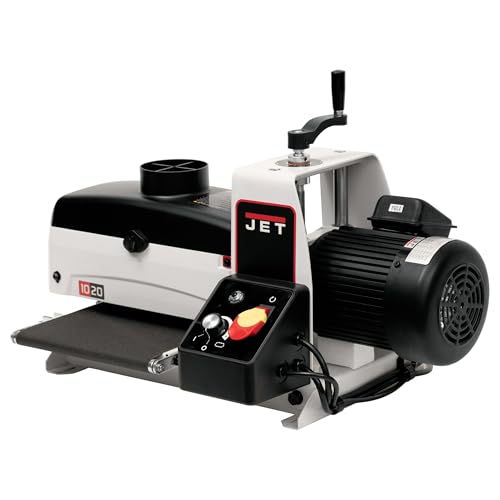
The JWDS-1020 is JET’s compact benchtop drum sander, built around a 1 HP motor and a 10-inch drum. Because the design is open-ended, a board up to 20 inches wide can be surfaced in two passes by flipping it end for end. The variable-speed conveyor, adjustable from 0 to 10 feet per minute, is the headline feature at this size: slowing the feed gives figured or resinous stock more drum contact per inch, while faster settings suit light finish passes on straight-grained boards. A parallelism adjustment dial helps keep the drum level with the conveyor bed, and the redesigned dust hood concentrates extraction at the drum through a 4-inch port.
In a home shop the JWDS-1020 earns its place as the compact variable-feed option: it sits on a bench, stores on a shelf-side footprint, and still surfaces 20-inch panels in two passes when a project demands it.
Key features and specifications (manufacturer):
- Sanding width: 10 inches in a single pass, 20 inches in two passes
- Motor: 1 HP, 115V
- Conveyor: variable speed, 0 to 10 feet per minute
- Stock thickness range: 1/32 inch to 3 inches
- Dust collection: 4-inch dust port
- Drum: self-cooling aluminum drum with toolless abrasive take-up fasteners
Best for: Home woodworkers whose panels are usually under 10 inches wide and who want variable feed control without giving floor space to a stand.
Limitations to know: The 10-inch single-pass width means most cabinet panels and wide glue-ups need two passes, and the 1 HP motor calls for shallow passes on dense hardwoods rather than heavy stock removal.
JET JWDS-1632 Drum Sander with Stand (723520K)

The JWDS-1632 doubles single-pass width over the smallest benchtop models and adds Sandsmart, JET’s load-sensing feed control that slows the conveyor automatically when the drum load rises. For a home shop surfacing cutting boards, drawer parts, and panel glue-ups, that combination of 16-inch capacity and self-regulating feed is the practical sweet spot. The variable conveyor covers the same 0 to 10 feet per minute range, and the open-ended frame allows 32-inch work in two passes. It ships with an open stand, so it can live on the floor or be bench-mounted in tighter spaces.
For home shops that surface panel glue-ups every week, the JWDS-1632 is the capacity step: Sandsmart load control is the most forgiving feed system here for newer drum sander users, because it intervenes before a too-fast feed burns or stalls.
Key features and specifications (manufacturer):
- Sanding width: 16 inches in a single pass, 32 inches in two passes
- Motor: 1-1/2 HP, 115V, 20-amp service recommended by the manufacturer
- Conveyor: variable speed with Sandsmart control that monitors load and adjusts feed
- Stock thickness range: 1/32 inch to 3 inches
- Dust collection: 4-inch dust port
- Includes open stand; built-in digital readout on current models
Best for: Home shops doing regular cutting boards, tabletops and cabinet panels up to 16 inches wide in a single pass.
Limitations to know: At roughly 156 pounds with the stand it is not a move-it-every-session machine, and the manufacturer specifies 20-amp service, which some older garage circuits cannot supply.
JET JWDS-2244 Oscillating Drum Sander (723540B)

The JWDS-2244 is the step-up option for shops that regularly surface wide panels. Its 22-inch drum handles most cabinet doors and tabletop glue-ups in one pass, and the drum oscillates side to side as it spins, which spreads abrasive wear and reduces the straight-line scratch pattern a fixed drum can leave. Sandsmart feed control and a variable conveyor carry over from the smaller JET models, and the 4-inch maximum stock thickness covers chunky workbench tops and thick door stock that smaller sanders cannot accept.
The JWDS-2244 blurs the benchtop category — it is a stand machine — but its oscillating drum and 22-inch width make it the reference for what variable-feed sanding can do when width stops being the constraint.
Key features and specifications (manufacturer):
- Sanding width: 22 inches in a single pass, 44 inches in two passes
- Motor: 1-3/4 HP, 115V
- Oscillating drum action for a finer finish pattern
- Conveyor: variable speed with Sandsmart load control
- Stock thickness range: 1/32 inch to 4 inches
- Dust collection: 4-inch dust port
Best for: Home shops with a permanent sanding station and frequent wide-panel or door work.
Limitations to know: This is a floor-standing machine with a footprint and weight to match, so it suits a permanent sanding station rather than a bench that must be cleared for other work.
Quick Comparison
| Product | ASIN | Width | Motor | Feed |
|---|---|---|---|---|
| JET JWDS-1020 Benchtop Drum Sander | B07Y9546K5 | 10 in (20 in two-pass) | 1 HP | Variable 0–10 FPM |
| JET JWDS-1632 Drum Sander with Stand | B07CHGFJ35 | 16 in (32 in two-pass) | 1-1/2 HP | Variable, Sandsmart |
| JET JWDS-2244 Oscillating Drum Sander | B07JMF88QN | 22 in (44 in two-pass) | 1-3/4 HP | Variable, Sandsmart |
Frequently Asked Questions
Why does variable conveyor speed matter on a drum sander?
Feed speed controls how many drum rotations each inch of stock receives. Slower feeds produce a finer, more even finish and reduce burning on dense wood; faster feeds suit light passes and soft stock. It is the main control you have over finish quality once grit is chosen.
What grit sequence should a home shop keep for a drum sander?
A practical home set is a coarse grit for leveling, a medium grit for refining, and a fine grit for pre-finish passes. Most woodworkers still finish with a random orbit sander afterward, because a drum sander leaves a straight-line scratch pattern.
Can a benchtop drum sander replace a planer?
No. A drum sander removes very little material per pass and is slow at dimensioning. Thickness stock with a planer or jointer first, then use the drum sander to flatten glue-ups and dial in final thickness and surface quality.
How much dust collection does a drum sander need?
Plan on a dust collector with a 4-inch connection rather than a small vacuum for anything beyond the smallest model. Drum sanding generates fine dust continuously, and extraction at the drum also helps keep the abrasive from loading.
Conclusion
For a home woodworking shop, the variable conveyor is not a luxury feature — it is the control that makes one machine serve both leveling and finishing roles. Choose the JWDS-1020 if bench space rules, the JWDS-1632 if 16-inch panels are your weekly work, and the JWDS-2244 if wide work is the norm and a permanent station is available.
Related guides
More from Amazon
Programs that pair well with the guide above. Offers and eligibility are set by Amazon and may change.
A free business account with business pricing and bulk-buying tools for work, shop or home office.
Create a business accountFree shipping on eligible items, Prime Video and more. Eligible new members can start with a free trial.
Start a Prime free trialAudiobooks and podcasts to listen to on the go. Eligible new members can start with a free trial.
Try Audible freeAd-free music streaming. Eligible new subscribers can start with a free trial.
Try Music Unlimited freeAs an Amazon Associate we earn from qualifying purchases.