What's inside
As an Amazon Associate I earn from qualifying purchases. This post may contain affiliate links at no extra cost to you.
A row of stain cans on an open shelf is cheap and convenient. It can also leave flammable vapors and containers exposed to a spark, a hot motor, or a knock from a board. A flammable-liquid cabinet adds protection, but it costs money, takes floor space, and does not make careless storage safe.
The right choice depends on what is in your finishes, how much you keep, and where the shelf sits. Read the product labels and safety data sheets (SDS), then compare your actual setup—not an imagined worst-case shop—to the trade-offs below.
As an Amazon Associate we earn from qualifying purchases at no extra cost to you.

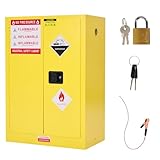
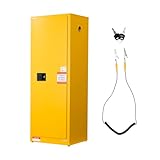
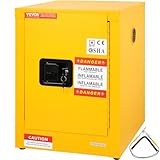
What counts as a flammable finish
Many oil-based stains, solvent-based paints, mineral spirits, lacquer thinner, and some aerosol finishes are flammable. Water-based products are generally less of a fire concern, though they still need protection from freezing, heat, and damage. “Low odor” is not the same as nonflammable; check the label or SDS for the flash point and storage instructions.
Keep oily rags in a separate, covered metal container intended for oily waste. Rags soaked with linseed oil or some oil-based finishes can heat up as they dry and ignite without a nearby flame. A flammable-liquid cabinet is not a substitute for safe rag handling.
Cabinet versus open shelf
| Factor | Flammable-liquid cabinet | Open shelf |
|---|---|---|
| Fire exposure | Helps shield contents from a fire outside the cabinet; not fireproof | Containers are directly exposed to heat, flame, and sparks |
| Leaks and spills | Many models have a raised, leak-resistant bottom sump | A leak can run onto the floor or into nearby equipment |
| Access and visibility | Contents are behind a door; must be labeled and kept organized | Fast to reach and inspect |
| Cost and space | Higher cost and a dedicated footprint | Cheaper, compact, and easy to install |
| Best fit | Regular use of several solvent-based products or storage near ignition risks | Small quantities of lower-risk products in a cool, low-traffic location |
When a cabinet makes sense
Choose a cabinet if you keep several gallons of flammable liquid, buy finishes in bulk, or store them near a furnace, heater, charging station, grinder, or other potential ignition source. It is also a sensible upgrade when containers sit where a dropped tool or shifting lumber could puncture them. A cabinet with a leak-resistant sump can contain some spills before they reach the floor; verify the capacity and construction in the product specifications.
For a home workshop, a purpose-built flammable-liquid storage cabinet is different from a generic metal locker. Check its stated capacity, intended liquid type, door and latch design, ventilation instructions, and applicable local requirements. Do not assume that a cabinet is suitable just because it is yellow or made of steel.
Cabinets are not magic fire boxes. They do not stop every fire, and they do not permit unlimited quantities. Avoid overloading shelves, keep containers closed, and follow the cabinet maker’s instructions. Some cabinets should not be vented unless required by local rules or the manufacturer; improvised vents can defeat the intended protection.
When an open shelf is enough
A shelf can be a reasonable choice for a few small, tightly closed containers when the products are not highly flammable, the area is cool and dry, and there are no nearby flames, heaters, sparks, or hot electrical equipment. For example, a couple of water-based stains on a stable shelf away from the finishing area may not justify buying a cabinet.
Even then, do not put finishes above a workbench where containers can be knocked down, beside a window in direct sun, or over a heater. Use a sturdy shelf with a lip or other way to prevent cans from sliding off, and keep the labels visible. A cheap plastic tote can catch drips, but it is not a fire-rated substitute for a cabinet and may be incompatible with some solvents.
Placement, quantity, and daily use
Keep flammable liquids away from ignition sources and routes where people or stock can strike them. Follow the label, SDS, cabinet instructions, and local fire code for separation and allowed quantities. Requirements vary by jurisdiction and by the type and amount of liquid, so do not rely on a universal gallon limit from an online rule of thumb.
Store only what you need for the work ahead. Smaller containers reduce the amount at risk and are easier to handle than a partly used five-gallon pail. Keep lids tight, wipe residue from the outside, and do not transfer a finish into an unmarked drink bottle or other food container. If a product is old, swollen, leaking, or has an unreadable label, treat it as a disposal problem rather than returning it to storage.
For a cabinet, consider a size that holds your normal stock without stacking containers or blocking the door. A cabinet with a spill-catching sump can be useful if you routinely handle cans that may drip, but compare the sump capacity with your largest container and follow the maker’s shelf-loading limits.
A practical buying rule
Start with an inventory: write down each finish, the quantity on hand, and its flammability guidance. If you store only a few low-risk, sealed containers in a protected spot, a well-built shelf may be the sensible, cheaper answer. If you keep solvent-based finishes in quantity, work around sparks or heat, or cannot protect containers from impact, buy a purpose-built cabinet sized for the stock you actually need.
Whichever option you choose, storage is only one part of shop safety. Use finishes with adequate ventilation, keep ignition sources out of the application area, and dispose of solvent and oily waste according to the product instructions and local rules. A cabinet reduces some storage risks; it does not make an unsafe finishing setup safe.