Key takeaways
- Compare the best closed end drum sanders for garage workshops, with rigid closed-frame picks verified on Amazon US, plus width, feed and dust checks.
What's inside
As an Amazon Associate I earn from qualifying purchases. This post may contain affiliate links at no extra cost to you.
A closed end drum sander carries its drum on bearings at both ends, inside a full frame or cabinet, instead of cantilevering the drum off one side the way open end designs do. That layout keeps the drum from flexing under load, so thickness stays even across a panel. The trade-off is a hard width limit: a board wider than the drum simply does not fit, which is the decision a garage workshop owner has to get right first.
The Shop Fox W1678 is the top pick here for its 26-inch capacity and micro-adjustable rear drum, with the Powermatic DDS-225 close behind as the heavier alternative. This guide suits garage woodworkers flattening glued-up panels, cabinet shops in a two-car space, and anyone upgrading from a cantilever sander. Every machine below was selected from its Amazon US listing details: frame type, width, motor, feed system and dust ports.
Quick Picks
As an Amazon Associate we earn from qualifying purchases.
| Product | Best for | Key spec |
|---|---|---|
| Shop Fox W1678 26-Inch Double Drum Sander (ASIN: B001R23SRC – https://www.amazon.com/dp/B001R23SRC) | Widest closed-frame capacity in a garage footprint | 26-inch dual drums, 5 HP motor |
| Powermatic DDS-225 25-Inch Dual Drum Sander (ASIN: B00064NGTM – https://www.amazon.com/dp/B00064NGTM) | Heaviest build and two-speed feeding | 25-inch dual steel drums, cast iron table |
| Grizzly G1066R 24-Inch Drum Sander (ASIN: B0000DD0CU – https://www.amazon.com/dp/B0000DD0CU) | Straightforward fixed-feed closed frame | 24-inch dual aluminum drums, rubber conveyor |
How to Choose
Start with the width ceiling
A closed end frame cannot cheat width with a second pass, so drum length is the largest panel the machine will ever handle. Measure the widest work the garage actually produces: cabinet doors, tabletop glue-ups and dresser panels usually set the number. The three machines here span 24 to 26 inches, and sizing for regular work rather than a rare oversized project keeps footprint and weight sensible.
Confirm the frame really is closed
Some sanders borrow closed-frame styling while still cantilevering the drum. A true closed end design encloses the drum in a cabinet or full frame with support at both ends, which resists deflection on wide, heavy cuts. All three picks here are cabinet machines with both drum ends supported, and that rigidity is the entire reason to accept the width ceiling.
Match the motor and circuit to the garage
Each machine here runs a 5 HP motor on 220V or 230V single-phase power, so a dedicated circuit is part of the purchase. Check panel capacity and breaker space before ordering, and note the amp draw in the listing: the Shop Fox lists a 25-amp drum motor.
Look at feed control and drum adjustment
Thickness consistency depends on how the conveyor moves stock and how finely the drums can be set parallel to the bed. Variable feed, like the 0 to 20 FPM range on the Shop Fox, lets the operator slow down for figured stock. A micro-adjustable rear drum makes dialing the second drum to a finer grit height easier, while a fixed feed rate, like the Grizzly’s 11 FPM, trades flexibility for simplicity.
The 3 Best Options
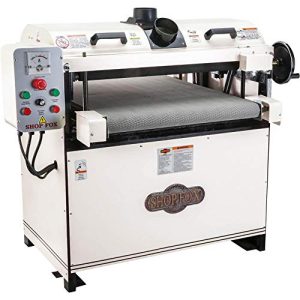
Shop Fox W1678 26-Inch Double Drum Sander — OUR TOP PICK
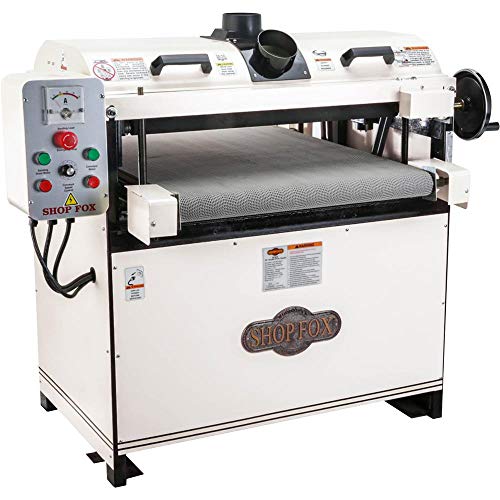
The W1678 pairs the widest capacity in this group with the closed cabinet layout the keyword calls for. Its rear drum is micro-adjustable for setting a finer finishing grit, and the variable-speed conveyor runs from 0 to 20 FPM so feed can slow for wide hardwood panels. Hook-and-loop abrasive speeds up grit changes, and an amp meter shows how hard the motor is working during a pass.
Specs
- Sanding width: 26 inches, dual drums
- Motor: 5 HP, 220V single-phase, 25 amp
- Drum surface speed: 2300 FPM
- Conveyor: variable feed, 0 to 20 FPM
- Stock: up to 4-1/4 inches thick, 9-inch minimum length
- Dust ports: two 4-inch; weight about 546 pounds
Best for: Garage workshops sanding panels in the 20 to 26 inch range that want rear drum adjustability to run two grits in one pass.
Watch out for: The 220V circuit and the machine’s weight make placement nearly permanent, so settle location and wiring before delivery day.
Powermatic DDS-225 25-Inch Dual Drum Sander

The DDS-225 is the production-leaning entry here, built around a full-size cast iron table and a heavy steel cabinet. Its two 6-inch steel drums carry a hard durometer rubber coating for a flat, mar-free finish. Instead of a variable conveyor, a two-speed gearbox feeds stock at 8 or 12 FPM and can run in reverse to back a board out of a cut that is not going well. Dual dust ports with directional baffles aim airflow where the drums throw debris.
Specs
- Sanding width: 25 inches, dual drums
- Motor: 5 HP, 1-phase, 230V
- Drums: 6-inch steel, rubber coated, 1700 RPM
- Conveyor: two-speed gearbox, 8 or 12 FPM, forward and reverse
- Table: full-size cast iron; dual dust ports with baffles
- Gross weight: 840 pounds
Best for: A garage shop that doubles as a small production space and values mass, a cast iron table and simple two-speed feeding.
Watch out for: At 840 pounds gross, this is a set-it-once machine; garage floors and doorways need measuring well ahead of freight delivery.
Grizzly G1066R 24-Inch Drum Sander
The G1066R is the simplest machine in this group: a closed-frame cabinet sander, described in magazine coverage of the G1066 family as a closed-frame design, with two aluminum drums and a fixed feed rate. A 1/4 HP conveyor motor moves stock at a steady 11 FPM over a rubber belt, and capacity matches the panel sizes most garage cabinet work involves.
Specs
- Sanding width: 24 inches (stock up to 23-1/2 inches wide)
- Motor: 5 HP, 220V single-phase
- Drums: two 6-inch aluminum, 2300 FPM surface speed
- Conveyor: rubber belt, fixed 11 FPM feed
- Stock: up to 4-1/4 inches thick, 9-inch minimum length
- Weight: about 453 pounds
Best for: Garage woodworkers who want closed-frame rigidity and dual drums without extra feed electronics to maintain.
Watch out for: The fixed 11 FPM feed gives no way to slow down for difficult grain, so depth per pass must be managed with lighter cuts.
Which One Fits Your Situation
- Wide tabletops and doors up to 26 inches: the Shop Fox W1678, the only pick whose drum covers that width in one pass, with variable feed for big, heavy panels.
- A garage that also handles small production runs: the Powermatic DDS-225, where cast iron table, cabinet mass and reverse conveyor support repeated daily use.
- A first closed-frame machine on a simpler brief: the Grizzly G1066R, with fixed feed and a rubber conveyor that keep setup to drum alignment and grit choice.
Common Mistakes
- Ordering a sander whose drum is narrower than the panels the shop builds most, forgetting there is no second-pass workaround.
- Assuming a cantilever machine is closed frame because it has a cabinet stand; drum support, not the stand, defines the design.
- Skipping the electrical check and finding the garage panel has no room for the required 220V circuit.
- Running both dust ports into an undersized collector, leaving fine dust escaping around the hood.
- Taking deep cuts at full feed speed on wide stock instead of lighter passes, which overloads the motor and leaves washboard marks.
Frequently Asked Questions
Can a closed end drum sander handle a panel wider than its drum?
No. The frame blocks any second-pass technique, so drum length is the absolute maximum width. Shops that regularly exceed 26 inches need an open end design instead, accepting the drum flex that comes with it.
Why choose a closed frame over an open end sander for a garage?
Support at both drum ends keeps the drum parallel to the conveyor under load, which shows up as even thickness across wide panels. For glue-ups and cabinet doors that must come out flat, that consistency is worth more than extra width.
Do these machines replace a planer?
No. A drum sander removes small amounts per pass, for flattening and finish thicknessing after stock has been jointed and planed close to size. Forcing heavy stock removal overloads the motor and glazes the abrasive.
What dust collector size suits a dual drum closed-frame sander?
Each pick here has two 4-inch ports, so the collector must move enough air to serve both at once. Match the collector and hose layout to those ports rather than sizing for a single-port tool.
For a garage workshop, the closed end layout is a deliberate trade: give up sanding beyond the drum width, and gain a drum that stays put under load. Measure the widest panels the shop truly makes, confirm the 220V circuit, and the three picks separate quickly by capacity and feed style.
Related guides
More from Amazon
Programs that pair well with the guide above. Offers and eligibility are set by Amazon and may change.
A free business account with business pricing and bulk-buying tools for work, shop or home office.
Create a business accountFree shipping on eligible items, Prime Video and more. Eligible new members can start with a free trial.
Start a Prime free trialAudiobooks and podcasts to listen to on the go. Eligible new members can start with a free trial.
Try Audible freeAd-free music streaming. Eligible new subscribers can start with a free trial.
Try Music Unlimited freeAs an Amazon Associate we earn from qualifying purchases.