What's inside
As an Amazon Associate I earn from qualifying purchases. This post may contain affiliate links at no extra cost to you.
Sanding and routing produce fine dust that clings to hoses, tool bodies, and clothing. A standard plastic dust hose can also build up a static charge, especially in a dry shop with a high-airflow extractor. An antistatic hose reduces that problem by providing a path for charge to drain. It does not automatically ground your entire dust-collection system, and it will not fix poor airflow or an undersized dust port.
As an Amazon Associate we earn from qualifying purchases at no extra cost to you.


What “antistatic” means in a dust hose
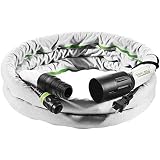
Antistatic hoses use conductive material in the hose wall, a conductive spiral, or both. When the hose is correctly connected to grounded equipment, static charge has somewhere to go instead of accumulating until you receive a sharp shock. The benefit is most noticeable with random-orbit sanders, routers, trim routers, and other tools that generate fine, dry dust.
There are two common constructions. A hose with a conductive helix may need a grounding wire or a metal fitting at each end. A hose made from conductive plastic can dissipate charge through its length, but the fittings and vacuum still need to provide a continuous electrical path. Do not assume that a black hose is antistatic; color is not a specification.
Static control is useful for comfort, dust cling, and reducing nuisance shocks. It is not a substitute for a suitable dust extractor, a grounded electrical system, or safe handling of combustible dust. Fine wood dust can burn or explode under the right conditions, so keep sparks, open flames, and improvised electrical connections out of the dust stream.
Choose the right diameter and length
For sanders and compact routers, a 27 mm or 32 mm hose is usually the practical choice. These sizes fit many power-tool dust ports and remain flexible enough for hand work. A 35 mm or 36 mm hose offers better airflow and is often a good match for shop vacuums with larger tool ports. A 38 mm hose is useful for routers and planers that have generous dust outlets, while a 50 mm hose is better suited to larger collection ports than to handheld tools.
Do not increase hose diameter without checking the tool connection. A reducer can connect different sizes, but every restriction costs airflow. Conversely, a large hose connected to a tiny sander port will not make the sander collect dust better. The port, hose, fittings, filter, and vacuum must work as a system.
Keep the hose as short as the job allows. A 6-foot hose is easier to manage around a workbench than a 12-foot hose, and it creates less drag and pressure loss. Longer lengths are worthwhile when routing large panels or using a tool across a bench, but support the hose overhead or from a boom so it does not pull on the tool.
| Use | Typical hose size | What to prioritize | Common compromise |
|---|---|---|---|
| Random-orbit sander | 27–32 mm | Flexibility and low tool drag | Less airflow than a larger hose |
| Trim router | 27–35 mm | Small, flexible hose and secure cuff | Clogs sooner with chips |
| Router table | 35–50 mm | Airflow and rigid connections | More cumbersome under the table |
| General shop-vac tools | 32–38 mm | Fitting availability and sealing | Adapters may restrict flow |
Features worth paying for
Look for a hose with a stated conductive or antistatic specification, not just “static-resistant” marketing language. A thick, crush-resistant wall matters when the hose gets dragged around a bench, but excessive stiffness makes sanding uncomfortable. A good hose should bend without kinking and recover its shape after being flattened.
The end fittings deserve as much attention as the hose. A swivel cuff prevents the hose from twisting the sander, while stepped rubber adapters fit several tool ports. For a permanent setup, a threaded or locking connection is less likely to pull loose than a loose friction fit. If the hose uses a separate grounding wire, the wire must remain attached after the hose is cut or an adapter is installed.
For most handheld tools, a 27–32 mm antistatic extractor hose is the sensible starting point. If your tools use larger ports, choose a 35–38 mm antistatic hose instead of relying on several reducers.
Grounding and installation
Before buying, check how your vacuum manufacturer expects antistatic accessories to be connected. Some extractors ground the hose through a metal inlet and conductive cuff. Others require a dedicated grounding lead. Use the manufacturer’s method, and never connect a wire to a random pipe, outlet ground pin, or water line.
Inspect continuity if the hose documentation provides a resistance specification. Test from the metal or conductive fitting at one end to the fitting at the other with a multimeter. A broken helix or poorly installed cuff can leave sections electrically isolated. Also inspect the hose after cutting it: trimming away a conductive spiral may remove the intended grounding path.
Seal leaks at the tool port and hose couplings. A small gap can spray dust into the air and reduce collection more than a modest difference in hose diameter. Use a proper stepped cuff or a short flexible adapter rather than wrapping layers of tape around a loose connection. Tape is acceptable as a temporary seal, but it makes routine removal and inspection difficult.
When the cheaper hose is fine
A standard flexible hose is often adequate for occasional routing, short sanding sessions, or a hobby shop that has never experienced static shocks. If the hose is only 3 to 4 feet long, the vacuum and tool are well matched, and dust collection is good, upgrading may produce little visible improvement. Spend the money on a better filter, a cyclone separator, or a tool-specific dust shroud first if those are your bigger problems.
An antistatic hose becomes easier to justify when you sand daily, work in a dry climate, use a long hose, or repeatedly feel shocks when touching the tool. Choose the smallest diameter that maintains useful airflow, the shortest length that reaches the work, and fittings that seal without force. That combination usually matters more than buying the most expensive hose on the shelf.