As an Amazon Associate I earn from qualifying purchases. This post may contain affiliate links at no extra cost to you.
A thickness planer earns its keep when a board comes out ready for finish, not merely thinner. The real decision is not how wide a machine cuts, but how clean the surface it leaves behind: a planer that tears grain, leaves knife marks, or dips the ends of every board forces hours of sanding that erase the time the machine was supposed to save. For furniture parts, cabinet doors and tabletops, the surface straight off the planer sets the quality of everything that follows, from glue joints to the final coat.
This guide is for woodworkers who mill their own lumber and want boards that need only light sanding before finishing. Every planer below was picked from its Amazon listing, using the cutterhead type, feed speed and capacity shown on the product page. The picks cover straight-knife and spiral or helical-style cutterheads, so you can weigh cut quality against upkeep before choosing.
Quick Picks
As an Amazon Associate we earn from qualifying purchases.
Product
Best for
Key spec from title
DEWALT DW735X
Smoothest finish from a straight-knife planer
13-inch, three-knife, two-speed, 15 amp
DEWALT DW734
Reliable everyday thicknessing on a budget
12.5-inch, three-knife, 15 amp
WEN PL1326
Spiral cutterhead finish at a lower outlay
13-inch, spiral cutterhead, 15 amp
JET JWP-13BT
Helical-style finish for wide boards
13-inch, helical-style cutterhead, 2 HP
How to Choose
Cutterhead Design and Cut Quality
The cutterhead decides what the surface looks like. A three-knife straight cutterhead slices the full width of the board in one pass, which leaves a very smooth surface when the knives are sharp, but a nick in one knife shows up as a raised line down the whole board. A spiral or helical-style cutterhead uses many small inserts arranged in a spiral, so each insert takes a smaller, shearing cut; this tends to leave less tearout on figured grain and lets you rotate one damaged insert instead of resharpening a full knife. On curly maple or wild-grained walnut, the insert cutterhead earns its place. For straight-grained stock, sharp straight knives do fine.
Feed Speed and Cuts Per Inch
Feed speed and cuts per inch work together to set how fine the finish feels. A slower feed gives the cutterhead more cuts over the same length of board, which leaves a smoother surface with less visible scalloping. Two-speed machines let you run a fast feed for rough dimensioning and a slow feed for the final pass, and that second, slower pass is where a finish-ready surface comes from. A single-speed planer can still produce good work, but you lose the option of slowing down for the last pass. Check the listed feed rates and the cuts-per-inch figure on the listing before deciding, because those numbers describe the finish more honestly than any headline about power.
Snipe Control and Bed Support
Snipe is the shallow dip a planer cuts at the ends of a board, and it is the most common reason a planed board needs extra work. It happens when the board tips as it enters or leaves the cutterhead, so a carriage lock, solid infeed and outfeed tables, and a rigid bed fight it better than a bare machine. Long boards make it worse, since their weight levers the ends into the cutterhead. Look for an automatic carriage lock and fold-out tables on the listing, and support long stock with a roller stand or an extra pair of hands. No benchtop planer removes snipe entirely, so expect to trim a small amount from each end on critical parts.
Dust Collection and Shop Fit
A planer throws off a large volume of chips in a short time, and without a clear path the bed clogs, the surface suffers, and the shop fills with dust. Fan-assisted chip ejection pushes chips through a hose, while a dust hood or adapter connects the planer to a collector or a shop vacuum. Check the outlet size on the listing and match it to your hose, because an adapter that does not fit becomes another purchase. Also measure the machine against your bench: a 13-inch planer with feed tables needs more depth than its footprint suggests, and at around a hundred pounds you will not want to lift it on and off a shelf between jobs.
The 4 Best Options
DEWALT DW735X
Top Pick
DEWALT DW735X
Best for: Furniture makers who want the smoothest finish a straight-knife planer can give.
The DW735X is the straight-knife planer to buy when surface quality matters and you want the option of a slow finishing feed. Its two-speed gearbox gives 96 cuts per inch for fast stock removal and 179 cuts per inch for the final pass, and that slow pass is what leaves boards needing only light sanding. The fan-assisted chip ejection keeps the bed clear during long runs, and the automatic carriage lock holds the head steady so the depth setting does not drift while you feed board after board. Extra knives and feed tables come in the box, which suits a shop that planes often.
Watch out for: Straight knives need resharpening or replacement when nicked, and a nick marks every board until the knife is changed.
DEWALT DW734
Runner-Up
DEWALT DW734
Best for: Home shops that need reliable everyday thicknessing without paying for a two-speed gearbox.
The DW734 is the workhorse pick for a shop that planes a steady stream of boards and does not need the second, slower feed speed. Its three-knife cutterhead runs at 96 cuts per inch, which leaves a clean surface on straight-grained stock, and the 12.5-inch width covers most furniture and cabinet boards without forcing a wider, heavier machine onto the bench. The single-speed design keeps the controls simple: set the depth, feed the board, and repeat. For dimensioning rough lumber down to thickness before a final pass elsewhere, it is a dependable, uncomplicated machine.
Watch out for: The single feed speed means no slow finishing pass, so figured grain may need more sanding than on a two-speed machine.
WEN PL1326
WEN PL1326
Best for: Woodworkers milling figured or mixed-grain boards who want insert-cutterhead tearout control.
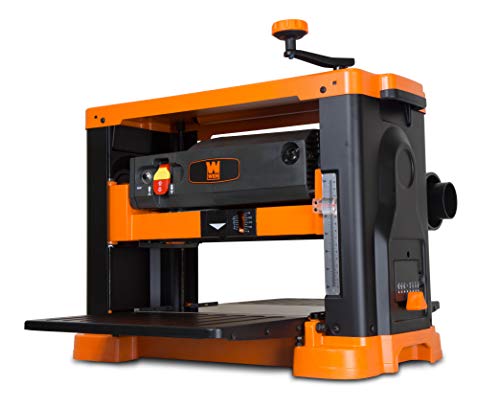
The WEN PL1326 brings a spiral cutterhead to a benchtop planer, and that cutterhead is the reason it belongs in a finish-focused list. Its 26 carbide inserts take small shearing cuts that handle grain changes with less tearout than straight knives, and a damaged insert can be rotated or replaced on its own instead of sending a full knife out for sharpening. The 13-inch width matches the larger DeWalt, and the cutterhead spins at 10,000 RPM, which keeps the cut consistent across the board. For a shop that planes figured stock and wants insert-cutterhead convenience, this is the value route in.
Watch out for: Check the insert seating and table flatness on arrival, and confirm replacement inserts are easy to order before you need them.
JET JWP-13BT
JET JWP-13BT
Best for: Cabinet shops that want helical-style finish quality with two feed speeds on wide boards.
Cabinet shops that want helical-style finish quality with two feed speeds on wide boards.
Watch out for
Confirm the cutterhead is the helical-style version when ordering, since JET sells straight-knife variants of this model family through other channels.
The JET JWP-13BT is the helical-style option for a shop that planes wide boards and wants two feed speeds without moving up to a floor-standing machine. Its 26 inserts sit in a helical-style cutterhead, and the two feed rates of 18 and 26 feet per minute let you take a fast pass for dimensioning and a slow pass for a finer surface. The 2 HP motor drives the 13-inch width without bogging down on deeper cuts in hardwoods, and the 120-volt supply means it runs from a standard shop circuit. It is the heaviest-duty benchtop pick in this list, aimed at steady, repeated use.
Watch out for: Confirm the cutterhead is the helical-style version when ordering, since JET sells straight-knife variants of this model family through other channels.
Planer Safety Before the First Pass
A thickness planer demands respect every time it runs. Keep hands well clear of the infeed opening and never reach into the machine while the cutterhead is turning; use a push stick or a scrap board to feed short pieces, and do not plane stock shorter than the minimum length on the listing, since short boards can kick back or tip into the cutterhead. Wear eye and hearing protection, tie back loose clothing and hair, and check each board for nails, screws, staples and embedded grit before feeding it in, because metal in the board damages knives and can throw fragments. Disconnect the power before changing knives or clearing a jam, and never clear a clogged chip chute with your hands while the machine is plugged in.
Which One Fits Your Situation
Furniture Maker Chasing a Glue-Ready Surface
Choose the DEWALT DW735X. The slow 179-cuts-per-inch feed leaves a surface that needs only light sanding before glue-up, and the automatic carriage lock keeps the thickness consistent across every part in a set. When panels must match and joints must close without gaps, that consistency matters more than raw width or power.
Small Shop Working on a Tighter Budget
Choose the DEWALT DW734. It covers the common 12.5-inch width, planes straight-grained stock cleanly, and skips the two-speed gearbox you may not use. Spend the saving on sharp spare knives and a dust hose, and the machine will handle daily thicknessing without complaint, leaving the budget for lumber instead of features.
Shop Milling Figured or Tricky Grain
Choose the WEN PL1326 or the JET JWP-13BT. Both use insert cutterheads that shear the grain in small bites, which limits tearout on curly or reversing grain. Pick the WEN for lighter use and lower outlay, or the JET when you also want two feed speeds and a stronger motor for wide hardwood boards.
Cabinet Shop Running Wide Boards All Day
Choose the JET JWP-13BT. The 13-inch width, 2 HP motor and two feed speeds suit repeated passes on cabinet stock, and the helical-style cutterhead keeps the surface consistent from the first board to the last. Pair it with proper dust collection, since a full day of planing fills a collector fast.
Common Mistakes
Feeding boards with hidden nails or staples, which nick knives and spoil the finish on every board that follows.
Taking too deep a cut in one pass, which strains the motor, increases tearout, and leaves a rougher surface than several light passes.
Skipping the slow finishing feed on a two-speed planer, then blaming the machine for a surface the fast feed was never meant to leave.
Planing boards shorter than the safe minimum length, which risks kickback and uneven thickness at the ends.
Ignoring dust collection until chips pack the bed and the planer starts leaving marks on the surface it just cut.
Frequently Asked Questions
Can a benchtop planer really leave a finish-ready surface?
Yes, with the right setup and a light final pass. A sharp cutterhead, a slow feed, and shallow cuts leave a surface that needs only light sanding before finishing. Boards with wild grain may still need a card scraper or extra sanding, but straight-grained stock often comes off the planer ready for a finish coat after a quick once-over.
Do I need a helical-style cutterhead for good results?
No, but it helps on difficult grain. Sharp straight knives leave an excellent surface on straight-grained wood, and many furniture makers work happily with them. A helical-style or spiral cutterhead earns its keep on figured grain, where it reduces tearout, and it saves time because you rotate single inserts instead of resharpening full knives.
How do I reduce snipe on a benchtop planer?
Support the board level with the bed as it enters and leaves, keep the feed tables unfolded, and lock the carriage if your planer has that feature. Feed boards end to end on long runs so each board supports the next, and take a light final pass. Even with good technique, expect to trim a small amount from each end on parts where the finish must be perfect.
How often should planer knives be changed?
Change straight knives when they leave lines, ridges, or a dull, fuzzy surface, or when you feel the motor working harder than usual on a light cut. Insert cutterheads last longer between changes because you rotate only the damaged inserts. Keep a spare set of knives or inserts on hand so a nick does not stop a project mid-run.
J
JD's Woodworks Editorial Team
We compare specs, warranty terms, long-term owner feedback and street pricing before anything earns a spot. Rankings are never paid.
Affiliate disclosure. As an Amazon Associate we earn from qualifying purchases at no extra cost to you. Prices accurate as of the date shown.
Table saws under the 1500 mark compared: the Grizzly G0771Z and Shop Fox W1837 hybrid saws with cast iron tables, 2 HP motors and T-square fences, specs from their listings.
Table saws for fine woodworking compared: the SawStop Professional Cabinet Saw and Powermatic PM1000, judged on fence precision, table flatness and vibration from listing specs.
Table saw combos explained: saws sold with a stand and accessories in one listing, what to check in the box, and which bundle fits your shop or jobsite.
Compare the best planer digital thickness gauges and digital readout kits for portable planers, with fit, resolution and mounting checks before you buy.
Model table saws for scale modelling and hobby work compared: the precision Proxxon FET 37070 and the compact Saker mini table saw, with specs taken from their Amazon listings.
Three CoreXY 3D printers for product development, each with the architecture stated on its listing: an enclosed multicolor machine, a large-format enclosed model and a heated-chamber model.


 JET JWP-13BT









