3 Best Benchtop CNC Routers for Furniture (November 2026)
Larger benchtop CNC routers chosen for furniture work: a 600 x 500 mm machine for panels, a ball-screw model for joinery parts and a 710W trimmer model for hardwood.
As an Amazon Associate I earn from qualifying purchases. This post may contain affiliate links at no extra cost to you.
Furniture work makes a specific set of demands on a benchtop CNC router. The parts are bigger than sign blanks and electronics enclosures: drawer fronts, cabinet panels, chair components, templates and joinery aids that need a work area measured in hundreds of millimeters and a frame that stays rigid in hardwood. Small 3018-class machines are the wrong tool for this, so this guide deliberately starts a size class up.
The three routers below were chosen for furniture makers rather than general hobbyists. Each listing states a work area of roughly 400 mm or more in at least one axis, a spindle or trimmer with the power for hardwood, and a frame design aimed at rigidity. Specs come from the Amazon listings. This roundup also keeps a clean line from this site’s smaller desktop CNC coverage: the pool here is larger-format machines only, with no model repeated from the entry-level desktop class.
Quick Picks
As an Amazon Associate we earn from qualifying purchases.
710W trimmer, linear rail drive, 410 x 405 x 77 mm
How to Choose
Size the work area to furniture parts, not to projects in general
A furniture maker should measure the largest recurring part: a drawer front, a cabinet side, a chair seat blank. The 600 x 500 mm class handles most casework components in one setup, while the 400 mm class suits joinery parts, templates and smaller components, with panel work done in tiles or on a bigger machine. Remember that clamps and fixtures consume the edges of the work area, so the usable cutting field is smaller than the listed travel. Buy for the parts you make monthly, and let the rare oversized piece go to a track saw or a commercial shop.
Judge the frame and drive by hardwood behavior
Hardwood exposes weak frames. Look at what the listing states about drive and structure: ball screws resist backlash better than basic lead screws, linear rails keep the gantry tracking straight under side load, and closed-loop steppers correct missed steps instead of silently ruining a part. All-metal frames and dual-rail Y axes matter when a bit is plowing through oak or maple at furniture feed rates. A machine can list an impressive spindle and still disappoint if the frame flexes, so weigh the motion system as heavily as the motor.
Match the spindle or trimmer to your cutters
Furniture routing uses larger bits than engraving: panel bits, surfacing cutters and joinery profiles. A 300W or 400W DC spindle handles them at conservative feeds, while a 710W trimmer router brings the torque and the collet ecosystem of a handheld router, including the bits already in a woodworker’s drawer. Check the collet size on the listing against your bit shanks before ordering. If your work is mostly carving and detail, spindle smoothness matters more; if it is sizing and surfacing hardwood parts, trimmer power earns its noise.
Plan dust collection and workholding from day one
Furniture parts generate serious chips, and a benchtop router without extraction buries its own rails in dust while filling the shop air. Confirm the machine accepts a dust shoe or boot, and leave budget for it if it is sold separately. Workholding deserves the same forethought: hybrid and T-track tables take clamps and spoilboards in flexible arrangements, which matters when parts are wide, thin or oddly shaped. The listing’s table description tells you which clamping style the machine was designed around, so read it before the first panel warps under a bad hold-down.
The 3 Best Options
Genmitsu PROVerXL 6050 Plus
Top Pick
Genmitsu PROVerXL 6050 Plus
Best for: Cabinet panels, drawer fronts and casework components in one setup
Work area: 600 x 500 x 115 mm (23.62 x 19.69 x 4.53 in)
The 6050 Plus is the panel machine of this group. Its listing states a 600 x 500 x 115 mm work area, the largest here, with a hybrid table for flexible clamping and a 300W spindle under GRBL control. Dual HG-15 linear rails and an all-metal frame with NEMA 23 motors address the rigidity furniture work demands, and the core system arrives pre-assembled, which shortens the path to a first cut. For a furniture maker whose recurring work is cabinet components, drawer fronts and casework panels, this is the machine sized to the job.
FoxAlien XE-PRO
Runner-Up
FoxAlien XE-PRO
Best for: Repeated joinery parts and hardware recesses that must match across a batch
The XE-PRO is the accuracy pick. Its listing states 1204 ball screws on its axes, four closed-loop NEMA 23 stepper motors and a 400W spindle, with a maximum moving speed of 5000 mm/min. Ball screws and closed-loop control are the combination that keeps joinery parts dimensionally honest across a batch, which is what a furniture maker cutting repeated tenons, mortise pockets or hardware recesses actually needs. The design also allows upgrading to linear rails later. Choose it when repeatability across many identical furniture parts matters more than the largest possible work area.
Genmitsu 4040-PRO MAX
Genmitsu 4040-PRO MAX
Best for: Hardwood parts, surfacing and joinery work using standard router bits
Hardwood parts, surfacing and joinery work using standard router bits
Watch out for
This MAX model is a different machine from the standard 4040-PRO, and several bundle ASINs circulate, so confirm the listing is the standalone MAX with the 710W trimmer
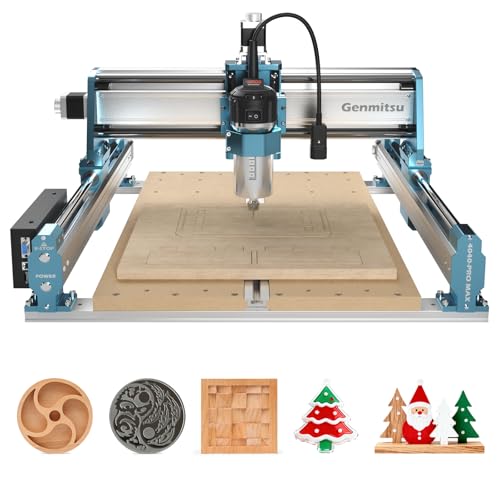
The 4040-PRO MAX brings a real trimmer to the benchtop class. Its listing states a 710W trimmer router as the spindle, linear rail drive and a 410 x 405 x 77 mm work area under GRBL control. That trimmer is the story for furniture work: it turns the bits a woodworker already owns, surfaces hardwood with authority, and keeps cutting when a small DC spindle would be working at its limit. The work area suits joinery components, small panels, templates and carved furniture details. Pick it when cutting power in hardwood outranks maximum panel size.
Which One Fits Your Situation
You build cabinets and casework
Choose the Genmitsu PROVerXL 6050 Plus. Panels and drawer fronts fit its 600 x 500 mm area in a single setup, and the hybrid table supports the clamping arrangements casework needs. It is the only machine here sized for casework components as the main job rather than the occasional job.
You cut joinery and hardware recesses in batches
Choose the FoxAlien XE-PRO. Ball screws and closed-loop motors protect the one thing batch joinery cannot lose, which is repeatability from the first part to the twentieth. Size your expectations to components and parts rather than full panels.
You surface and shape hardwood components
Choose the Genmitsu 4040-PRO MAX. The 710W trimmer gives it the cutting authority hardwood demands, and it uses the router bits already in a furniture shop. Its 410 mm class area covers components, templates and detail work comfortably.
You are upgrading from a 3018-class machine
Any of the three is a genuine step up, so choose by the work that frustrated you. Outgrown panels point to the 6050 Plus, lost steps and backlash point to the XE-PRO, and an underpowered spindle in hardwood points to the 4040-PRO MAX. Do not buy a second small machine and expect furniture results.
Common Mistakes
Buying a 3018-class desktop router for furniture parts and discovering the work area before the first cabinet.
Comparing spindle wattage while ignoring frame rigidity, then watching hardwood cuts chatter.
Forgetting that clamps and fixtures shrink the usable work area well below the listed travel.
Skipping dust extraction on a machine that will spend its life cutting hardwood panels.
Ordering a bundle variant with accessories you did not price, or the wrong voltage variant of an imported model.
Frequently Asked Questions
Can a benchtop CNC actually make furniture, or only parts?
Realistically, parts and components. These machines cut panels, drawer fronts, joinery elements, templates and carved details, which is most of the machining in a furniture build, but assembly, edge work and finishing remain bench work. A furniture maker who treats the CNC as a precise parts machine, rather than a furniture factory, will be happy with any router in this guide.
Is the 600 x 500 mm machine worth it over the 400 mm class?
If casework panels are regular work, yes. A panel that fits in one setup avoids tiling, repositioning errors and doubled setup time. If your parts are mostly joinery components, templates and small panels, the 400 mm class covers them and leaves budget for tooling and dust extraction. Let the largest recurring part, not the largest imaginable one, make this decision.
Ball screws or linear rails: which matters more?
They solve different problems. Ball screws control backlash and positioning accuracy along the drive, which is why the XE-PRO suits batch joinery. Linear rails control how straight and rigid the moving axis stays under load, which is why the other two machines emphasize them for hardwood cutting. For furniture work, having at least one of the two stated on the listing is the minimum; the strongest setups combine both.
What else should I budget for beyond the machine?
Dust extraction or at least a dust shoe, a spoilboard setup, clamps that fit the table system, and cutters matched to your materials. Furniture work also consumes bits faster than engraving, so a small stock of quality router bits in the collet size your machine uses belongs in the first order. None of that appears in the machine listings, and all of it decides how the first month goes.
J
JD's Woodworks Editorial Team
We compare specs, warranty terms, long-term owner feedback and street pricing before anything earns a spot. Rankings are never paid.
Affiliate disclosure. As an Amazon Associate we earn from qualifying purchases at no extra cost to you. Prices accurate as of the date shown.
Table saws under the 1500 mark compared: the Grizzly G0771Z and Shop Fox W1837 hybrid saws with cast iron tables, 2 HP motors and T-square fences, specs from their listings.
Table saws for fine woodworking compared: the SawStop Professional Cabinet Saw and Powermatic PM1000, judged on fence precision, table flatness and vibration from listing specs.
Table saw combos explained: saws sold with a stand and accessories in one listing, what to check in the box, and which bundle fits your shop or jobsite.
Compare the best planer digital thickness gauges and digital readout kits for portable planers, with fit, resolution and mounting checks before you buy.
Model table saws for scale modelling and hobby work compared: the precision Proxxon FET 37070 and the compact Saker mini table saw, with specs taken from their Amazon listings.
Three CoreXY 3D printers for product development, each with the architecture stated on its listing: an enclosed multicolor machine, a large-format enclosed model and a heated-chamber model.