What's inside
As an Amazon Associate I earn from qualifying purchases. This post may contain affiliate links at no extra cost to you.
The short answer
For a small woodshop with a typical 1- to 2-horsepower dust collector, a cartridge filter is usually the better upgrade if you work indoors, make fine dust, or want to return filtered air to the shop. Its larger surface area and finer filtration can improve airflow and reduce airborne dust—provided the collector’s fan, ductwork, and filter are properly matched.
A bag filter can be the sensible choice if you mostly collect chips and coarse dust, work in a detached shop where air is exhausted outdoors, or need to keep costs down. Neither filter can compensate for undersized ductwork, a clogged impeller, or a machine connection that leaks.
As an Amazon Associate we earn from qualifying purchases at no extra cost to you.


What the two filters do
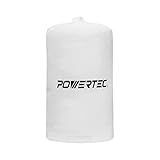
A bag collector generally uses a fabric upper bag to trap dust while the lower bag collects it. The fabric’s weave determines how much fine dust escapes; an inexpensive, coarse-woven bag can visibly puff dust into the room. A finer felt bag may improve this, but it can also restrict airflow, especially as dust loads the fabric.
A cartridge filter uses pleated media packed into a compact cylinder. Pleats provide substantial filtering area without requiring a large bag. Many cartridge filters are rated to capture particles around 1 micron, but check the actual rating and test standard: “1 micron” is not a guarantee that all fine particles are captured, nor does it describe the performance of the entire collector system.
Both types need cleaning and a correctly fitted collection container. Fine dust that escapes at a poorly sealed drum or filter connection defeats the benefit of better filter media.
Bag filter vs. cartridge filter
| Factor | Bag filter | Cartridge filter |
|---|---|---|
| Typical cost | Lower, particularly for basic fabric bags | Higher; confirm the replacement filter price before buying |
| Fine-dust control | Depends heavily on fabric; coarse bags can release visible dust | Often better with fine-rated media and good seals |
| Airflow as it loads | Can drop as dust cakes the fabric | Can also drop as pleats clog; more surface area may help, but does not prevent clogging |
| Cleaning | Usually shaken or brushed; dust can spill during handling | Often cleaned with a paddle or compressed air, depending on design |
| Best fit | Coarse chips, budget setups, or outdoor exhaust | Indoor shops that need better fine-dust filtration |
Choose for your shop, not just the filter
Think about the dust you make and where the collector exhaust goes. A planer or jointer produces plenty of chips, while sanding and many handheld tools produce finer dust that is easier to breathe and harder to capture with a coarse bag. If you run a sander regularly in an attached garage or basement, a fine-rated cartridge is generally the more appropriate filter choice. Pair it with a well-sealed collector and suitable source capture; a filter is not a substitute for a hood close to the cutting or sanding point.
For a low-cost setup used mainly for planing and occasional sawing, a sound bag filter may be adequate, particularly if the collector exhausts outdoors and the shop is not occupied during cleanup. Keep the exhaust away from doors and windows, and avoid sending dust toward neighboring properties. If the bag sheds dust, leaks, or is damaged, replace it rather than accepting a cloud as normal operation. A fine-filter replacement bag for a dust collector can be a cheaper improvement than changing the whole collector.
For a cartridge upgrade, match the filter to the collector’s mounting diameter, height, and airflow needs. Some cartridges need an adapter or a different cleaning system. Check whether your existing unit has enough clearance above it and whether the filter can be removed without dismantling ductwork. A fine-rated dust-collector cartridge filter is worth considering when fine dust is a recurring problem, but verify the dimensions and compatibility before ordering.
Airflow matters as much as media
Do not choose by horsepower alone. A collector advertised at 1,200 cubic feet per minute may deliver much less at a tool once hose length, elbows, narrow fittings, and the filter’s resistance are included. A 4-inch branch line is commonly used for many small-shop machines, while a 2-1/2-inch hose is typical for portable tools, but the right layout depends on the tool and collector. Long runs of small hose, abrupt bends, and open blast gates can reduce capture.
A cartridge with a large filtering area can help maintain airflow as dust accumulates, but it cannot make an undersized fan perform like a larger one. If suction has fallen, first check for a full drum, clogged filter, blocked hose, closed blast gate, or packed impeller. A sudden loss of airflow after fitting a new cartridge may point to a compatibility problem or a poorly designed adapter—not necessarily a defective filter.
Maintenance and safety
Clean the filter when airflow noticeably drops, not only when the outside looks dirty. Use the cleaning method the manufacturer specifies. Compressed air can damage media or drive dust deeper into pleats if used too close or at excessive pressure. Clean outdoors when practical, wear a properly fitted respirator, and keep ignition sources away from collected dust. Fine wood dust is a respiratory hazard and combustible; never use a shop vacuum or dust collector to pick up hot embers.
Check the lower bag or drum seal whenever you empty it. A leak can send dust straight back into the room, and an overfilled container can let debris reach the filter or obstruct airflow. If filter cleaning repeatedly produces a large dust cloud, improve the handling setup or choose a design that contains dust more effectively.
A practical buying decision
Buy a cartridge filter if you sand often, work in an occupied indoor space, and can confirm that the filter fits your collector and its airflow. Buy a better-quality bag—or keep the existing bag—if your work is mostly chip-heavy, your budget is tight, and your setup does not return dusty exhaust to the shop. In either case, inspect seals, keep duct runs sensible, and capture dust at the tool. Those details often matter more than swapping one filter style for another.