
What's inside
As an Amazon Associate I earn from qualifying purchases. This post may contain affiliate links at no extra cost to you.
The best 12-inch surface planer for most workshops is the Makita 2012NB when low weight and controlled feed rates matter, while the DeWalt DW735X is the stronger choice for frequent stock preparation and long boards; buyers wanting lower entry cost should compare the WEN PL1252 and Craftsman CMEW320.
One important clarification: “12-inch surface planer” is usually a category rather than an exact cutting width. The Makita 2012NB accepts boards up to 12 inches wide, while several competing machines marketed as 12-inch planers have a 12.5-inch maximum capacity. That extra half-inch is useful for rough-sawn boards, but it does not automatically mean better performance.
As an Amazon Associate we earn from qualifying purchases at no extra cost to you.

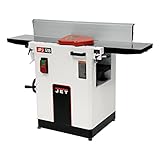
Quick comparison of leading portable planers
| Model | Actual maximum width | Cutting system | Feed rates | Approx. weight | Best fit |
|---|---|---|---|---|---|
| Makita 2012NB | 12 in / 305 mm | Two straight knives | 6.7 m/min and 8.5 m/min | 61.5 lb / 27.9 kg | Portable shops and quieter, controlled work |
| DeWalt DW735X | 13 in / 330 mm | Three straight knives | 4.3 m/min and 8.5 m/min | 92 lb / 41.7 kg | Frequent use and faster finishing |
| WEN PL1252 | 12.5 in / 318 mm | Two straight knives | 7.9 m/min | About 66 lb / 30 kg | Budget-conscious occasional use |
| Craftsman CMEW320 | 12.5 in / 318 mm | Two straight knives | Approx. 7.9 m/min | About 65 lb / 29.5 kg | General home workshop work |
| Metabo HPT P13F | 12.5 in / 318 mm | Two straight knives | Single feed rate | About 77 lb / 35 kg | Value-oriented users needing wider capacity |
Published weights and dimensions can vary slightly by revision and included accessories. Treat the table as a buying comparison, then verify the manual for the exact version available in your market.
Best choices by workshop situation
- For the smallest shop: Choose the Makita 2012NB. Its roughly 62-pound body is substantially easier to lift onto a bench or store on a shelf than the heavier DeWalt.
- For frequent furniture making: Choose the DeWalt DW735X. Its three-knife head, two feed rates, sturdy infeed and outfeed support, and wide 13-inch opening make it more capable with repeated batches.
- For the lowest sensible purchase cost: Consider the WEN PL1252 or Craftsman CMEW320. Their 12.5-inch capacity handles common rough boards, but their straight knives and lighter-duty construction require more attention to feed direction and cut depth.
- For boards that regularly exceed 12 inches: A portable planer is the wrong category. Move to a 15-inch stationary planer, or use a router sled or wide-belt service instead of trying to force oversized stock through a 12-inch machine.
- For occasional renovation or DIY work: A budget 12.5-inch planer can be adequate if you accept slower preparation, more frequent knife changes, and less refined chip control.
Head-to-head: what separates these planers?
Actual width capacity
Capacity should be measured at the cutter opening, not inferred from the product name. A nominal 12-inch planer may accept exactly 12 inches, while a “12-inch” competitor may accept 12.5 inches. That difference can save a ripping operation when a board is 12 1/4 inches wide, but it does not compensate for badly cupped stock. A thickness planer makes both faces parallel; it does not reliably flatten a severely bowed or twisted board.
The DeWalt DW735X is technically a 13-inch planer, giving it the greatest allowance in this group. That additional clearance is useful when jointing a wide panel by other means and then bringing it to final thickness.
Straight knives versus cutterhead upgrades
All of the models above are commonly sold with conventional straight knives. They are inexpensive to replace and can produce a clean finish when sharp, but a nick in one knife creates a visible line across every board. Knife replacement also requires careful alignment.
Helical and spiral cutterheads use many small carbide inserts. They generally reduce tear-out on figured or reversing grain, and a damaged insert can be rotated or replaced individually. They cost more initially and are not a universal drop-in upgrade. Check compatibility with the exact planer, motor shaft, cutterhead height, and chipbreaker before ordering.
The DeWalt’s three-knife head spreads the cut across more edges than a two-knife design, which can improve finish consistency and extend the interval between changes. It is still a straight-knife system, not a true helical head.
Feed-rate performance
Feed rate determines the balance between finish quality and productivity. Slower feed produces more cuts per inch and is usually preferable for visible furniture parts or difficult grain. Faster feed is useful when removing modest amounts from long, straight-grained boards.
The Makita provides two feed rates, allowing a practical choice between finish and throughput. The DeWalt also offers two speeds and has the greatest motor-and-frame presence here, but its approximately 92-pound weight makes it less convenient to reposition. Single-speed budget models can work well, but they give you fewer ways to respond to tear-out.
Dust extraction is not optional
A portable planer creates large volumes of chips quickly. The included chip ejection is useful for a short job, but a dust extractor or high-capacity shop vacuum is preferable indoors. Connect the correct adapter, keep the hose short where possible, and avoid reducing the outlet to a restrictive fitting.
As a practical starting point, use a dust collector capable of roughly 400 CFM or more at the machine for comfortable chip handling. A small shop vacuum may capture fine dust but still clog when taking deep cuts in wide stock. If chips begin backing up around the cutterhead, stop rather than continuing; packed chips can mark the board, increase heat, and strain the motor.
Setup procedure that improves accuracy
- Support the machine. Place it on a rigid stand, not a lightweight folding table. Infeed and outfeed extensions must be level with the bed to prevent snipe.
- Inspect the board. Remove nails, staples, loose bark, and grit. Mark the grain direction and feed the board so the knives cut with the grain when possible.
- Take a shallow first pass. Start around 1/16 inch or less, particularly with wide, hard, or figured stock. Deep cuts increase tear-out and overload the feed rollers.
- Use consistent reference faces. Flatten one face first with a jointer, sled, or other reliable method. Then plane the opposite face until the target thickness is reached.
- Measure after the board settles. Use calipers or a reliable thickness gauge at both ends and several points across the width. Do not rely only on the planer scale.
A simple capacity calculation explains why shallow passes matter. Removing 1/16 inch from a 12-inch-wide board over 6 feet processes about 36 square feet of cut surface. A 1/8-inch pass doubles the removed volume and increases the load on the cutterhead, knives, rollers, and dust system. Multiple light passes usually produce a more predictable result than one aggressive pass.
Ownership costs and common wear points
General market pricing varies by country and sales period, but budget 12.5-inch machines commonly occupy the lower price range, the Makita sits in the midrange, and the DeWalt commands a premium for its capacity and heavier construction. Include replacement knives, dust adapters, a sturdy stand, and hearing protection in the ownership budget.
Knives are usually the first consumable. Replace or rotate them when edges become dull, boards require excessive force, or repeating lines appear across the surface. Feed rollers can accumulate resin and dust, causing slipping or uneven advancement. Clean them with an appropriate non-oily cleaner and keep the bed waxed or otherwise maintained according to the manual. Avoid spraying lubricant where it can contaminate rollers.
Do not use a planer to correct major twist, and do not feed short pieces below the manufacturer’s minimum length. Never reach into the throat while the cutterhead is moving. Disconnect power before clearing a jam or changing knives.
Bottom line
Choose the Makita 2012NB when portability, two-speed control, and a compact footprint matter most. Choose the DeWalt DW735X when you prepare stock regularly and can dedicate space to a heavy machine. Choose a WEN PL1252, Craftsman CMEW320, or Metabo HPT P13F when a 12.5-inch opening and lower general market cost outweigh premium cutterhead and feed-control features. For the cleanest finish on difficult grain, budget for a compatible carbide cutterhead upgrade rather than assuming every machine marketed as a 12 surface planer includes one.