4 Best 2000 Watt Inverter Generators (November 2026)
Compare four 2000-watt inverter generators for camping, RV trips, and home backup — quiet, portable models with the starting watts and runtime that matter.
Compare four 2000-watt inverter generators for camping, RV trips, and home backup — quiet, portable models with the starting watts and runtime that matter.
As an Amazon Associate I earn from qualifying purchases. This post may contain affiliate links at no extra cost to you.
A 2000-watt inverter generator sits in a useful middle ground: strong enough to run a fridge, charge tool batteries, or keep campsite lights and a small fan going, yet light enough for one person to carry from truck to tent. The real decision is not whether 2000 starting watts is enough in the abstract, but whether the running watts, tank size, and noise level fit how you will actually use it. A generator perfect for weekend camping can fall short as home backup, and one built for quiet campsites may lack the outlets an RV owner needs.
This guide is for campers, RV owners, tailgaters, and homeowners who want portable backup power without a heavy open-frame unit. It also suits woodworkers and DIYers who need clean power for battery chargers and small tools at a remote job site. The four generators below were chosen from names and specifications on their Amazon product pages, spanning a range of weights, runtimes, and outlet layouts.
Quick Picks
As an Amazon Associate we earn from qualifying purchases
Product
Best for
Key spec
WEN 56200i
Camping trips on a tight gear budget
2000 starting watts, 1600 running watts
Champion Power Equipment 100692
Carrying by hand over uneven ground
39 pounds, 2000 starting watts
GENMAX GM2000i
The lightest carry in this group
34 pounds, 2000 starting watts
A-iPower SUA2000iV
RV use with a 30-amp style hookup
2000 starting watts, low idle mode
How to Choose
Match running watts to your real load
Starting watts get the headline, but running watts decide what you can power for hours at a time. A 2000-watt inverter generator typically delivers 1600 to 1700 running watts, which covers a modern fridge, a laptop, phone chargers, LED lights, and a small fan together. Add up the running watts of everything you plan to run at once, then leave a margin for a motor starting up, such as a fridge compressor or a small air conditioner fan. If your total sits near the running-watts limit, step up to a larger class or plan to run loads in turns rather than all together.
Weigh noise against where you will run it
Inverter generators are far quieter than open-frame models, but the spread between models still matters at a campsite or in a quiet neighborhood. Manufacturers usually quote noise at one-quarter load from a set distance, so compare figures measured the same way and be wary of a single number quoted without a load or distance. A unit rated near 52 to 53 dBA at light load is easy to talk over at a few paces, while a louder unit can draw complaints at a campground with quiet hours. If you camp in organized sites, treat noise as a primary filter rather than a tiebreaker.
Check runtime and tank size together
Runtime claims only mean something next to the load they were measured at. A generator that runs eleven hours at one-quarter load may run under four hours at full load, so read the fine print before assuming it will last the night. Tank size matters just as much: a one-gallon tank needs refilling more often than a larger one, and refilling a hot generator in the dark is a chore worth avoiding. For overnight use, favor the combination of a larger tank and an economy mode that throttles the engine down when demand drops.
Look at outlets and parallel capability
Count the outlets and match them to your gear before you buy. Two standard 120-volt household outlets cover most camping setups, while a 30-amp RV-style outlet or a 12-volt DC outlet adds real convenience for trailers and battery charging. USB ports are handy for phones but no substitute for a proper AC outlet. Parallel capability is worth having if you might ever need more power: two matching 2000-watt units linked with a parallel kit roughly double your capacity without forcing you to buy and store a much larger generator now.
The 4 Best Options
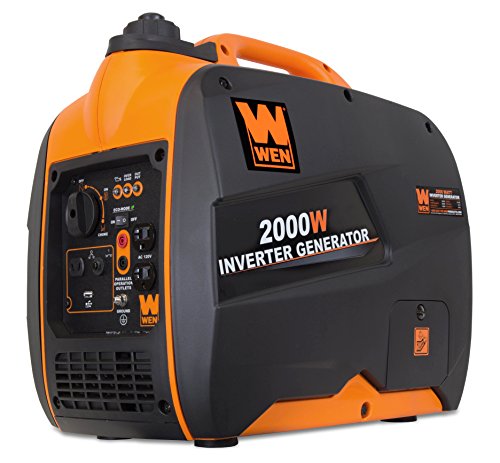
WEN 56200i 2000-Watt Portable Inverter Generator
Top Pick
WEN 56200i 2000-Watt Portable Inverter Generator
Best for: Campers and homeowners who want a capable 2000-watt inverter generator without paying for a premium badge.
Campers and homeowners who want a capable 2000-watt inverter generator without paying for a premium badge.
Watch out for
The listing shows a 240-volt figure in its voltage field, which does not match the usual 120-volt household outlets on this class of unit, so confirm the outlet layout on the product page before ordering.
The WEN 56200i is the straightforward value pick in this class, a compact gasoline inverter generator with 2000 starting watts and 1600 running watts. Its 79.7 cc four-stroke engine and one-gallon tank keep the package simple, and the unit is CARB compliant, which matters if you live in or travel through a state with stricter emissions rules. Four total power outlets give you room for a couple of devices at once, and the two-year warranty with a 90-day commercial term is solid for a generator at this end of the range.
Watch out for: The listing shows a 240-volt figure in its voltage field, which does not match the usual 120-volt household outlets on this class of unit, so confirm the outlet layout on the product page before ordering.
Champion Power Equipment 100692 2000-Watt Ultralight Portable Inverter Generator
Runner-Up
Champion Power Equipment 100692 2000-Watt Ultralight Portable Inverter Generator
Best for: Anyone who carries the generator by hand and values light weight above all else.
The Champion 100692 earns its place on weight alone: at 39 pounds it is one of the lightest 2000-watt inverter generators you can carry, and that difference shows the moment you lift it in and out of a vehicle or haul it across a campsite. It delivers 2000 starting watts and 1700 running watts, the highest running output in this roundup, with a quoted noise level of 53 dBA from 23 feet and up to 11.5 hours of runtime. The box includes a USB adapter, engine oil, an oil funnel, and battery charging cables, so you can get running without a separate shopping trip.
Watch out for: The long runtime figure applies at a light load, so expect noticeably shorter runtimes when you run the generator near its full rated output.
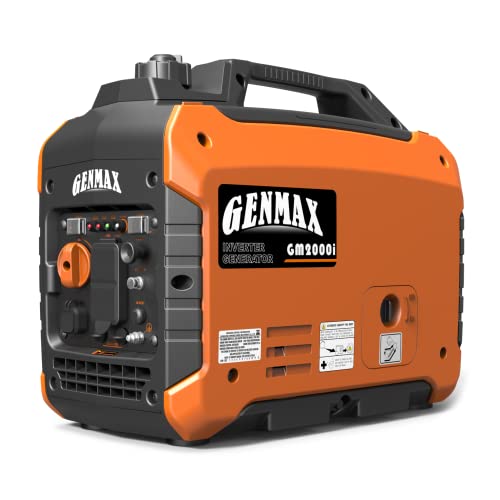
The GENMAX GM2000i is the featherweight of this group at just 34 pounds, the easiest unit here to lift into a truck bed or carry across a campsite. It delivers 2000 starting watts and 1600 running watts from a 79.7 cc four-stroke overhead-valve engine, with clean power under 3 percent total harmonic distortion for phones, laptops, and other sensitive electronics. Eco mode stretches a one-gallon tank to a claimed 8 hours at half load, and a CO detect shutdown sensor stops the engine if carbon monoxide builds up nearby. Low oil and overload alarms, plus parallel capability, round out a panel built for worry-free weekends.
Watch out for: The 60 dBA noise figure is the highest stated figure in this roundup, so it is not the best pick for campsites with strict quiet hours.
RV owners and tailgaters who want a mid-weight unit with engine protection and steady half-load runtime.
Watch out for
Published noise figures for this model vary between sources, so treat the decibel rating as approximate and check the current listing before deciding on noise grounds alone.
The A-iPower SUA2000iV is a practical all-rounder with 2000 starting watts and 1600 running watts from an 80 cc overhead-valve four-stroke engine. Its low idle technology stretches fuel by slowing the engine when demand is low, giving up to 7 hours at half load and 4 hours at full load from a 1.1-gallon tank. A low oil alert light and automatic shutdown protect the engine if oil runs low, and the 52-decibel noise figure keeps it comfortable around a campsite. At 46 pounds it sits between the featherweight Champion and the heavier WEN in this group.
Watch out for: Published noise figures for this model vary between sources, so treat the decibel rating as approximate and check the current listing before deciding on noise grounds alone.
Which One Fits Your Situation
Weekend camping with a small tent setup
For a tent, lights, and phone charging, the WEN 56200i covers the load with 1600 running watts. Its four outlets take a light string and a charger at once, and the one-gallon tank is easy to top up on the way in. If your campsite has quiet hours, choose the A-iPower SUA2000iV instead: its noise figure is the lowest here at 52 decibels, and its low idle mode keeps the engine from racing when demand is low.
RV trips and tailgating
RV owners should look first at the A-iPower SUA2000iV, which pairs 2000 starting watts with low idle operation and engine protection for long days away from hookups. The Champion 100692 is the better choice if you move the generator in and out of a storage bay alone, because at 39 pounds it is the easiest unit here to lift and carry. Either way, check whether your RV needs a 30-amp style outlet or an adapter before you buy.
Home backup during a short outage
For keeping a fridge, a few lights, and phones running through an outage, the Champion 100692 gives you the most running watts at 1700, leaving more headroom for a fridge compressor cycling on. The A-iPower SUA2000iV is the pick if the generator will sit near a bedroom window or a neighbor’s fence, since quiet operation matters more than a small wattage edge when it runs for hours. Plan your fuel and extension cords before the storm, not during it.
Remote work sites and tool charging
Woodworkers and DIYers running battery chargers, a small fan, and lights at a site without power should favor the GENMAX GM2000i for its light weight and CO detect shutdown, or the WEN 56200i if the budget is tighter. The Champion 100692 works well because it is light and easy to move between truck and work area. Avoid running a saw or dust collector on any 2000-watt unit; those tools belong on a bigger generator or shop power.
Common Mistakes
Buying on starting watts alone and then overloading the generator once the running watts are exceeded for more than a brief surge.
Comparing runtime figures measured at different loads, which makes a short-tank generator look like it lasts all night.
Running a generator indoors, in a garage, or too close to windows, where exhaust can build up to dangerous levels.
Skipping the break-in and first oil change, which shortens engine life on a brand-new unit.
Forgetting that a parallel kit, an RV adapter, or a transfer switch is a separate purchase and not included in the box.
Frequently Asked Questions
How many running watts does a 2000-watt inverter generator actually deliver?
Most 2000-watt inverter generators deliver 1600 to 1700 running watts, with 2000 watts available only as a starting surge for motors. That running figure is the number to plan around: add up the running watts of everything you will power at once and keep the total below it, leaving a margin for a fridge or pump motor starting. If your load is near the limit, choose a larger class.
Can a 2000-watt inverter generator run a refrigerator?
Yes, a typical modern refrigerator draws far less than 1600 running watts once it is going, so a 2000-watt inverter generator handles it comfortably. The catch is the startup surge when the compressor kicks on, which is why the 2000-watt starting figure matters. Keep other heavy loads off while the fridge starts, and avoid adding a microwave or a space heater at the same time.
Is a 2000-watt inverter generator quiet enough for a campsite?
Inverter generators in this class are among the quietest gasoline generators available, with quoted figures from 52 to 60 dBA at light load. That is quiet enough to hold a conversation nearby, though the engine gets louder as the load rises. For campsites with quiet hours, pick the quietest model you can, run it in economy mode, and place it as far from neighboring tents as your cords allow.
Do I need a parallel kit for a 2000-watt generator?
You only need a parallel kit to link two matching generators for double the power, such as running an RV air conditioner that one unit cannot start alone. For camping, tailgating, or running a fridge during an outage, a single 2000-watt unit is enough. If you might need more power later, buy a model that supports parallel operation now, since the kit and a second unit are separate purchases.
J
JD's Woodworks Editorial Team
We compare specs, warranty terms, long-term owner feedback and street pricing before anything earns a spot. Rankings are never paid.
Affiliate disclosure. As an Amazon Associate we earn from qualifying purchases at no extra cost to you. Prices accurate as of the date shown.
Table saws under the 1500 mark compared: the Grizzly G0771Z and Shop Fox W1837 hybrid saws with cast iron tables, 2 HP motors and T-square fences, specs from their listings.
Table saws for fine woodworking compared: the SawStop Professional Cabinet Saw and Powermatic PM1000, judged on fence precision, table flatness and vibration from listing specs.
Table saw combos explained: saws sold with a stand and accessories in one listing, what to check in the box, and which bundle fits your shop or jobsite.
Compare the best planer digital thickness gauges and digital readout kits for portable planers, with fit, resolution and mounting checks before you buy.
Model table saws for scale modelling and hobby work compared: the precision Proxxon FET 37070 and the compact Saker mini table saw, with specs taken from their Amazon listings.
Three CoreXY 3D printers for product development, each with the architecture stated on its listing: an enclosed multicolor machine, a large-format enclosed model and a heated-chamber model.


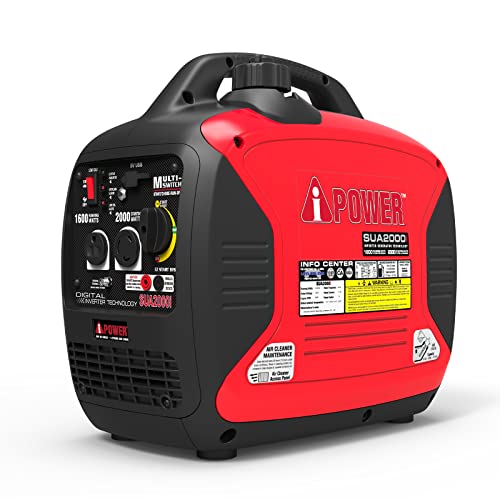 A-iPower SUA2000iV 2000-Watt Portable Inverter Generator









