Key takeaways
- Compare four arc welding machines for home shops and farm repair, with dual-voltage input, duty cycle and output range explained before you buy.
What's inside
As an Amazon Associate I earn from qualifying purchases. This post may contain affiliate links at no extra cost to you.
The real decision when buying an arc welder is not the headline amperage on the box. It is whether the machine matches the power you actually have in your shop, and whether its duty cycle holds up at the amperage you will run most often. A welder rated at full output for only a short share of each ten-minute cycle will keep stopping to cool on long repair beads, while a dual-voltage inverter can run off a household outlet today and a heavier circuit later.


This roundup is for home-shop welders, farmers fixing equipment, and hobbyists who want one stick machine that fits their building’s wiring. Every pick below was chosen from its Amazon listing title and stated specifications: output class, duty cycle, input voltage and weight. The four machines split into a heavier Lincoln unit, two compact inverters and one wide-voltage option, so the right choice depends on your circuit and your rods.
Quick Picks
As an Amazon Associate we earn from qualifying purchases
| Product | Best for | Key spec from title |
|---|---|---|
| Lincoln Electric Weld-Pak 225i | Heavier repair work where a 240V circuit is available | Dual voltage, 225-amp class output |
| YESWELDER ARC-205DS | A compact inverter that also covers Lift TIG | 205 amps, 110V/220V dual voltage |
| Hobart Stickmate 160i | Carrying one light welder between jobs | 15 lb, 120/240V dual voltage |
| Amico ARC-160 | Shops with inconsistent supply voltage | 100–250V wide voltage input |
How to Choose
Start with the circuit you actually have
Stick welders split sharply by input. A machine that only runs on a 240V circuit is no use in a garage wired with standard outlets, while a dual-voltage inverter runs on either. Check the listing’s stated input before anything else, and be honest about whether you will really install a heavier circuit. Dual-voltage models also change character with input: the same welder generally delivers less output on the lower voltage, so match the input you will use every day to the work you plan, not the other way round.
Read duty cycle at your working amperage
Duty cycle tells you how many minutes in ten a welder can run at a stated output before it has to cool. Thirty percent at full output means three minutes of arc time in ten at that setting, which is fine for tacks and short beads but frustrating on long seams. The figure that matters is the duty cycle at the amperage you will actually use, which usually sits below the maximum. Listings state duty cycle at their rated output, so compare those stated figures across machines rather than headline amps alone.
Match the output range to your electrodes
The output range decides which rods you can burn properly. Small-diameter electrodes for thin sheet need a machine that stays stable at low amperage, while thick farm steel and larger rods need headroom at the top of the range. Look at the full stated range on the listing, not just the maximum figure, and think about the rod sizes you reach for most. A welder whose range brackets your usual electrodes with room on both sides is easier to dial in than one you constantly run at its limit.
Weigh portability against a second process
Inverter machines have made stick welders genuinely portable: several picks here weigh twenty pounds or less, light enough to carry to a fence line or a neighbour’s barn. Decide whether that matters more to you than raw output. Then decide whether you want a second process in the same box. Two picks below add Lift TIG to stick, which suits occasional TIG work on steel, while the pure stick machines keep things simpler. Neither route is wrong; the mistake is paying for a process you will never strike an arc with.
The 4 Best Options
Lincoln Electric Weld-Pak 225i Stick Welder
The Weld-Pak 225i is the heavy lifter of this group, a Lincoln stick welder whose listing leads with dual voltage and a 225-amp class output. It suits the buyer who has a proper shop circuit and welds gates, trailer frames and farm implements, and who wants output headroom rather than the smallest possible box. At twenty pounds it is still light enough to move around a workshop, and the Lincoln name sits behind a deep dealer and consumables network. If your work is mostly thick material and long beads, this is the pick built around that workload.
Specs
- Process: stick (arc) welding
- Output: 225-amp class
- Duty cycle: thirty percent at 225 amps, as listed
- Input: 120V and 240V dual voltage
- Weight: 20 lb
Best for: Shop welders with a 240V circuit who regularly weld thicker steel.
Watch out for: Thirty percent duty cycle at full output means cooling pauses on long continuous runs, so check the stated duty cycle at the amperage you plan to use most before ordering.
ASIN: B0FFCBQ837
YESWELDER ARC-205DS
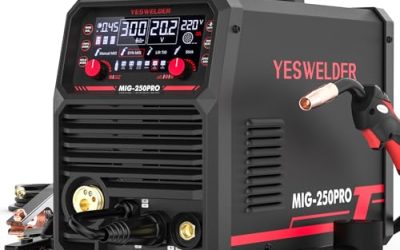
The ARC-205DS is a compact digital inverter that covers stick and Lift TIG in one small unit, which makes it the flexible pick for a home garage. Its listing states 205 amps on dual voltage, so it can run from a standard outlet for light work and step up when a heavier circuit is available. The digital display suits beginners who are still learning to set amperage by rod size. Choose it if you want one portable machine that can grow from stick repairs into occasional TIG work on steel.
Specs
- Output: 205 amps
- Processes: stick and Lift TIG, 2-in-1
- Input: 110V/220V dual voltage
- Inverter: digital IGBT
Best for: Home garages that want stick plus occasional Lift TIG in one portable unit.
Watch out for: This model also appears in a listing bundled with a Lift TIG torch, so confirm which configuration the listing you open actually includes before ordering.
ASIN: B086SNKTTK
Hobart Stickmate 160i
The Stickmate 160i is the carry-it-anywhere pick: fifteen pounds, dual voltage, and DC stick output that behaves well on thinner material. Hobart’s figures are stated plainly for this model: on a 120V input, the specification gives a 20 to 80 amp output range, which makes it easy to judge against the rods you already use. It will not match the Lincoln on heavy sections, but for gates, brackets and general farm fixes it covers the work most small shops actually do, and it stores on a shelf instead of living on a cart.
Specs
- Process: DC stick (SMAW)
- Input: dual voltage, 120V and 240V
- Output on 120V input: 20–80 amps, with 65 amps at a twenty percent duty cycle
- Weight: 15 lb
Best for: Welders who move between jobs and mostly run smaller electrodes.
Watch out for: Availability on this model comes and goes, so confirm a live offer on this exact listing before ordering, and check the figures on the live listing page rather than relying on an older spec sheet.
ASIN: B072BDSKY8
Amico ARC-160
The ARC-160 stands out for its wide-voltage input, which its listing title states as 100 to 250 volts. That tolerance is useful in outbuildings and older shops where the supply voltage is not always what it should be. It is a 160-amp stick machine that also covers Lift TIG, and its title carries an eighty percent duty cycle claim, the strongest duty-cycle figure in this group. For buyers whose power supply is the unpredictable part of the workshop, that tolerance is the reason to pick it over a standard dual-voltage unit.
Specs
- Output: 160 amps
- Processes: stick arc and Lift TIG
- Duty cycle: eighty percent, as titled
- Input: 100–250V wide voltage
Best for: Outbuildings and older shops where supply voltage varies.
Watch out for: A recent crawl of this listing showed no featured offers, so confirm a live offer on this exact listing before ordering. A newer ARC-160 listing also circulates, so check that the model details on the page you open match this one.
ASIN: B06XGL97WT
Which One Fits Your Situation
You only have a standard household outlet
Pick one of the dual-voltage inverters and run it on the lower input while you learn. The ARC-205DS and the Stickmate 160i both state dual voltage in their listings, and the Hobart’s published figures for 120V input tell you exactly what output to expect there. Thin material and smaller rods suit this setup well; save the thick-steel projects for the day a heavier circuit goes in.
You weld thick steel and farm equipment most weeks
The Weld-Pak 225i is the pick aimed at you. Its 225-amp class output and dual voltage mean it can sit on a proper shop circuit and still move to a lighter supply when needed. The honest limit is its thirty percent duty cycle at full output, so plan long jobs in sections rather than expecting uninterrupted beads at maximum amperage.
You carry your welder to the work
Weight decides this one. The Stickmate 160i at fifteen pounds is the easiest machine here to load into a truck and carry across a yard, and its DC output handles the brackets, hinges and gate repairs that make up most mobile stick work. The ARC-205DS is the alternative if you also want Lift TIG in the same trip.
You want to try TIG without buying a second machine
Two picks here add Lift TIG to stick: the ARC-205DS and the ARC-160. Lift TIG will not give you the high-frequency start or foot-pedal control of a dedicated TIG welder, but it is a fair way to learn torch handling on steel. Choose the ARC-205DS for its digital display, or the ARC-160 if your workshop power supply is unreliable.
Common Mistakes
- Judging a welder by headline amps and ignoring the duty cycle stated at that output.
- Assuming a dual-voltage machine delivers its full rated output on the lower voltage input.
- Buying a machine for a 240V circuit your shop does not have, with no plan to install one.
- Ordering the wrong listing of the same model, such as a bundle that adds or omits a torch.
- Choosing output far beyond your electrodes, then fighting an unstable arc at the bottom of the range.
Frequently Asked Questions
Can an arc welder run on a normal household outlet?
Yes, if the listing states dual voltage or a 120V-class input, as three of these four picks do. Expect reduced output compared with the higher input, and check the machine’s stated figures for that input before planning work. Thick material and large electrodes will quickly show the limits of a household circuit.
What does duty cycle mean in practice?
It is the share of a ten-minute period the welder can run at a stated output before it must cool. Thirty percent at 225 amps means three minutes of welding in ten at that setting. At lower amperage the effective duty cycle is usually better, which is why the figure at your working amperage matters more than the headline number.
Is Lift TIG a substitute for a dedicated TIG welder?
Not fully. Lift TIG starts the arc by touching and lifting the tungsten, and machines like these do not offer the high-frequency start, AC output for aluminium, or pedal control of a dedicated AC/DC TIG unit. It is a useful second process for occasional steel work, and a reasonable way to learn torch control before committing to a full TIG setup.
Which of these suits a complete beginner?
A compact inverter with a digital display, such as the ARC-205DS, is the forgiving starting point: amperage is set precisely by rod size, and dual voltage means it works on the outlet you already have. The Stickmate 160i is the other beginner-friendly route if you prefer a simple, light machine from an established welding brand.
Related guides
More from Amazon
Programs that pair well with the guide above. Offers and eligibility are set by Amazon and may change.
A free business account with business pricing and bulk-buying tools for work, shop or home office.
Create a business accountFree shipping on eligible items, Prime Video and more. Eligible new members can start with a free trial.
Start a Prime free trialAudiobooks and podcasts to listen to on the go. Eligible new members can start with a free trial.
Try Audible freeAd-free music streaming. Eligible new subscribers can start with a free trial.
Try Music Unlimited freeAs an Amazon Associate we earn from qualifying purchases.