As an Amazon Associate I earn from qualifying purchases. This post may contain affiliate links at no extra cost to you.
The real decision is the material you will turn. A metal lathe cuts steel, brass and aluminum to measured tolerances with a tool bit fed along a rigid bed by a carriage, and it can cut threads. A wood lathe spins a blank between centers while you shape it freehand, guiding chisels against a tool rest — no carriage, no threading, a far simpler and lighter build. The two types share a name and a rough shape, but almost nothing about how they work carries over.
OUR TOP PICK
Grizzly G0602 10-Inch by 22-Inch Benchtop Metal Lathe
This comparison puts two bench metal lathes against two bench wood lathes, all sized for a home workshop rather than a factory floor. The picks were chosen from the names and specifications on their Amazon product pages: swing and distance between centers, spindle and tailstock tapers, included workholding and tool rests, and how each machine handles speed. Match those figures to the parts or blanks you plan to turn, and the right type usually picks itself.
Quick Picks
As an Amazon Associate we earn from qualifying purchases
Product
Best for
Key spec from title
Grizzly G0602
Larger metal parts on a bench
10-inch swing, 22 inches between centers
Grizzly G8688
Small metal parts, tight benches
7-inch swing, 0.78-inch spindle bore
WEN LA3421
First wood lathe
8 by 13 inches, variable speed, soft start
WEN LA3424
Bigger bowls and spindles
12 by 18 inches, 5-speed, 4.5-amp motor
How to Choose
Start With the Material You Will Turn
The material decides almost everything else. A metal lathe removes stock with a tool bit carried on a rigid carriage that feeds along the bed, which is how it holds close tolerances and cuts threads. A wood lathe holds a blank between centers while you guide chisels by hand against a tool rest, trading precision for speed and freedom of shape. Wood machines are not built for the cutting forces or the accuracy metal work demands, and metal machines make slow, awkward wood lathes. Pick the type built for your material first; size and features come after.
Swing and Distance Between Centers Set the Size Limit
Two figures cap every job. Swing is the largest diameter that clears the bed, and distance between centers is the longest piece that fits between the headstock and tailstock. On the metal side here, the G0602 offers a 10-inch swing with 22 inches between centers, against 7 inches and 12 inches on the mini G8688. The wood pair runs the other way: the LA3421 turns 8 inches over the bed and 13 inches long, while the LA3424 stretches to 12 inches wide and 18 inches long. Measure your largest planned part or blank, then leave headroom.
Speed Control Works Differently on Each Type
Metal cutting speeds depend on the material and the diameter in the chuck, so a variable-speed drive like the G8688’s lets you dial in a setting without stopping to change belts or gears. Wood turning is less exact but just as speed-sensitive: large, unbalanced blanks start slow, and smaller work spins faster. The LA3421 answers with electronic variable speed and a soft-start motor that ramps up gently, which suits beginners. The LA3424 instead gives five fixed speeds, simple and predictable once you know the settings your projects use. Either approach works; the question is how often you will change speed mid-project.
Workholding and Tooling Do Not Transfer
Each type holds work its own way. Metal lathes grip stock in a chuck and support long pieces with a tailstock center; the G8688’s MT#2 tailstock taper is the fitting its centers and drills must match, and its 0.78-inch spindle bore lets bar stock pass through the headstock. Wood lathes use a spur center to drive the blank, a live center to support it, and a faceplate for bowls — the LA3421 ships a 2.3-inch faceplate and two tool rests, 4-1/2 and 7 inches. Chisels, tool bits and rests are type-specific, so budget tooling for one type only.
The 4 Best Options
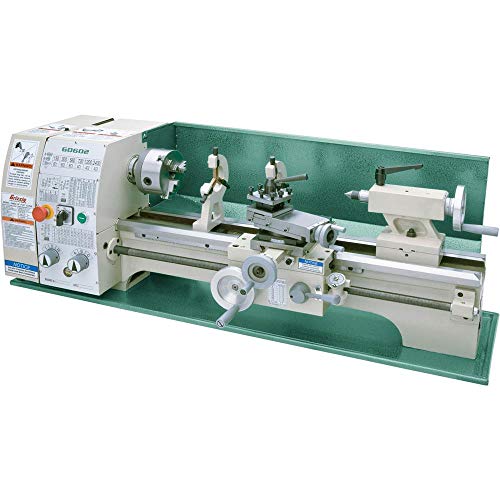
Grizzly G0602 10-Inch by 22-Inch Benchtop Metal Lathe
Top Pick
Grizzly G0602 10-Inch by 22-Inch Benchtop Metal Lathe
Best for: Hobby machinists turning shafts, bushings and fittings too large for a mini lathe.
Hobby machinists turning shafts, bushings and fittings too large for a mini lathe.
Watch out for
Captured listing content for this model was title-level only and carried no current stock confirmation — open the live listing to confirm a current new offer and the full specification before ordering.
The G0602 is the capacity pick on the metal side: a 10-inch swing and 22 inches between centers in a benchtop machine, sized for shafts, bushings and fittings that would overwhelm a mini lathe. That extra length between centers is what separates it from the G8688 — long bar work and larger diameters are its reason to exist. It suits a hobby machinist who already knows the parts they want to make and has outgrown, or expects to outgrow, a 7-inch machine. As a benchtop model it still fits a garage workshop, but plan for a stand or bench that can carry a full-size metal lathe’s weight and resist vibration.
Grizzly G8688 7-Inch by 12-Inch Mini Metal Lathe
Runner-Up
Grizzly G8688 7-Inch by 12-Inch Mini Metal Lathe
Best for: Model engineers and hobbyists turning small metal parts on a limited bench.
Model engineers and hobbyists turning small metal parts on a limited bench.
Watch out for
Selling signals were mixed across sellers, and the motor and speed-range figures differ between older listing content and the maker’s current page — confirm a live new offer and read the figures off the live listing.
The G8688 is the mini end of metal turning: 7 inches of swing over the bed and 12 inches between centers, in a machine one person can place on a bench. Its variable speed suits small-diameter work in brass, aluminum and steel, where the right surface speed changes with every part. The MT#2 tailstock taper matches common small centers and drill chucks, and the 0.78-inch spindle bore lets slim bar stock feed through the headstock for repeated small parts. It is the pick for model engineering, clock and instrument work, and anyone whose metal parts stay small.
WEN LA3421 8-Inch by 13-Inch Mini Benchtop Wood Lathe
WEN LA3421 8-Inch by 13-Inch Mini Benchtop Wood Lathe
Best for: Beginners turning pens, small bowls and spindles in wood.
Beginners turning pens, small bowls and spindles in wood.
Watch out for
An older 3421 listing with different dimensions still circulates — make sure the listing you order from is the current LA3421, the 8-inch by 13-inch model.
The LA3421 is the gentle on-ramp to wood turning: an 8-inch swing and 13 inches between centers cover pens, small bowls, spindles and tool handles, and the variable-speed motor’s soft start ramps the blank up smoothly instead of jolting it. The 3.2-amp motor is matched to that small capacity rather than to large, heavy blanks. It arrives ready to hold work several ways — an MT1 spindle and tailstock, a 2.3-inch faceplate for bowl blanks, and two interchangeable tool rests, 4-1/2 and 7 inches, so support sits close to the cut on short and longer pieces alike.
WEN LA3424 12-Inch by 18-Inch Benchtop Wood Lathe
WEN LA3424 12-Inch by 18-Inch Benchtop Wood Lathe
Best for: Wood turners ready for furniture-scale bowls, legs and spindles.
Type: Benchtop wood lathe
Motor: 4.5 amp
Capacity: Workpieces up to 12 inches wide and 18 inches long
Wood turners ready for furniture-scale bowls, legs and spindles.
Watch out for
Amazon’s own offer was out of stock at the last check while new third-party offers remained — check the seller, and that the offer is the standalone lathe rather than a bundle.
The LA3424 steps the wood side up: workpieces up to 12 inches wide and 18 inches long, turned by a 4.5-amp motor through five speeds. That capacity moves you from pens and trinkets to salad bowls, chair legs and table spindles without changing machines. It comes with the workholding a spindle project needs on day one — a 7-7/8 inch tool rest, a spur center to drive the blank and a live center to support the tail end. The five fixed speeds are a simpler arrangement than electronic control: pick the setting, and it stays there until you change it.
Which One Fits Your Situation
You Make Small Metal Parts on a Tight Bench
If your work is model engineering, small fittings, bushings and instrument parts, the G8688 covers it without taking over the bench. Its 7-inch swing and 12 inches between centers match small stock, the variable speed suits frequent diameter changes, and the spindle bore lets bar stock feed through for repeat parts. Confirm the live listing shows a current offer before ordering, since selling signals on this model were mixed at research time.
Your Metal Work Has Outgrown Mini Capacity
Choose the G0602 when your parts run longer or wider than a mini lathe allows — shafts, rollers and fittings up to 10 inches in diameter and 22 inches long. It stays a benchtop machine, so it fits a garage workshop, but it is the serious end of this comparison: check your bench can carry it, and confirm the full specification and a current offer on the live listing, since the captured listing content was title-level.
You Are Buying a First Lathe, for Wood
Start with the LA3421. Pens, small bowls and spindles all fit inside its 8-by-13-inch capacity, the soft-start variable speed is forgiving while you learn, and the included faceplate and two tool rests let you try both spindle and faceplate work without buying accessories first. If turning sticks, your next machine is a capacity upgrade — and you will know exactly which figure, swing or length, you ran out of.
You Want Bowls and Spindles at Full Furniture Scale
The LA3424 is the wood pick when the projects are furniture-sized: blanks up to 12 inches wide for bowls and 18 inches long for legs and spindles, a stronger 4.5-amp motor, and the spur center, live center and tool rest included to start spindle work immediately. Check the seller on the live listing — Amazon’s own offer was out of stock at the last check, with new third-party offers carrying the listing.
Common Mistakes
Buying a wood lathe for metal work: it has no carriage feed or threading, and freehand tooling cannot hold metal tolerances.
Judging a lathe’s size by its overall length instead of swing and distance between centers.
Assuming accessories transfer between types: MT1 and MT#2 tapers, chucks, centers and tool rests are type- and size-specific.
Ordering from an older or bundle listing of the same model instead of the current standalone listing.
Starting a large, unbalanced wood blank at full speed instead of ramping up from the lowest setting.
Frequently Asked Questions
Can a metal lathe turn wood?
It can spin a blank, and some machinists do rough small wooden parts on one. But a metal lathe has no tool rest for hand chisels, its slowest work is geared toward cutting metal, and wood dust works into precision slides and screws. For regular wood turning, a wood lathe is faster, safer and cheaper to run.
Can a wood lathe cut metal?
No. A wood lathe shapes material with hand-held chisels against a rest; it has no carriage to feed a tool bit, no threading gearing, and neither the rigidity nor the workholding to take metal-cutting forces. Soft metals can be spun and polished on one with abrasives, but cutting metal parts to size belongs on a metal lathe.
Which size should a beginner choose?
Match the machine to the largest piece you realistically plan to turn, not the smallest. On the wood side, the LA3421’s 8-by-13-inch capacity covers most starter projects; the LA3424 adds room for bowls and furniture parts. For metal, the G8688 handles small parts, while the G0602’s extra swing and length suit bigger work from day one.
Do these lathes include the tooling needed to start?
The two WEN wood lathes list their starting workholding: the LA3421 includes a faceplate and two tool rests, and the LA3424 includes a tool rest, spur center and live center; turning chisels are bought separately for either. For the two Grizzly metal lathes, check the live listing’s included-accessories list before ordering, since captured listing content did not itemize it.
J
JD's Woodworks Editorial Team
We compare specs, warranty terms, long-term owner feedback and street pricing before anything earns a spot. Rankings are never paid.
Affiliate disclosure. As an Amazon Associate we earn from qualifying purchases at no extra cost to you. Prices accurate as of the date shown.
The best welding gear bags compared: backpacks and a wide-mouth tool bag with helmet storage, tough fabrics and room for gloves, jackets and hand tools.
Find the best tool laser engraver for your woodworking shop with five machines compared on power, bed size, enclosure, air assist, and safety features.
A best christmas tree laser cutter guide comparing four diode and CO2 machines for wooden and acrylic ornaments, with work area, beam power and safety.
Find the best woodwork table saw for your shop: four current models compared by rip capacity, motor power, fence design, and stand, with a buying guide.
Compare the best two stage dust collectors for weekend woodworking projects, with cyclone separation, canister filters, drum sizes and inlet specs compared.



 WEN LA3424 12-Inch by 18-Inch Benchtop Wood Lathe