
Our Top Picks
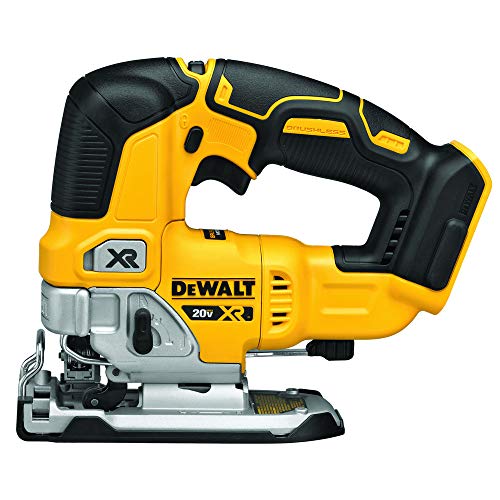
 BLACK+DECKER 20V MAX Brushless Cordless JigSaw Kit with12.7 x 3.7 x 9.6 inches6.6 poundsCheck on Amazon

What's inside
As an Amazon Associate I earn from qualifying purchases. This post may contain affiliate links at no extra cost to you.
Most jigsaw frustration has nothing to do with the motor. It is the blade wandering off your line on a 3/4 inch panel, the cut coming out beveled when the base was supposed to be square, and the tool feeling like a paint mixer after twenty minutes of scrollwork. So when I went looking for the best brushless jigsaw for my garage, I stopped reading power claims and started paying attention to blade support, base rigidity, and vibration. That is where the good ones separate themselves.
To be honest about what brushless actually gets you: longer runtime per charge, better heat behavior on long cuts, and electronic speed control that holds an rpm under load instead of bogging. It does not fix a sloppy blade clamp. It does not make a stamped base flat. I have owned jigsaws that cut beautifully and jigsaws that made me hate curves, and the motor was never the deciding factor.
As an Amazon Associate we earn from qualifying purchases at no extra cost to you.


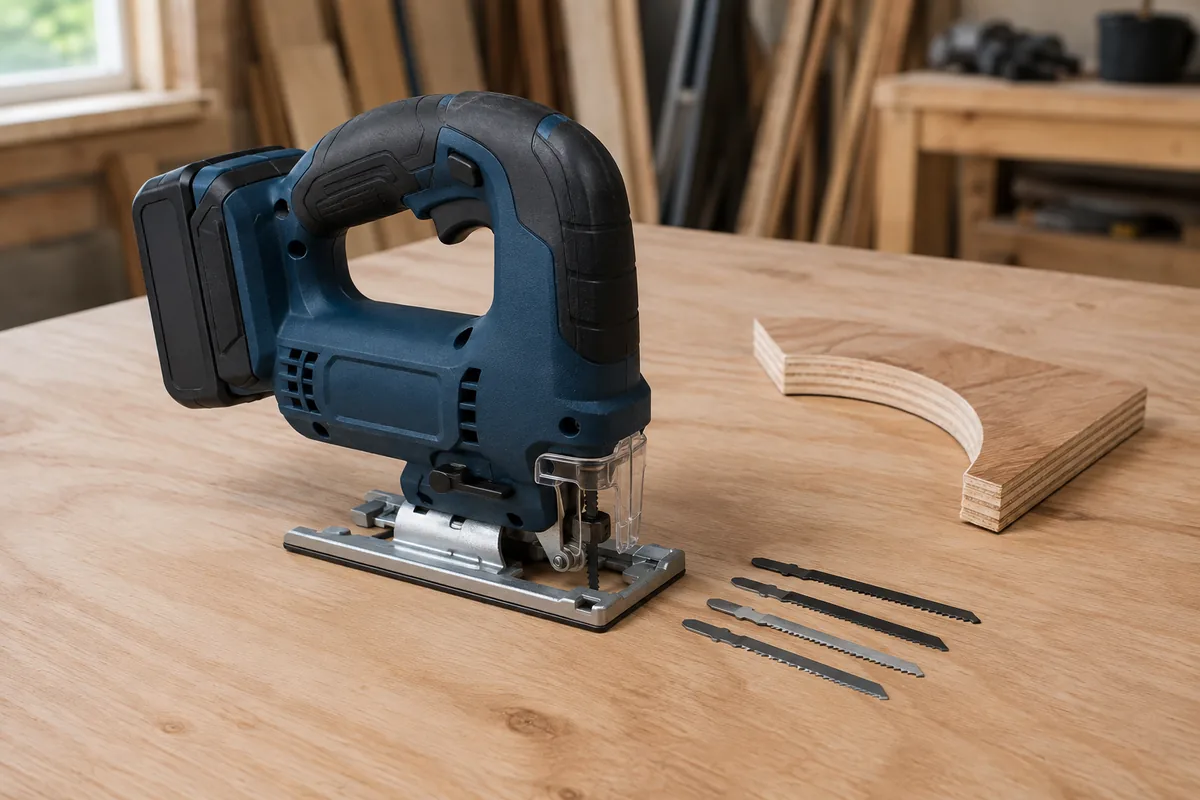
What actually matters in the best brushless jigsaw
Here is the short list I use when I am comparing models on a screen instead of in my hands. These are the things that show up in your cut quality every single time, ranked roughly by how much they will annoy you if you get them wrong.
| Feature | Why it matters in a small shop | What to look for |
|---|---|---|
| Blade guide/roller | Stops the blade twisting on thick stock | Firm rear roller, minimal side play when you wiggle the blade |
| Base plate | Beveled cuts and square cuts both depend on it | Cast or thick stamped base, positive detents at 0 and 45 |
| Orbital settings | Speed vs. finish trade-off | At least 3 orbit steps plus straight-cut mode |
| Variable speed | Slow for plastics and laminate, fast for softwood | Dial plus a variable trigger, not trigger only |
| Dust handling | Sightline on your pencil line | Blower to clear the line, port for a shop vac |
| Grip style | Comfort on long sessions | Barrel grip for control, top handle for familiarity |
| Battery platform | Cost of ownership | Whatever platform you already own |
Notice what is not on that list: raw amps, marketing numbers, or cut-depth ratings. Almost every full-size jigsaw will cut 2x material. Very few of them cut it straight without you fighting the tool.
Top handle or barrel grip, and why I switched
This is the biggest fork in the road, and it is more consequential than brand. A top-handle jigsaw puts your hand above the tool. It is the shape everybody learned on, it is easier to grab one-handed off the bench, and it works fine for straight rips and rough cutouts.
A barrel-grip jigsaw puts your palm around the body, low and close to the base. Your hand is nearly in line with the blade, which means you steer with your whole forearm instead of levering from up high. For following a curve on a template, or nibbling out a sink cutout, that low center of control is a real advantage. I resisted it for years because it looked awkward. Then I cut a set of curved brackets with a borrowed barrel grip and my lines were noticeably cleaner.
The trade-off is honest: barrel grips usually cost more, the selection is smaller, and if you have small hands the body can feel like a soda can. Some of them also need two hands to feel stable when you are starting a cut on a narrow edge. If you mostly break down sheet goods and occasionally cut a curve, a good top handle is the smarter buy. If curves and templates are your normal work, the barrel grip earns it.
Brushless Barrel Grip Jigsaw
If you cut a lot of curves, templates, or interior cutouts, the barrel grip is worth the premium. Filter for tool-free blade change, a cast base plate, and a dust port that accepts a standard vac hose. Skip the ones that only bevel with a hex key stashed in the case, because you will lose the key.
Where cordless brushless makes sense, and where it does not
I run cordless for nearly everything in a one-car garage, and jigsaws are a good fit for it. Cuts are short, you are usually moving around a workpiece or crouched over sawhorses, and a cord that snags on a clamp at the wrong moment is how you get a wobble in your line. Brushless motors make that practical because they pull less current for the same work, so a mid-size pack actually lasts through a project instead of a single sheet.
The counterargument is real, though. If you already own a good corded jigsaw and it holds a blade tight, replacing it with a cordless one will not improve your cuts. It will improve your convenience. Those are different purchases. The other honest issue is weight: a cordless jigsaw with a 5.0 Ah pack hanging off the back is noticeably nose-heavy over your head or on a vertical cut, and that is worth remembering if you do trim work on a ladder.
Battery platform matters more than model choice for most people. DeWalt XR, Milwaukee FUEL, Makita LXT, Ryobi ONE+, and the Bosch 18V line all have credible brushless jigsaws in them. If you already have four batteries and a charger for one of those systems, buying into a second platform for a jigsaw is usually a bad financial call. Bare-tool pricing is the whole reason to stay on one platform.
- ✔ Longer runtime per charge than brushed equivalents
- ✔ Holds speed under load, so less bogging in hardwood
- ✔ Runs cooler on long cuts, less heat-related fade
- ✔ No cord to snag on clamps or drag across your line
- ✔ Bare-tool options if you already own batteries
- ✘ Costs meaningfully more than a brushed or corded saw
- ✘ Battery adds nose weight on overhead and vertical cuts
- ✘ A brushless motor cannot fix a sloppy blade clamp or flexy base
- ✘ Locks you deeper into one battery platform
The parts of the tool people ignore until it bites them
Blade change is the one I underestimated. Tool-free keyless clamps are standard now, but they are not all equal. Some release the blade so eagerly that it drops on the floor mid-cut with heavy stock; others require a hard shove and a prayer. If you can handle a display model at a store, wiggle the installed blade side to side. Any perceptible slop at the clamp becomes a wandering cut later.
Base plate flatness is the other one. Set the saw upside down on a known-flat surface, like your table saw top, and look for daylight. A base with a slight rock will make your bevel cuts inconsistent, and no amount of technique fixes it. Also check that the bevel detent at zero actually snaps home. On cheaper saws, the bevel lock drifts under vibration and you find out when your “square” cut is off by two degrees.
Dust and sightline are underrated in a small shop. The blower nozzle that clears sawdust off your pencil line is a bigger deal than an LED. If a saw has both, good. If it has an LED and no blower, that is a hint about who designed it. And if the dust port needs a proprietary adapter you have to buy separately, factor that into the price.
One more thing: buy good blades. I have seen people spend $200 on a saw and then feed it the bargain-bin blades that came in a ten pack. A quality bi-metal or T-shank progressive-tooth blade will improve your cuts more than a hundred dollars of tool upgrade. Down-cut blades for veneered plywood, coarse fast-cut for framing lumber, fine tooth for laminate.
Brushless Top Handle Jigsaw Kit
For most garage shops this is the practical pick. Get a kit if you are new to the platform, or a bare tool if you already have batteries. Look for four orbital settings, a dial for speed, and a case that actually holds blades so they do not end up loose in a drawer.
How I would spend the money
If you already own a battery platform, buy the bare-tool brushless jigsaw in that platform and put the savings into blades and a good vac hose adapter. That is the highest-return version of this purchase and it is what I would do again.
If you are starting fresh with no batteries, buy a kit that includes two packs and a charger, because a single-battery kit is a false economy on a tool you use in bursts. And if your budget is genuinely tight, a solid corded jigsaw plus better blades will out-cut a cheap cordless one. That is not the exciting answer, but it is the correct one.
Where I have made mistakes: I once bought the lightest jigsaw I could find, thinking weight was the enemy. It vibrated so much on 3/4 inch maple that my lines looked hand-drawn. A little mass in the body is a feature, not a flaw. I also skipped a barrel grip for years because I assumed the shape was a gimmick. It was not.
FAQ
Is a brushless jigsaw actually worth the extra money? For cordless, yes, mostly for runtime and speed stability under load. For pure cut quality, no. A brushed saw with a tight blade clamp and a flat base will cut cleaner than a brushless saw with a sloppy one. Buy brushless for the battery behavior, not for the finish.
Can a jigsaw cut a straight line in plywood? Yes, but not freehand across a full sheet. Clamp a straightedge and run the base against it, use a straight-cut orbital setting, and let the saw feed at its own pace. If you need repeatable straight rips in sheet goods, a track saw or a circular saw with a guide is the right tool and the jigsaw is the wrong one.
Do I need the barrel grip or is a top handle fine? A top handle is fine for the majority of DIY work, especially cutouts and rough breakdown. Choose the barrel grip if curves, templates, and pattern work are a regular part of what you build, because the lower hand position gives you noticeably better steering control.
Pick the platform you already own, prioritize the blade clamp and base plate over the motor spec, and put the leftover money into decent blades. That combination has done more for my cuts than any single tool upgrade.
Check prices on Amazon →