4 Best Campbell Hausfeld Air Compressors (November 2026)
Our guide to the best campbell hausfeld air compressor compares tank size, airflow, noise and duty cycle, so you can pick the right one for your shop and tools.
Our guide to the best campbell hausfeld air compressor compares tank size, airflow, noise and duty cycle, so you can pick the right one for your shop and tools.
As an Amazon Associate I earn from qualifying purchases. This post may contain affiliate links at no extra cost to you.
A Campbell Hausfeld compressor earns its place in a woodworking shop when it keeps up with the tools you actually run. The wrong pick leaves a nailer waiting between shots or a spray gun starved for air, while the right one fades into the background and lets you work. This guide compares four compressors from the brand, from a small portable tank for inflation and trim work to a large stationary unit for sanders and spray guns.
OUR TOP PICK
Campbell Hausfeld FP209499AV 3-Gallon Air Compressor
We chose every model below from the name and specifications shown on its Amazon page, and we compare tank size, airflow, noise and duty cycle so you can match the compressor to your tools instead of guessing. Whether you work in a small garage or a full shop, the four picks below cover the range, and the buying advice that follows will help you size the tank and the airflow for the jobs you do most.
Quick Picks
As an Amazon Associate we earn from qualifying purchases
Product
Best for
Key spec from title
Campbell Hausfeld FP209499AV
Inflation and light trim work
3-gallon tank, 110 max PSI
Campbell Hausfeld DC060500
Quiet garage work and trim nailers
6-gallon pancake, 68 dBA
Campbell Hausfeld DC080500
Framing nailers and longer runs
8-gallon tank, 125 max PSI
Campbell Hausfeld VT6290
Sanders, spray guns and all-day shop air
20-gallon tank, 135 max PSI
How to Choose
Tank Size and Airflow
Tank size and airflow decide whether a compressor keeps up with your tools. Gallons describe the reserve of air the tank holds, while cubic feet per minute at 90 PSI describes how fast the pump replaces that air while you work. A nailer sips air in short bursts, so a small tank can serve it well, but a sander or spray gun draws air without pause and needs a higher CFM figure. Compare the CFM at 90 PSI on the listing with the air demand of the tool you run most, and choose a compressor whose airflow meets or beats that demand.
Noise and Placement
Noise matters more than most buyers expect, because a compressor often runs in the same room where you measure, mark and cut. The listings in this guide range from 68 dBA on the quiet models to 93 dB on the smallest portable unit, and that gap is easy to hear across a garage. Place the compressor where its sound does not bounce straight off a shared wall, and use a longer hose to put distance between the pump and your ears. Rubber feet and a flat floor cut vibration, and a hose reel keeps the line out of the way. If you share walls with neighbours, the quiet models below are the safer starting point.
Power and Pump Type
Power and pump type shape how a compressor fits your shop. Most models in this guide run on household 120V power, while the largest unit also accepts 240V, which suits a shop wired for bigger machines. Oilless pumps need no oil checks and start easily in cold weather, and the two quiet models here use oil-free dual-piston pumps. An oil-lubricated cast-iron pump runs longer between services and handles heavy daily use, but it asks you to check the oil level before you start. Duty cycle tells you how much of each hour the pump can run, so match it to long sanding sessions rather than short bursts.
Safety and Setup Basics
Safe setup starts with the features already listed on each product page. Use the built-in regulator to set working pressure for the tool in hand, and never run a tool above the pressure its maker states. Open the drain valve after each session so moisture does not sit in the tank, and keep the compressor on a flat, stable surface so it cannot tip while the pump runs. Wear hearing protection with the louder models, and check hose fittings for leaks before the first cut of the day. Keep the air intake clear of sawdust, and give the pump room to breathe so it does not overheat during a long run.
The 4 Best Options
Campbell Hausfeld FP209499AV 3-Gallon Air Compressor
Top Pick
Campbell Hausfeld FP209499AV 3-Gallon Air Compressor
Best for: Inflation, airbrush touch-ups and light trim work where portability matters most.
The FP209499AV is the smallest compressor in this guide, and it suits buyers who need portable air for inflation and light trim work rather than a shop workhorse. Its 3-gallon tank and oilless pump keep the unit light enough to carry to a job, and the included 10-piece accessory kit with a 25-foot recoil hose means you can start inflating tires and topping up sports gear without buying extra parts first. Its airflow is modest, so treat it as a portable helper for short bursts and not as the air supply for a sander or spray gun.
Watch out for: The low airflow limits it to short bursts, and at 93 dB it is loud for its size, so wear hearing protection.
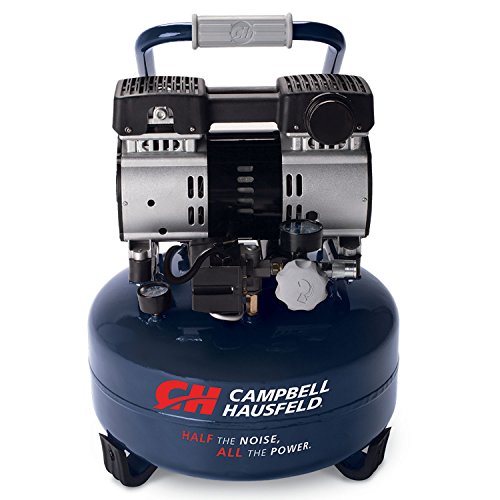
Campbell Hausfeld DC060500 6-Gallon Quiet Pancake Air Compressor
Runner-Up
Campbell Hausfeld DC060500 6-Gallon Quiet Pancake Air Compressor
Best for: Trim nailers, brad nailers and quiet garage work beside the bench.
The DC060500 is the quiet pick for a garage where a compressor runs beside the workbench. Its oil-free dual-piston pump holds noise to 68 dBA, which is far easier to live with than a loud portable unit, and the 6-gallon pancake tank gives a trim nailer enough reserve for a steady run of fasteners. Airflow of 2.4 CFM at 90 PSI covers brad and finish nailers with room to spare, and the 1 HP motor runs on household 120V power. It is a sensible middle step for a woodworker moving up from a tiny portable tank.
Watch out for: One retailer lists this model as discontinued, so confirm it is still sold before ordering.
Campbell Hausfeld DC080500 8-Gallon Quiet Air Compressor
Campbell Hausfeld DC080500 8-Gallon Quiet Air Compressor
Best for: Framing nailers, staple guns and longer nailing runs in a home shop.
The DC080500 takes the quiet dual-piston design of its smaller sibling and adds a larger 8-gallon hot dog tank, which stretches the time between pump cycles on longer runs. Airflow matches the 6-gallon model at 2.4 CFM at 90 PSI and 3.5 CFM at 40 PSI, so it drives the same nailers, but the extra reserve helps when you fire a framing nailer in quick succession or run a staple gun through a long stretch of trim. Noise stays at 68 dBA, and the large wheels and handle make it easy to roll across the shop.
Watch out for: It is heavier and taller than the 6-gallon model, so check your storage space first.
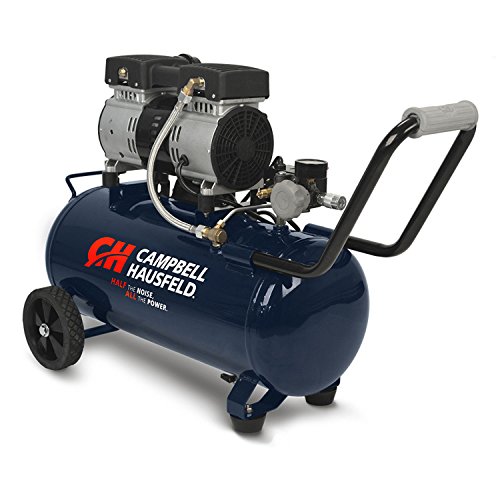
Campbell Hausfeld VT6290 20-Gallon Air Compressor
Campbell Hausfeld VT6290 20-Gallon Air Compressor
Best for: Sanders, spray guns and all-day shop air in a dedicated workspace.
The VT6290 is the full shop compressor in this guide, built for tools that draw air without pause. Its 20-gallon horizontal tank and 2 HP dual-voltage motor deliver 5.5 CFM at 90 PSI and 6.5 CFM at 40 PSI, which covers random-orbit sanders, spray guns and impact wrenches that smaller tanks cannot feed. The cast-iron oil-lubricated two-cylinder pump is rated for 5,000 hours, and the ASME tank holds up to 135 max PSI. Ten-inch semi-pneumatic wheels help you move it, and the 80/20 duty cycle suits long sessions. It is the loudest pick here at 82 to 85 dBA, so plan its placement and wear hearing protection during heavy runs.
Watch out for: It needs regular oil checks, it is the loudest model here, and it needs real floor space.
Which One Fits Your Situation
Small Garage and Trim Work
A small garage with a brad nailer needs portability more than raw airflow. The 3-gallon FP209499AV carries easily and stores on a shelf, while the 6-gallon DC060500 stays quiet beside the bench and feeds trim nailers without fuss. Pick the small tank when you carry air to the job, and pick the quiet pancake when the compressor lives where you work.
Framing and Longer Runs
Framing and long trim runs ask for reserve air, because a nailer firing in quick succession drains a small tank fast. The 8-gallon DC080500 holds enough air to keep the rhythm going, and its wheels make it easy to roll along a wall as the work moves. If your projects regularly involve framing, the extra gallons earn their floor space.
Spraying and Sanding All Day
Spray guns and random-orbit sanders draw air continuously, so they need the biggest tank and the highest airflow here. The 20-gallon VT6290 delivers 5.5 CFM at 90 PSI and keeps a spray gun fed through a full coat. Give it a fixed spot with room to breathe, and keep the oil level checked. Smaller tanks will leave a spray gun sputtering.
First Compressor for a New Shop
A first compressor should cover the tools you own today and leave room to grow. The 6-gallon DC060500 is the balanced starting point, with quiet operation and enough airflow for nailers. If you already own a sander or plan to spray finishes, step up to the 20-gallon VT6290 instead. Buy for the hungriest tool you expect to run, not the smallest one you own.
Common Mistakes
Buying on tank size alone and ignoring the CFM at 90 PSI that your tools actually need.
Running a sander or spray gun on a compressor sized only for a nailer.
Skipping the drain valve and letting moisture build up inside the tank.
Placing a loud compressor against a shared wall where the noise carries.
Forgetting to check the circuit and the extension cord rating before the first run.
Frequently Asked Questions
What size air compressor do I need for a nail gun?
A brad or finish nailer needs only modest airflow, so a 6-gallon compressor delivering around 2.4 CFM at 90 PSI covers most trim work. A framing nailer fires larger fasteners faster and benefits from an 8-gallon tank or more. Check your nailer’s air demand against the CFM at 90 PSI on the listing.
How loud is a quiet air compressor?
The quiet models in this guide are listed at 68 dBA, roughly the sound of a normal conversation heard from a short distance. The small portable model is listed at 93 dB in its manual, which is far louder and calls for hearing protection. If your shop shares walls with living space, a 68 dBA compressor makes long sessions far more comfortable.
Do I need an oil-lubricated or oilless compressor?
An oilless pump needs no oil checks and starts easily, which suits occasional use and small shops. An oil-lubricated cast-iron pump runs longer between services and handles heavy daily use, but it asks you to check the oil level before each session. Weekend woodworkers suit oilless models, while busy shops get more life from oil-lubricated pumps.
How often should I drain my air compressor tank?
Open the drain valve after each session so moisture does not sit in the tank and rust the inside. In humid weather or during long runs, draining once a day is a sensible habit. Let the tank cool first, open the valve slowly, and close it firmly once only air escapes.
J
JD's Woodworks Editorial Team
We compare specs, warranty terms, long-term owner feedback and street pricing before anything earns a spot. Rankings are never paid.
Affiliate disclosure. As an Amazon Associate we earn from qualifying purchases at no extra cost to you. Prices accurate as of the date shown.
Compare the best dewalt portable air compressor picks for trim, framing and finish work, the 6-gallon pancake, cordless FlexVolt and quiet trim models.
Compare the best cup laser engraver picks with rotary chucks and rollers for tumblers, mugs and glasses, from enclosed diode machines to open-frame models.
Compare the best cnc systems sold as complete packages — machine, controller and software in one box — by work area, spindle, drive and control ecosystem.
Find the best bandsaw light for your saw: magnetic gooseneck LED machine lights that aim at the blade, from a 2,000-lumen work light to cordless picks.
Miter saw vs table saw: compare crosscuts, rip cuts, accuracy, space, and value to choose the right saw for your shop and your first woodworking projects.
Compare five solar portable generators for shops, campsites, and outages, covering battery size, output, solar charging, outlets, and what to check first.
The best portable CNC machines for small shops and shared spaces, compared by footprint, weight, work area, and setup. Compact benchtop picks for wood, acrylic, and soft metal.


 Campbell Hausfeld VT6290 20-Gallon Air Compressor