
Key takeaways
- Compare the best dovetail jigs for beginners, from simple fixed-template kits to a premium adjustable system, with specs on capacity, templates, and bits.
What's inside
As an Amazon Associate I earn from qualifying purchases. This post may contain affiliate links at no extra cost to you.
- Top Pick: PORTER-CABLE 4210 Dovetail Jig
- Runner-up: VEVOR Dovetail Jig 28104-3
- Also consider: Rockler Complete Dovetail Jig
The fastest way to learn dovetails is to remove the layout work from the equation. A beginner-friendly dovetail jig holds both boards in position, guides the router with a template, and turns a joint that takes years to master by hand into a repeatable process you can learn in an afternoon. The five jigs below were chosen for first-time users: each one limits the adjustments you have to make, includes clear setup aids, or arrives as a kit with bits and bushings already matched to the template.
Fixed-template jigs are the easiest to set up but lock you into one pin spacing. Template-only systems cost less and handle wide boards but ask you to build part of the setup yourself. One premium adjustable jig closes the list for readers who would rather buy once and grow into the tool.
As an Amazon Associate, we earn from qualifying purchases.
Table of Contents
- Quick Answer
- PORTER-CABLE 4210 Dovetail Jig
- VEVOR Dovetail Jig 28104-3
- Rockler Complete Dovetail Jig
- Keller 135-1500 Journeyman Dovetail Jig Template
- Leigh D4R Pro 24-Inch Dovetail Jig
- How to Choose
- Who Should Skip
- FAQ
- Final Verdict
Quick Answer
For most beginners, the PORTER-CABLE 4210 is the easiest starting point: one template, alignment lines, and depth gauges remove most setup guesswork. The VEVOR 28104-3 adds more joint types for a similar entry tier, the Rockler Complete kit includes its bits and bushing, the Keller 135-1500 simplifies through dovetails, and the Leigh D4R Pro is the premium system to grow into.
PORTER-CABLE 4210 Dovetail Jig

The 4210 is the entry model in Porter-Cable’s 4200 series, and its simplicity is exactly what a first-time user needs. It ships with a single template, the 4211, which cuts half-blind, rabbeted half-blind, and sliding dovetails. That covers the joint most beginners build first, the half-blind dovetail hidden inside a drawer front.
Alignment lines are printed on the template so the boards register in the same place every time, and router bit depth gauges let you set cutting depth against a gauge instead of measuring and guessing. The template itself is machined aluminum, the base is steel, and cam clamps keep boards from creeping mid-cut. A carbide-tipped dovetail bit, template guide, and lock nut are in the box, so the router is the only major purchase left. Capacity matches most drawer and small-box work at 12 inches wide. This is the budget pick for anyone who wants the shortest path to a first tight drawer joint.
Specs:
- Capacity: boards up to 12 inches wide
- Stock thickness: 1/4 inch to 1-1/8 inches
- Template: 4211 machined aluminum template
- Joint types: half-blind, rabbeted half-blind, and sliding dovetails
- Clamping: heavy-duty cam clamps with sandpaper-backed locking bars
- Included: carbide-tipped dovetail bit, template guide, and lock nut
VEVOR Dovetail Jig 28104-3

The VEVOR 28104-3 is the deluxe version of VEVOR’s 12-inch jig, for beginners who already know they want more than one joint type. Three templates are included: a 1/2-inch through template, a 1/2-inch half-blind template, and a 1-inch through template. Between them, the jig cuts half-blind, through, and sliding dovetails, plus straight tenons, and four router bits come in the kit so no separate cutter shopping is needed.
An eccentric wheel clamping design presses the boards against the template, and the frame accepts thicker stock than most entry jigs: up to 1.57 inches on top and 1.42 inches on the side, with processing widths of 5.5 to 12 inches on top and 5.9 to 11 inches on the side. At 17.35 pounds it stays put on the bench yet stores easily. The trade-off is a busier setup: three templates and two clamping orientations mean more to learn up front. If your first projects are boxes and casework rather than drawers alone, that extra range earns its keep in this tier.
Specs:
- Capacity: top processing width 5.5 to 12 inches; side 5.9 to 11 inches
- Stock thickness: up to 1.57 inches on top; up to 1.42 inches on the side
- Templates: three (1/2-inch through, 1/2-inch half-blind, 1-inch through)
- Joint types: half-blind, through, and sliding dovetails, plus straight tenons
- Included: four router bits
- Clamping: eccentric wheel design
- Construction: steel and 6061T5 aluminum alloy with electrostatic spray finish
- Weight: 17.35 pounds
Rockler Complete Dovetail Jig

Rockler’s Complete Dovetail Jig takes the kit idea seriously. Two phenolic templates cut both through and half-blind dovetails, and the box includes three carbide-tipped router bits plus a 7/16-inch guide bushing, so the cutter, bushing, and template arrive as a matched set. That matters for beginners: the most common cause of sloppy first joints is a bit-and-bushing combination that does not match the template, and a complete kit removes that variable.
Phenolic templates keep the jig light and portable, and the 11-inch capacity fits drawer boxes, keepsake boxes, and small case pieces. The honest limitation is width: at 11 inches, this is the narrowest jig in the group, so wide drawer fronts and blanket-chest panels are off the table. The mid-range Complete kit is the right call if your projects are small, your bench space is tight, and you want to unbox one package and start cutting practice joints the same day. Check the current listing before ordering, since Rockler has rotated this kit in and out of its catalog.
Specs:
- Capacity: stock up to 11 inches wide
- Templates: two phenolic templates
- Joint types: through and half-blind dovetails
- Included: three carbide-tipped router bits and a 7/16-inch guide bushing
Keller 135-1500 Journeyman Dovetail Jig Template
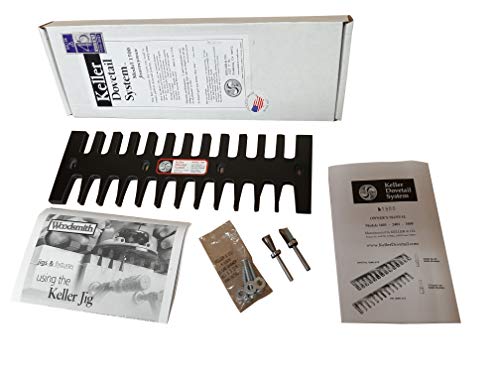
The Keller system takes the opposite approach to a bench jig: there is no jig body at all. The Journeyman 135-1500 is a 15-inch precision-milled phenolic template that mounts to a shop-made backer board, and its back-to-back design cuts tails on one side and pins on the other. Because the template registers against the end of the board, board width and length are effectively unlimited.
The included bits carry ball bearings that ride the template directly, so there are no guide bushings to source or swap, and once the bit height is dialed in, joints repeat without test cuts. The kit includes a dovetail bit, a straight bit, and the bearing guides. The limits are real, though: the Keller cuts through dovetails only, stock thickness tops out at 3/4 inch, and you must build the backer board and supply your own clamping. Choose it if through dovetails on wide panels are your goal and a small setup project does not scare you.
Specs:
- Template: 15-inch precision-milled phenolic template, back-to-back design
- Stock thickness: 1/8 inch to 3/4 inch
- Width capacity: unlimited board widths and lengths
- Joint types: through dovetails only
- Included: dovetail bit, straight bit, and ball-bearing template guides
- Requires: shop-made backer board and your own clamps
Leigh D4R Pro 24-Inch Dovetail Jig

The D4R Pro is not a beginner jig in the same sense as the other four; it is included for readers who would rather buy the last dovetail jig they will own. Leigh’s flagship uses an adjustable finger assembly instead of a fixed template, so pin and tail spacing can be varied across the joint. That variable spacing is what makes jig-cut dovetails look hand-cut rather than machine-uniform, and every fixed-template jig in this roundup gives it up for simplicity.
Capacity doubles the entry jigs at 24 inches, covering wide drawer fronts, case sides, and blanket chests. The D4R Pro cuts through and half-blind dovetails, plus sliding dovetails and box joints. Expect the steepest learning curve here: adjustable fingers reward careful manual reading and a few practice joints in scrap first. Priced in the premium tier, it only makes sense if furniture-scale work is the plan from day one. Everyone else will learn faster, and cheaper, on a fixed template, then upgrade later knowing which features they missed.
Specs:
- Capacity: boards up to 24 inches wide
- Template: adjustable finger assembly for variably spaced pins and tails
- Joint types: through and half-blind dovetails; sliding dovetails and box joints in the system
- Spacing: fully variable, for a hand-cut look
How to Choose
Start with the joints you will cut in your first year. If that list is drawer boxes, a half-blind-only jig like the PORTER-CABLE 4210 is the easiest teacher. If you want through dovetails for boxes and cases right away, look at the VEVOR 28104-3, the Rockler Complete, or the Keller template. Match capacity to your projects next: 11 to 12 inches covers most drawers, while wide panels push you toward the Keller’s unlimited width or the Leigh’s 24-inch frame.
Then check what is in the box. Kits that include matched bits and bushings, like the Rockler and VEVOR, remove the most common beginner mistake. Template-only systems like the Keller cost less per joint type but assume you can build a backer board and clamp work securely. Finally, confirm router compatibility before ordering: most of these jigs need a router that accepts standard template guide bushings and 1/2-inch-shank bits, while the Keller’s bearing-guided bits sidestep bushings entirely. Whatever you choose, budget scrap wood for two or three practice cuts before real project stock goes in.
Who Should Skip
Skip dovetail jigs entirely if you only build one or two drawers a year; a dovetail saw and a marking gauge will cost less and teach you more. Skip the fixed-template models if you want the varied pin spacing of hand-cut work, since only the Leigh D4R Pro offers it. Skip the Keller if you need half-blind dovetails for drawer fronts, because it cuts through dovetails only, and skip the Rockler if your drawer fronts run wider than 11 inches. If you do not yet own a router with a 1/2-inch collet, pause: most of these systems are built around 1/2-inch-shank bits, and the router purchase matters more than the jig.
FAQ
What router do I need for a dovetail jig?
Most bench jigs need a fixed-base or plunge router that accepts template guide bushings and 1/2-inch-shank bits. A mid-size router in the 1-3/4 to 2-1/4 horsepower range is the usual match for drawer work. The Keller is the exception: its bits carry guide bearings, so no bushing is required.
Are fixed-template dovetails strong enough for drawers?
Yes. Joint strength comes from the mechanical interlock and glue surface of the dovetail shape, not from who spaced the pins. Fixed templates space pins evenly, which looks more uniform than hand-cut work but holds drawers together just as well.
How long does it take a beginner to learn a dovetail jig?
Plan on an afternoon of practice. Most first-time users cut a sloppy first joint, adjust bit depth once or twice, and get a snug fit within a handful of test pieces in scrap. Notes on the bit depth that worked for each stock thickness speed up later setups.
Can one jig cut both half-blind and through dovetails?
Some can. The VEVOR 28104-3 and Rockler Complete include templates for both, and the Leigh D4R Pro handles both as well. The PORTER-CABLE 4210 focuses on half-blind and sliding dovetails, and the Keller cuts through dovetails only, so match the jig to the joints you plan to build.
Final Verdict
For a first dovetail jig, the PORTER-CABLE 4210 is the safest recommendation: one template, printed alignment lines, and depth gauges keep the learning curve short. The VEVOR 28104-3 is the better buy if you want several joint types and thicker stock capacity at an entry tier. The Rockler Complete suits small projects and small benches, the Keller 135-1500 is the pick for through dovetails on wide panels, and the Leigh D4R Pro is the premium system to grow into. Pick the jig that matches your first five projects, not your fiftieth, and spend the difference on practice lumber.
Related guides
More from Amazon
Programs that pair well with the guide above. Offers and eligibility are set by Amazon and may change.
A free business account with business pricing and bulk-buying tools for work, shop or home office.
Create a business accountFree shipping on eligible items, Prime Video and more. Eligible new members can start with a free trial.
Start a Prime free trialAudiobooks and podcasts to listen to on the go. Eligible new members can start with a free trial.
Try Audible freeAd-free music streaming. Eligible new subscribers can start with a free trial.
Try Music Unlimited freeAs an Amazon Associate we earn from qualifying purchases.


