
Key takeaways
- Compare the best dovetail jigs for routers, from a budget portable jig to adjustable premium systems, with specs on capacity, templates, and included bits.
What's inside
As an Amazon Associate I earn from qualifying purchases. This post may contain affiliate links at no extra cost to you.
- Top Pick: PORTER-CABLE 4212 Deluxe Dovetail Jig
- Runner-up: POWERTEC 71529 15-Inch Dovetail Jig System
- Also consider: General Tools 861 E-Z Pro Dovetail Jig
A dovetail jig turns a router into a joinery machine, letting you cut matching pins and tails in minutes instead of laying out and sawing every joint by hand. The right jig depends on three things: how wide your stock is, which joint types you actually cut, and whether you want fixed templates that trade flexibility for speed or an adjustable finger system that lets you space pins and tails wherever you like. This guide compares five router dovetail jigs that cover the full range, from a lightweight portable model for occasional drawer work to a premium adjustable system for furniture-grade through dovetails.
As an Amazon Associate, we earn from qualifying purchases.
Table of Contents
- Quick Answer
- PORTER-CABLE 4216 Super Jig
- Leigh Super 12 Dovetail Jig
- PORTER-CABLE 4212 Deluxe Dovetail Jig
- POWERTEC 71529 15-Inch Dovetail Jig System
- General Tools 861 E-Z Pro Dovetail Jig
- How to Choose
- Who Should Skip
- FAQ
- Final Verdict
- Product and ASIN Reference
Quick Answer
For most shops, the PORTER-CABLE 4216 Super Jig is the safest all-around choice because its three templates cover half-blind, through, miniature, and box joints on stock up to 12 inches wide. Choose the Leigh Super 12 if you want adjustable pin and tail spacing. The General Tools 861 is the budget pick for light drawer work, while the POWERTEC 71529 suits wider stock.
PORTER-CABLE 4216 Super Jig
The 4216 is the flagship of Porter-Cable’s 4200-series jigs and the most complete fixed-template option in this roundup. It arrives fully assembled and mounts to a bench with cam-action clamps, so setup is mostly about setting bit depth with the built-in gauges rather than building the tool. Its machined aluminum templates are the draw: three templates handle half-blind dovetails, through dovetails, miniature dovetails, and box joints, which covers nearly every drawer and small-case joint a home shop produces.
Because the fingers are fixed, spacing follows the template rather than your layout, which makes the 4216 fast and repeatable for batches of identical drawers. Stock capacity runs to 12 inches wide and from 1/4 inch to 1-1/8 inches thick, and the jig includes the router bits needed for its standard joints. At roughly 26 pounds it stays planted during routing, though that weight also means most owners bolt it down and leave it in place.
Specs
- Model: 4216 Super Jig
- Board capacity: up to 12 inches wide
- Stock thickness: 1/4 inch to 1-1/8 inches
- Templates: 3, machined aluminum
- Joint types: half-blind, through, miniature dovetails, and box joints
- Included: router bits and bit-depth gauges
- Tier: premium
Leigh Super 12 Dovetail Jig
Leigh built its reputation on adjustable jigs, and the Super 12 brings that approach to a 12-inch format. Instead of fixed fingers, it uses an infinitely adjustable finger assembly, so you can space pins and tails to suit the board in front of you rather than forcing the layout to match a template. That freedom is what separates it from every fixed-template jig here: narrow pins, wide tails, and asymmetric layouts are all possible on through and half-blind dovetails.
The Super 12 ships with three router bits and uses Leigh’s e-bush guide system, and its aluminum construction keeps it to about 13 pounds, light enough to move on and off the bench. The trade-off is setup time. Adjustable fingers reward careful test cuts in scrap, so this is a jig for woodworkers who cut dovetails often enough to value layout control over push-button repeatability.
Specs
- Model: Super 12
- Board capacity: up to 12 inches wide
- Finger system: infinitely adjustable fingers
- Joint types: through and half-blind dovetails with variable spacing
- Included: 3 router bits
- Construction: aluminum
- Tier: premium
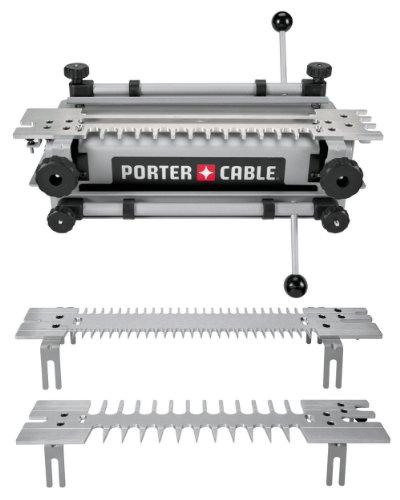
PORTER-CABLE 4212 Deluxe Dovetail Jig

The 4212 is the middle step in the Porter-Cable line: a 12-inch deluxe jig that keeps the 4216’s basic design but trims the kit to two templates and two router bits. It cuts half-blind and through dovetails, which are the two joints most drawer and box work actually calls for, and it handles the same 1/4 inch to 1-1/8 inch stock thickness range as its bigger sibling.
Like the 4216, it uses machined aluminum templates and cam-action clamping, and it comes fully assembled with router bit depth gauges for repeatable setups. If you know you will never cut miniature dovetails or box joints on the jig, the 4212 gives up little that matters. If there is any chance you will want those extra joint types later, the 4216’s third template is the better long-term buy, since template ecosystems are rarely worth piecing together afterward.
Specs
- Model: 4212
- Board capacity: up to 12 inches wide
- Stock thickness: 1/4 inch to 1-1/8 inches
- Templates: 2, machined aluminum
- Joint types: half-blind and through dovetails
- Included: 2 router bits and bit-depth gauges
- Tier: mid-range
POWERTEC 71529 15-Inch Dovetail Jig System

Most bench jigs stop at 12 inches, so the POWERTEC 71529 earns its place by going wider. Its 15-inch template handles broader drawer fronts and small case sides that would need repositioning on a 12-inch jig, and the system is sold as a working kit rather than a bare jig: the box includes the template, a straight edge router bit, a dovetail bit, and the mounting hardware needed to fix it to a bench or shop-made base.
This is a template-based system rather than a self-contained clamping jig, so expect to spend a little more time on initial mounting and alignment than with the Porter-Cable models. In return you get the widest capacity in this roundup at a mid-range tier. It cuts the standard drawer joints, and the included bits mean a first-time buyer can start with a complete package instead of sourcing matched cutters separately.
Specs
- Model: 71529
- Board capacity: up to 15 inches wide
- Joint types: half-blind and through dovetails
- Included: template, straight edge router bit, dovetail bit, and mounting hardware
- Setup: bench or base mounted
- Tier: mid-range
General Tools 861 E-Z Pro Dovetail Jig
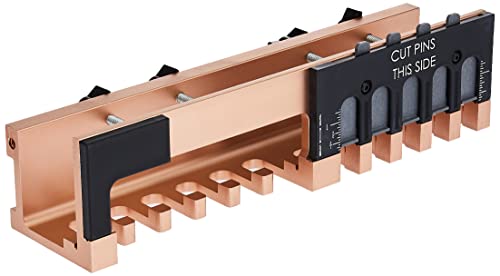
The 861 is the outlier here: a one-piece aluminum jig that weighs under 3 pounds and skips the bench-mounted frame entirely. Its integrated clamping design grips the workpiece without bolting the jig down, and it works with a handheld router or a router table. Despite the simple format, the joint list is broad on paper: half-blind dovetails, through dovetails, box joints, and edge-to-edge joints.
The kit includes a 14-degree, 1/2-inch dovetail router bit, and the 12-inch capacity matches the Porter-Cable jigs for width. What you give up is rigidity and fine adjustment. A light, portable jig depends heavily on careful clamping and test cuts, so treat it as an entry point for occasional drawers and small boxes rather than a production tool. For a first dovetail jig or a small shop with no room for a dedicated bench fixture, that trade makes sense.
Specs
- Model: 861 E-Z Pro
- Board capacity: up to 12 inches wide
- Weight: 2.94 pounds
- Material: aluminum, one-piece layout
- Joint types: half-blind, through, box, and edge-to-edge joints
- Included: 14-degree, 1/2-inch dovetail router bit
- Tier: budget
How to Choose
Start with capacity. Measure the widest board you realistically join: most drawers fit a 12-inch jig, but wide case sides push you toward the 15-inch POWERTEC or toward repositioning stock mid-joint, which risks misalignment. Next, decide between fixed and adjustable templates. Fixed templates, as on the Porter-Cable and POWERTEC jigs, are faster for repeated identical joints and leave less room for setup error. Adjustable fingers, as on the Leigh, take longer to dial in but let you design the joint layout.
Check joint types against your projects. Half-blind dovetails cover most drawer fronts; through dovetails matter for visible case joinery; box joints and miniature dovetails are bonuses worth having only if you build small boxes. Confirm router compatibility before ordering, since these jigs rely on template guide bushings in Porter-Cable style and specific bit diameters. Finally, weigh the kit contents. Jigs that include matched bits and depth gauges cost less time than bare templates that leave you sourcing cutters.
Who Should Skip
Skip a router dovetail jig entirely if you only cut a handful of dovetails a year and enjoy hand work; a dovetail saw and marking gauge will serve you better and take no bench space. Skip the budget portable jig if you plan to batch out kitchen drawers, because its light frame will slow you down. Skip fixed-template jigs if your furniture designs depend on custom pin spacing. And skip every jig here if your router lacks a compatible guide bushing base, since none of these systems work without one.
FAQ
Can one jig cut both pins and tails in a single setup?
On most bench jigs, yes. Both boards are clamped together and routed against the same template, which is why jig-cut dovetails fit consistently. Template systems like the POWERTEC and the General Tools 861 may need the template flipped or the board repositioned between the pin and tail cuts.
What router bits do dovetail jigs need?
Each joint type pairs a dovetail bit with a straight bit, matched to the template and guide bushing size. Kits such as the Porter-Cable 4216 and 4212 and the POWERTEC 71529 include their bits; adjustable systems like the Leigh Super 12 include bits sized for their guide system.
Are jig-cut dovetails as strong as hand-cut dovetails?
A well-fitted jig-cut joint is glued the same way and interlocks the same way, so strength is comparable when the fit is snug. The visible difference is spacing: templates produce evenly spaced pins and tails, while hand cutting allows the fine pins many woodworkers prefer for fine furniture.
Do I need a router table to use a dovetail jig?
No. Bench jigs like the Porter-Cable models and the Leigh Super 12 are designed for a handheld router guided by a template bushing. The General Tools 861 also works on a router table, but a table is an option, not a requirement, for any jig in this roundup.
Final Verdict
The PORTER-CABLE 4216 is the best dovetail jig for routers for most woodworkers: three templates, included bits, and a rigid frame make it the most complete fixed-template package. Pick the Leigh Super 12 when adjustable spacing matters more than setup speed, the POWERTEC 71529 when 15-inch capacity is the deciding factor, the PORTER-CABLE 4212 for a simpler two-joint kit, and the General Tools 861 when budget and portability come first.
Related guides
More from Amazon
Programs that pair well with the guide above. Offers and eligibility are set by Amazon and may change.
A free business account with business pricing and bulk-buying tools for work, shop or home office.
Create a business accountFree shipping on eligible items, Prime Video and more. Eligible new members can start with a free trial.
Start a Prime free trialAudiobooks and podcasts to listen to on the go. Eligible new members can start with a free trial.
Try Audible freeAd-free music streaming. Eligible new subscribers can start with a free trial.
Try Music Unlimited freeAs an Amazon Associate we earn from qualifying purchases.


