
Key takeaways
- Compare the best cutting gauges for woodworking, from a Sheffield rosewood knife gauge to Japanese kebiki and brass wheel gauges, with buying tips.
What's inside
As an Amazon Associate I earn from qualifying purchases. This post may contain affiliate links at no extra cost to you.
- Top Pick: Crown 143 Rosewood Plated Cutting Gauge
- Runner-up: Taytools 464763 Solid Brass Wheel Marking Cutting Gauge
- Also consider: KAKURI Suji Kebiki Marking Gauge, 120 mm
A cutting gauge solves the one layout job a pin marking gauge handles badly: marking across the grain. Instead of a pin that scratches and tears the fibers, a cutting gauge carries a small knife that severs them, leaving a clean, visible line that a chisel edge can register in. For most woodworkers, the best cutting gauge is a traditional Sheffield-pattern knife gauge such as the Crown 143, while Japanese kebiki gauges and brass wheel gauges cover the other two main styles.
This roundup compares five cutting gauges sold on Amazon: a rosewood and brass English knife gauge, two Japanese kebiki in different sizes, and two brass wheel gauges with fine adjustment. Each pick is described from its published specifications only, and the five are spread across budget, mid-range and premium tiers so the differences are easy to compare.
As an Amazon Associate, we earn from qualifying purchases.
Quick Answer
The best cutting gauge for most woodworkers is the Crown 143, a rosewood and brass knife gauge from Sheffield that severs cross-grain fibers cleanly and holds its setting with a brass thumbscrew. Japanese kebiki gauges from KAKURI suit woodworkers who prefer a pull-stroke blade tool, while the Taytools and iGaging wheel gauges add micro-adjustment and graduated beams.
Table of Contents
- Crown 143 Rosewood Plated Cutting Gauge
- Taytools 464763 Solid Brass Wheel Marking Cutting Gauge
- KAKURI Suji Kebiki Marking Gauge, 120 mm
- KAKURI Wood Marking Gauge Kebiki, 90 mm
- iGaging Wheel Marking Gauge Micro-Adjust
- How to Choose
- Who Should Skip
- FAQ
- Final Verdict
Crown 143 Rosewood Plated Cutting Gauge

The Crown 143 is the traditional English cutting gauge in its most refined form, and it is the premium pick on this list. Crown Hand Tools of Sheffield, England builds the body from rosewood, inlays brass wear strips into the face of the fence, and fits a brass thumbscrew for locking. The cutter is a single hardened steel knife, flat on one face and beveled on the other, and it is secured in the end of the beam by a brass wedge rather than a screw.
Because the knife severs fibers instead of dragging through them, the 143 leaves a clean shoulder line across the grain, which is exactly what dovetail baselines, tenon shoulders and hinge gains call for. The brass wear strips protect the fence face where it rides along the reference edge, and the wedge releases with a tap so the knife can be removed for honing.
Specs
- Brand: Crown Hand Tools
- Model: 143
- Gauge type: Cutting gauge, knife style
- Body material: Rosewood with brass wear strips inlaid on the fence
- Cutter: Single hardened steel knife, held by a brass wedge
- Locking: Brass thumbscrew
- Origin: Sheffield, England
- Tier: Premium
Taytools 464763 Solid Brass Wheel Marking Cutting Gauge
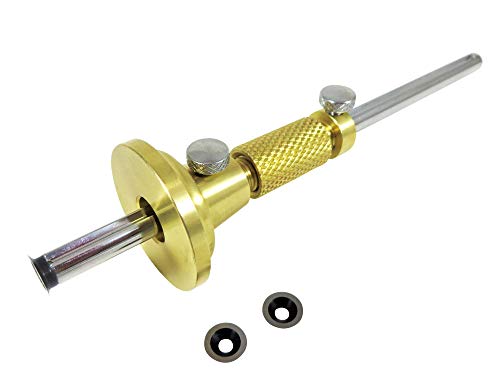
The Taytools 464763 represents the second family of cutting gauges, the wheel type, in which a sharpened disk does the cutting. Its head is solid brass, 1.625 inches in diameter, and it is both lockable and micro-adjustable: a knurled knob and tail move the head in small increments so a setting can be crept up on rather than tapped into place. The hardened steel beam is 7 inches long and 5/16 inch in diameter, and it is grooved so the head cannot rotate while adjustments are made.
The cutter is a hardened round disk 3/8 inch in diameter. It rolls as the gauge is drawn along the edge, slicing fibers on cross-grain and end-grain lines, and it retracts into a countersink in the head when the tool is stored. Two extra cutters are included, so a dull or nicked wheel can be swapped instead of stopping work.
Specs
- Brand: Taytools
- Model: 464763
- Gauge type: Wheel cutting gauge with micro-adjust head
- Head: Solid brass, 1.625 inch diameter, lockable
- Cutter: Hardened round cutter, 3/8 inch diameter, 2 extra cutters included
- Beam: Hardened steel, 7 inches long, 5/16 inch diameter, grooved
- Tier: Premium
KAKURI Suji Kebiki Marking Gauge, 120 mm

The suji kebiki is the Japanese answer to the cutting gauge: a single-blade gauge with a wide fence, used on the pull stroke. This KAKURI version pairs a laminated bamboo body with a Japanese carbon steel blade, and its stated maximum marking width is 120 mm, enough for most furniture parts such as drawer sides, rails and door frames. The blade is beveled on one side, and that bevel pulls the fence toward the reference edge as the cut is made.
Between jobs the blade stores inside the body, which protects the edge in a tool roll or drawer. Adjustment is metric only, and settings are checked on an offcut before the line is committed. Woodworkers who already work with Japanese saws and planes, which are also pulled, will find the motion familiar. It is the mid-range pick here, and the wider-reaching of the two Japanese gauges in this roundup.
Specs
- Brand: KAKURI
- Gauge type: Suji kebiki, Japanese blade marking gauge
- Body material: Laminated bamboo
- Blade: Japanese carbon steel, stores inside the body
- Maximum marking width: 120 mm
- Origin: Made in Japan
- Tier: Mid-range
KAKURI Wood Marking Gauge Kebiki, 90 mm

KAKURI also makes the compact traditional kebiki sold as its 90 mm wood marking gauge, model 40947. The maximum marking width is 90 mm, or 3.5 inches, and the listing gives a weight of 3.17 ounces, so this is a small, light tool aimed at box work, drawer parts and other small-scale layout rather than wide casework panels. The blade is carbon steel and the body follows the same bamboo kebiki pattern as the larger version.
The shorter reach is the trade-off for the compact size: lines more than 3.5 inches from an edge are beyond it. Within that range it does the same work as any knife gauge, severing fibers on shoulder lines instead of tearing them the way a pin does. This is the budget pick for woodworkers who want to try the Japanese style.
Specs
- Brand: KAKURI
- Model: 40947
- Gauge type: Kebiki, Japanese blade marking gauge
- Maximum marking width: 90 mm (3.5 inches)
- Blade material: Carbon steel
- Weight: 3.17 ounces
- Origin: Made in Japan
- Tier: Budget
iGaging Wheel Marking Gauge Micro-Adjust
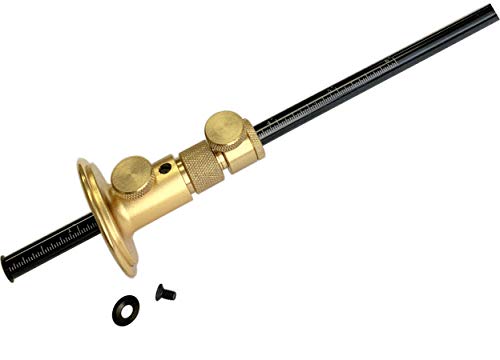
The iGaging wheel marking gauge is the budget route into the wheel style. The body is precision machined from solid brass and closes with a knurled lock nut, and the steel shaft is graduated in both 1 mm and 1/32 inch increments, so a setting can be read straight off the shaft instead of being transferred with a separate rule every time. The free-spinning wheel cuts wood fibers rather than tearing them, which keeps cross-grain lines clean.
An O-ring fitted inside the fence gives the slide a controlled amount of friction, so the fence stays where it is put while still moving smoothly for fine adjustments. The shaft also works as a depth gauge for quick measurement transfers, such as checking mortise depth, which makes this two layout tools in one.
Specs
- Brand: iGaging
- Gauge type: Wheel marking gauge with micro-adjust
- Body: Precision machined solid brass, knurled lock nut
- Shaft: Steel, graduated in 1 mm and 1/32 inch increments
- Fence fit: O-ring inside the fence
- Extra use: Doubles as a depth gauge
- Tier: Budget
How to Choose
Start with the cutter style. A fixed knife, as on the Crown 143, cuts the deepest, most visible line and can be honed to a rounded profile that cuts in both directions. A wheel cutter, as on the Taytools and iGaging gauges, is easier to steer and resists wandering, and dull wheels are replaced rather than sharpened. A kebiki blade pulls the fence into the work and suits a pull-stroke technique.
Next, check the reach against the work you lay out. The KAKURI gauges top out at 90 mm and 120 mm from the edge, while the 7 inch beam on the Taytools covers wider panels. Then look at how settings are held: a thumbscrew and wedge are simple and durable, while a micro-adjust head is slower but more precise.
Finally, consider graduations and spares. Dual-scale beams, like the iGaging shaft marked in 1 mm and 1/32 inch steps, save conversion errors when plans mix units. Included spare cutters, as supplied with the Taytools, keep the tool working when an edge is nicked. Whatever the style, set the gauge from the workpiece or the mating part whenever possible rather than from a nominal dimension.
Who Should Skip
Skip a cutting gauge if nearly all of your layout runs with the grain, where a cheaper pin marking gauge scribes just as well and its pin is simpler to maintain. Skip it, too, if you need paired lines for mortises in a single pass: that is the job of a mortise gauge, which carries two cutters and is covered in a separate guide on this site. Woodworkers who lay out almost entirely with a marking knife and square, one line at a time, may also find a fence-style gauge adds little. And if your work is mostly sheet goods broken down with a track saw from pencil lines, a cutting gauge will sit in the drawer; the tool earns its place in solid-wood joinery.
FAQ
What is the difference between a cutting gauge and a marking gauge?
A marking gauge scribes with a pointed pin, which works well along the grain but can tear fibers across it. A cutting gauge replaces the pin with a small knife, or a sharpened wheel, that severs the fibers, so cross-grain and end-grain lines come out clean and deep enough for a chisel to register in.
Which way should the bevel face on a cutting gauge?
The flat face of the knife should sit on the side of the line you intend to keep, with the bevel facing the waste side. Set up this way, the bevel pushes waste fibers aside and pulls the fence tight against the reference edge, so the kept line stays crisp and exactly on dimension.
Can a cutting gauge replace a marking knife for dovetails?
For baselines, largely yes: a cutting gauge strikes the same shoulder line all the way around a board at one setting, which a knife alone cannot repeat as quickly. Most dovetail work still pairs the two, using the gauge for baselines and a knife for the angled tails and pins.
How do you sharpen a cutting gauge knife?
Remove the knife, by tapping out the wedge on a traditional gauge, and hone the bevel on a fine stone, keeping the back flat. Many woodworkers round the tip slightly so the knife cuts in both directions without digging in. Wheel cutters are not sharpened in the same way; they are rotated to a fresh section or replaced.
Final Verdict
For a single traditional cutting gauge that will handle a lifetime of shoulder lines, the Crown 143 is the pick: rosewood, brass wear strips and a wedge-held Sheffield knife. Woodworkers who prefer to dial in settings should choose the Taytools 464763, while the iGaging covers the wheel style at a budget tier. For the Japanese pull-stroke approach, the KAKURI Suji Kebiki 120 mm offers the wider reach, and the compact KAKURI 90 mm kebiki is the low-cost way into blade-style layout.
Related guides
More from Amazon
Programs that pair well with the guide above. Offers and eligibility are set by Amazon and may change.
A free business account with business pricing and bulk-buying tools for work, shop or home office.
Create a business accountFree shipping on eligible items, Prime Video and more. Eligible new members can start with a free trial.
Start a Prime free trialAudiobooks and podcasts to listen to on the go. Eligible new members can start with a free trial.
Try Audible freeAd-free music streaming. Eligible new subscribers can start with a free trial.
Try Music Unlimited freeAs an Amazon Associate we earn from qualifying purchases.


