What's inside
As an Amazon Associate I earn from qualifying purchases. This post may contain affiliate links at no extra cost to you.
Measuring tools need more care than a box of screws. A steel rule can disappear under a caliper, a micrometer can get knocked against a socket, and a tape measure’s hook can snag on loose dividers. The right drawer setup keeps tools visible and separated without making the drawer so precious that you stop putting things away.
As an Amazon Associate we earn from qualifying purchases at no extra cost to you.


Start with the drawer and the tools
Measure the drawer’s usable inside width, depth, and height—not its outside dimensions. Check for slides, screws, and a drawer bottom that isn’t quite flat. Leave roughly 1/4 inch of clearance at the sides so an insert won’t bind, and make sure dividers stay below the drawer’s inside height. A divider that catches the cabinet frame is a daily annoyance.
Group tools by how they’re used: calipers and micrometers together, rules and squares together, and tapes or layout tools in their own section. Keep frequently used tools near the front. If a caliper lives in a case, make room for the case; removing it may improve access but leaves the instrument more exposed to dust and accidental impact.
Before buying anything, lay the tools out on a bench in the arrangement you want. Include handles, cases, and the room needed to lift each item out. A compartment that fits a caliper exactly may be difficult to use when your fingers can’t get around it.
Compare divider options
| Option | Best for | Trade-off |
|---|---|---|
| Adjustable plastic dividers | Quick, low-cost compartments in a standard drawer | May shift, flex, or leave gaps at the drawer walls |
| Foam insert | Fixed layouts and delicate instruments | Custom cutting takes time; small changes can spoil the fit |
| Wood dividers | Sturdy, changeable sections in a shop-made drawer | Needs measuring, cutting, and a reasonably square drawer |
| Modular bins | Mixed small layout tools, scribers, and accessories | Uses space between bins and can waste room around long tools |
When adjustable dividers make sense
For a first pass, adjustable drawer dividers are an easy way to separate tools without committing to a permanent layout. They work well in drawers with straight sides and tools that aren’t especially fragile. Choose a system with firm connections and enough height to keep tools from rolling over the top; very low dividers are little help if a drawer gets opened hard.
The common failure is movement. A divider that only presses against a slick drawer wall can creep over time, especially when a heavier tool bumps it. Check the fit after loading the drawer and after opening it briskly a few times. If it shifts, add a small non-slip pad under the ends or choose a divider that locks mechanically. Don’t rely on friction alone to hold a layout around heavy steel tools.
Adjustable dividers are also a sensible cheap option if your tool collection changes often. You can reconfigure the drawer in minutes, and a slightly imperfect compartment is usually fine for tape measures, combination squares, or spare rulers.
Use foam selectively
Foam is useful when instruments must not knock together or when you want to spot a missing tool at a glance. A tool drawer foam sheet can be cut to fit a caliper, micrometer case, or precision square. Use a sharp knife and make several shallow passes rather than forcing one deep cut. Test the layout with the tools in place before trimming close to their outlines.
Foam is not automatically the best choice for every measuring tool. Deep, tight cutouts make tools awkward to remove, and thin foam can tear around narrow features. Dust and chips can also collect in recesses. Keep the cutout slightly larger than the tool and leave a finger notch where needed. If you change tools frequently, foam becomes frustrating; a divider system is easier to adapt.
For instruments that already have protective cases, storing the cases in a divided drawer may be safer and simpler than cutting custom foam. Don’t force a precision instrument into a bare cutout if its manufacturer recommends storage in a case.
Wood dividers and small bins
Wood is a good middle ground for a drawer that has a stable tool lineup. Thin plywood strips can form long channels for rules and squares, with crosspieces separating shorter tools. Sand the edges so they won’t snag cloth cases or scratch finished handles. A few drops of removable adhesive can stop strips from wandering, but avoid permanent glue until you’ve used the layout for a week.
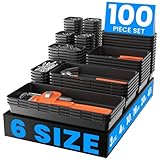
For loose accessories—scriber points, spare batteries, depth rods, or small magnetic bases—modular drawer organizer bins are often more practical than a maze of narrow dividers. They’re easy to lift out for cleaning and can be rearranged as the collection changes. Their drawback is wasted space: a bin around a long rule leaves more dead area than a simple channel.
Build a layout that stays usable
Keep long tools in a compartment aligned with the drawer’s depth or width, whichever gives them the easiest clearance. Don’t stack steel rules on top of calipers or micrometers. Put heavy squares and tape measures where they cannot slide into delicate instruments when the drawer closes. If the drawer is deep, use a shallow tray for small items rather than burying them beneath long tools.
Allow a little slack around every tool. If you need two hands or have to lift neighboring tools to remove one, the compartment is too tight. Check the drawer after a few weeks: look for shifted dividers, foam tearing, tools rubbing together, and dust collecting in places that are hard to clean. Rework the layout before those small problems turn into damaged tools or a drawer nobody wants to use.