Key takeaways
- Step a dust line down without choking it: the best reducers for 5-to-4, 4-to-3 and 4-to-2-1/2 inch drops and small tool ports, with fit notes.
What's inside
- Quick Answer
- Table of Contents
- POWERTEC 70186 Threaded Quick Coupler Adapter, 5 x 4 Inch
- POWERTEC 70475 4-Inch to 3-Inch Reducer and Flex Cuff Kit
- POWERTEC 70423 4-Inch to 2-1/2-Inch Reducer and Flex Cuff Kit
- POWERTEC 70338-P2 4-Inch to 2-1/2-Inch Hose Cone Reducer, 2-Pack
- POWERTEC 70140-P2 2-1/2-Inch to 1-1/4-Inch Hose Reducer, 2-Pack
- How to Choose
- Who Should Skip
- FAQ
- Conclusion
- Product and ASIN Reference
As an Amazon Associate I earn from qualifying purchases. This post may contain affiliate links at no extra cost to you.
Sooner or later every dust collection layout hits a size mismatch. The collector inlet is 5 inches, the trunk line is 4, one machine drops to 3, and the sander at the end of the bench presents a port barely over an inch wide. A reducer is the fitting that bridges each of those steps, and the wrong one in the wrong place quietly costs suction.
This roundup covers the step-downs a home shop actually needs: a threaded coupler for the 5-to-4 transition at the collector, reducer-and-cuff kits for the 4-to-3 and 4-to-2-1/2 drops, a hose-to-hose cone reducer pair, and a small reducer pack for 2-1/2-to-1-1/4 tool ports. Every pick is a passive fitting, so the differences that matter are fit style, included clamps and cuffs, and published dimensions.
As an Amazon Associate, we earn from qualifying purchases.
Quick Answer
Start with the POWERTEC 70423 kit for the common 4-to-2-1/2 inch drop, because its flex cuff seals onto real machine ports instead of only hose ends. Use the POWERTEC 70186 threaded coupler where a 5-inch line meets a 4-inch threaded port, the 70475 kit for a 4-to-3 drop, the 70338-P2 cone pair for hose-to-hose joins, and the 70140-P2 pack for 1-1/4 inch tool ports.
Table of Contents
- POWERTEC 70186 Threaded Quick Coupler Adapter, 5 x 4 Inch
- POWERTEC 70475 4-Inch to 3-Inch Reducer and Flex Cuff Kit
- POWERTEC 70423 4-Inch to 2-1/2-Inch Reducer and Flex Cuff Kit
- POWERTEC 70338-P2 4-Inch to 2-1/2-Inch Hose Cone Reducer, 2-Pack
- POWERTEC 70140-P2 2-1/2-Inch to 1-1/4-Inch Hose Reducer, 2-Pack
- How to Choose
- Who Should Skip
- FAQ
- Conclusion
POWERTEC 70186 Threaded Quick Coupler Adapter, 5 x 4 Inch

Many mid-size collectors present a 5-inch inlet while the shop’s hose and fittings are all 4-inch, and that first joint is where this coupler earns its place. One end accepts the 5-inch side of the system; the other is a threaded 4-inch connection that screws onto threaded machine ports instead of relying on friction and a clamp alone. A threaded joint resists the creep that works friction joints loose when hose gets dragged around the shop.
Because it is molded ABS rather than thin stamped metal, the body tolerates being snugged down firmly, and the compact footprint adds almost no length to the run. Reach for it at the collector inlet or on any machine whose port is threaded; on smooth ports it is the wrong tool, and the cuff kits below are the answer.
Specs
- Size step: 5 inch to 4 inch
- Connection: Threaded quick coupler
- Material: ABS (acrylonitrile butadiene styrene)
- Color: Black
- Item dimensions: 5 x 5.2 x 5.2 inches
- Part number: 70186
- UPC: 709619853693
- Item weight: Not stated
- Best for: Stepping a 5-inch inlet or hose down to a threaded 4-inch port
- Tier: Mid-range
POWERTEC 70475 4-Inch to 3-Inch Reducer and Flex Cuff Kit

The 4-to-3 step shows up on older machines, some European tools and a handful of planers and jointers whose ports never joined the 4-inch standard. This kit pairs the rigid reducer with a 4-inch dust control flex cuff and steel hose clamps, and the cuff is what makes it useful: machine ports are outside-diameter fittings, and a rigid reducer alone often rocks on them or leaves a crescent gap that leaks.
The rubber cuff stretches over the port, absorbs the small diameter errors nominal sizing hides, and clamps down into a seal. That makes the kit a practical fix at the machine end of a drop, exactly where a reducer belongs. If your 3-inch connection is hose-to-hose, the cuff goes unused and a plain cone reducer is the leaner buy.
Specs
- Size step: 4 inch to 3 inch
- Includes: Reducer, 4-inch dust control flex cuff, steel hose clamps
- Cuff type: Rubber flex cuff coupler
- Part number: 70475
- UPC: 843441145172
- Material: Not stated
- Item weight: Not stated
- Best for: Sealing a 4-inch hose onto a 3-inch machine port
- Tier: Budget
POWERTEC 70423 4-Inch to 2-1/2-Inch Reducer and Flex Cuff Kit

This is the step-down most home shops buy, because 2-1/2 inch is the working size for shop vacuum hose, smaller band saws, miter saws and benchtop tools hanging off a 4-inch system. Like the 4-to-3 kit above, it bundles the cone reducer with a 4-inch flex cuff, here with stainless steel key hose clamps that tighten by hand, no nut driver needed. That matters at a machine drop you disconnect for cleaning, where tool-free clamps turn a chore into a ten-second job.
Used at the end of a branch, it lets a 4-inch drop serve a low-volume tool without giving up the big line’s capacity elsewhere. Keep it off the trunk: reducing a main line to 2-1/2 inches starves every machine downstream.
Specs
- Size step: 4 inch to 2-1/2 inch
- Includes: Cone reducer, 4-inch dust control flex cuff, stainless steel key hose clamps
- Clamp style: Key clamps, tool-free tightening
- Part number: 70423
- Material: Not stated
- Item weight: Not stated
- Best for: Dropping a 4-inch branch to a 2-1/2 inch tool or shop vacuum hose
- Tier: Mid-range
POWERTEC 70338-P2 4-Inch to 2-1/2-Inch Hose Cone Reducer, 2-Pack
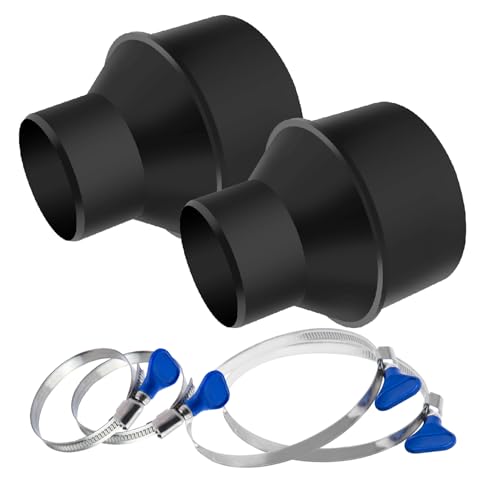
Some joints are hose to hose: a 4-inch flex run that continues as a 2-1/2 inch hose to reach a mobile machine, with no machine port involved. This two-pack is built for that joint. Each cone reducer carries published, measured dimensions rather than nominal ones alone: the large end measures 3-61/64 inches outside diameter and 3-41/64 inches inside, the small end 2-15/32 inches outside and 2-9/32 inches inside, so you can check it against your actual hose before ordering.
Two reducers and a full set of key clamps, two at 4 inch and two at 2-1/2 inch, cover a pair of drops in one purchase. The maker’s own note is worth repeating: these cones fit hose inside diameters and ID ports, and a reducer alone will not seal onto an outside-diameter machine port. For that joint, pair it with a flex cuff or choose a cuff kit above.
Specs
- Size step: 4 inch hose to 2-1/2 inch hose
- Pack contents: 2 cone reducers, 2 key clamps of 4 inch, 2 key clamps of 2-1/2 inch
- Large end: 3-61/64 inch OD, 3-41/64 inch ID
- Small end: 2-15/32 inch OD, 2-9/32 inch ID
- Fit note: Hose ID connections; OD ports need a flex cuff
- Part number: 70338-P2
- Item weight: Not stated
- Best for: Joining a 4-inch hose run directly to a 2-1/2 inch hose
- Tier: Budget
POWERTEC 70140-P2 2-1/2-Inch to 1-1/4-Inch Hose Reducer, 2-Pack

The last step in many shops is the smallest: a 2-1/2 inch vacuum hose that has to meet the 1-1/4 inch ports on random orbit sanders, compact routers, biscuit joiners and track saws. This two-pack makes that reduction with a short molded body, and the pair format is the point. Leaving one reducer parked on each of two tools ends the ritual of swapping one shared adapter between machines.
Airflow expectations need setting honestly. A 1-1/4 inch port passes a fraction of the air a 4-inch line carries, so this reducer belongs on a shop vacuum circuit or the end of a short drop serving a fine-dust tool, where high velocity in a small hose carries the dust. It is a finishing fitting for small tools, not a way to run a planer.
Specs
- Size step: 2-1/2 inch to 1-1/4 inch
- Pack contents: 2 hose reducers
- Part number: 70140-P2
- Material: Not stated
- Item weight: Not stated
- Best for: Connecting a 2-1/2 inch hose to small 1-1/4 inch tool ports
- Tier: Budget
How to Choose
Place the reducer as close to the tool as the layout allows. Air moves best in the largest duct that reaches the machine, so a 5-to-4 step belongs at the collector, a 4-to-2-1/2 step at the end of the branch, and nothing should step down mid-trunk. Every reduction is a choke point: the smaller section raises air speed locally but cuts total volume, which is why a planer or jointer should never sit downstream of one.
Match the fitting to the joint, not just the size. Dust ports on machines are outside-diameter connections, and a rigid reducer sized to the same nominal number often will not seal on them; that is the joint a flex cuff exists to fix. Hose-to-hose joints are inside-diameter work, where a cone reducer with clamps is the cheaper answer, and threaded ports deserve the threaded coupler rather than tape and hope.
Finally, measure before ordering. Nominal dust sizes hide real variation between brands, and the honest listings publish measured OD and ID figures, like the cone reducer above. A reducer a thirty-second of an inch off in the hand is a leak you paid for.
Who Should Skip
Skip this roundup if your layout is a single 4-inch collector serving only 4-inch machines; you need couplers and blast gates, not reducers. Skip it, too, if you plan to reduce a trunk line to feed a high-volume machine: no fitting fixes that, and the answer is a larger duct run or a second drop at full size. Shops on a shop vacuum alone should start with the small-port pack, and woodworkers chasing a fully metal, grounded duct system will find these molded fittings the wrong material class.
FAQ
Where in a run should a reducer go?
As close to the tool as possible. Keep the duct at full diameter for as much of the run as you can, then step down at the machine drop. Reducing early turns the rest of the branch into a small duct, while reducing late costs almost nothing on a low-volume tool.
Will a reducer hurt my dust collector’s suction?
At the machine it serves, yes, somewhat: a smaller opening passes less air, and the tool’s own port usually limits flow more than the reducer does. The real damage comes from reducing a shared trunk, which starves every machine downstream. One reducer at the end of a branch is normal practice; a reduced main line is a design error.
How do I know whether a reducer will fit my port?
Check whether the joint is a port or a hose end. Machine ports are outside diameter, so look for a reducer sold with a flex cuff, or plan to add one. Hose ends are inside diameter, where cone reducers are sized to fit. When a listing publishes measured OD and ID figures, compare them against your own fitting instead of trusting the nominal size.
Can I stack two reducers to step down twice?
You can, and a 5-to-4 coupler followed later by a 4-to-2-1/2 kit is a normal layout, but the steps should happen at different points in the run, each near the connection that needs it. Stacking two reducers back to back at one joint builds a long, turbulent choke that collects chips; one correct reducer, or a cuff that bridges the difference, is the cleaner joint.
Conclusion
Reducers are unglamorous fittings that decide whether a mixed-size shop works as one system. The 70186 coupler handles the 5-to-4 step at threaded ports, the 70475 and 70423 cuff kits seal the 4-to-3 and 4-to-2-1/2 drops onto real machine ports, the 70338-P2 cones join hose to hose with verifiable dimensions, and the 70140-P2 pack finishes the run at small tool ports. Buy the joint you actually have, keep each step close to its tool, and a system built from three sizes of hardware will pull like it was designed that way, because it was.
Product and ASIN Reference
| Product | ASIN |
|---|---|
| POWERTEC 70186 Threaded Quick Coupler Adapter, 5 x 4 Inch | B01FCUAA84 |
| POWERTEC 70475 4-Inch to 3-Inch Reducer and Flex Cuff Kit | B0DQBDS3WJ |
| POWERTEC 70423 4-Inch to 2-1/2-Inch Reducer and Flex Cuff Kit | B0CV52DY9Q |
| POWERTEC 70338-P2 4-Inch to 2-1/2-Inch Hose Cone Reducer, 2-Pack | B09TNQ6YBG |
| POWERTEC 70140-P2 2-1/2-Inch to 1-1/4-Inch Hose Reducer, 2-Pack | B0BH3Y62G6 |
Related guides
More from Amazon
Programs that pair well with the guide above. Offers and eligibility are set by Amazon and may change.
A free business account with business pricing and bulk-buying tools for work, shop or home office.
Create a business accountFree shipping on eligible items, Prime Video and more. Eligible new members can start with a free trial.
Start a Prime free trialAudiobooks and podcasts to listen to on the go. Eligible new members can start with a free trial.
Try Audible freeAd-free music streaming. Eligible new subscribers can start with a free trial.
Try Music Unlimited freeAs an Amazon Associate we earn from qualifying purchases.