What's inside
As an Amazon Associate I earn from qualifying purchases. This post may contain affiliate links at no extra cost to you.
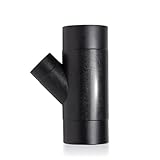
A Y-adapter lets one dust collector serve two machines, but it does not give each machine the airflow it needs automatically. The collector, hose, fittings, and blast gates all affect performance. For small tools such as a benchtop sander and a scroll saw, a well-sized Y can be a practical way to share a collector. For a planer or other high-chip-volume machine, that same setup may leave you with clogged hoses and dust escaping at the hood.
As an Amazon Associate we earn from qualifying purchases at no extra cost to you.



What to check before buying
Match the adapter to the hose and machine ports you actually have. Small machines often use 2-1/2-inch ports, while larger dust-collection ducting commonly uses 4-inch connections. Measure the outside diameter of each port and hose; labels such as “2-1/2 inch” can refer to a nominal size, and adapters are not always a snug fit. Check whether the Y has stepped ends, plain ends, or cuffs, and plan for reducers if the sizes differ.
For two small machines, a 4-inch trunk splitting into two 2-1/2-inch branches is a common arrangement. Do not assume that a Y with two 4-inch outlets will work well if the collector and main hose are only 2-1/2 inches. The smaller upstream section remains the bottleneck.
Look for a smooth interior and a gradual split. A sharp-edged junction and abrupt reductions can add resistance and collect chips. If the fitting’s branch ends are plain, secure flexible hose with clamps rather than relying on friction alone. Tape can help seal a minor air leak, but it is not a substitute for a connection that stays mechanically secure.
Which Y-adapter style makes sense?
| Style | Best fit | Trade-off |
|---|---|---|
| Rigid plastic Y | Fixed shop layout with matching hose sizes | Usually inexpensive and smooth inside, but awkward to reposition |
| Stepped or reducing Y | Different port and hose diameters | Convenient, but a reducer can narrow airflow if sized poorly |
| Metal Y | Rougher service or a permanent duct run | Durable, but may cost more and still need adapters for small ports |
| Two-way fitting with separate blast gates | Alternating between machines | More parts and a little extra resistance, but lets you close the unused branch |
For a portable collector and two nearby benchtop tools, a 2-1/2-inch dust-collection Y-adapter is a straightforward, low-cost starting point. Verify the end dimensions before ordering; some fittings have one 4-inch inlet and two smaller outlets, while others are the same diameter throughout.
Plan on controlling the branches
If both tools are used one at a time, install a blast gate on each branch and keep the gate for the active machine open. Leaving both branches open divides the available airflow. The inactive tool’s open hood or port acts as an easy path for air, so suction at the machine you are using can drop noticeably.
For two 2-1/2-inch branches, use gates that fit the branch diameter and check that the sliders move freely after installation. Fine dust can make a cheap gate stick. A 2-1/2-inch blast gate is usually worth adding when only one machine runs at a time. If both machines genuinely need collection simultaneously, an open-and-shut gate setup does not solve the airflow problem: the collector must provide enough airflow through both branches.
Size the system around airflow
A Y-adapter cannot create airflow. Check the collector’s specifications and the machine manufacturers’ port requirements, then account for hose length, bends, filters, and reducers. A long run of narrow, corrugated hose can perform much worse than a short, smooth run. Keep branches as short and straight as practical; avoid stacking several reducers and elbows right at the fitting.
As a rough area comparison, one 4-inch round duct has about 12.6 square inches of cross-sectional area. Two 2-1/2-inch branches together have about 9.8 square inches. That does not guarantee a particular airflow, but it shows why splitting a small trunk into two large branches does not make the collector stronger. For a collector with a 4-inch outlet feeding two small tools, a 4-inch-to-two-2-1/2-inch reducing Y can be a sensible match, provided the collector and hoses are suitable for the load.
Common problems and quick checks
Dust escapes at the machine hood: close the unused branch first. If collection is still weak, inspect for a loose hose, clogged filter, full bag, or a hood that does not capture dust well. A fitting change will not fix a collector that is already restricted.
Large chips lodge at the split: remove sharp reductions and tight bends near the Y, and check that the machine port is not smaller than the chips it produces. A compact Y intended for fine dust may be a poor choice for a chip-heavy machine.
The adapter keeps separating: use correctly sized cuffs or clamps and support heavy hose so its weight is not pulling on the fitting. Do not force a nominally similar diameter onto the connection; it can split a plastic fitting or leak under vibration.
Both machines run poorly together: test each machine alone with its branch open, then compare with both gates open. If performance falls sharply with both running, use the machines in turns or upgrade the collector and ducting. A bigger Y alone will not address an undersized fan or filter.
A practical buying choice
For two small machines used alternately, buy a smooth Y sized to the main hose, add two matching branch hoses, and fit blast gates if they are not already in the system. The least expensive plastic fitting is fine when the sizes match, the layout is fixed, and the hose is supported. Pay more for a reducing or metal fitting only when its sizing, durability, or layout advantage addresses a real need. Before committing, dry-fit the parts, open one branch at a time, and check for leaks and visible dust escaping at the tool during a short test cut.