What's inside
As an Amazon Associate I earn from qualifying purchases. This post may contain affiliate links at no extra cost to you.
Why Lockable Drawers Work in Shared Workshops
A shared workshop needs storage that separates ownership, controls access, and survives daily use. Open shelves are convenient, but they make small tools easy to misplace and expensive tools easy to borrow without asking. A lockable drawer unit gives each user a defined space while keeping the bench area clear.
The best choice is usually a steel drawer cabinet or a mobile tool chest with a built-in lock. Drawers are more practical than a locked cupboard for hand tools because you can see the contents at once and avoid stacking boxes. They also keep tools away from dust, grinding debris, and accidental spills. However, no drawer cabinet is completely dustproof. Fine sanding dust will still enter through gaps around the drawer fronts unless the cabinet has proper seals.
As an Amazon Associate we earn from qualifying purchases at no extra cost to you.

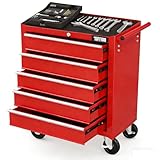


Start with your largest tools and work backward. A drawer that is only 2 inches high may hold pliers, drivers, and measuring tools, but not a cordless drill or compact sander. Measure the actual tools, including cases and battery packs, before buying.
Drawer Cabinet Features That Matter
Lock type: A keyed cam lock is simple and inexpensive. It is suitable for keeping casual users out, but it is not high security; many low-cost cabinets use similar keys. A tubular lock or removable-core lock offers better resistance to picking and makes key replacement easier. For several users, a combination lock avoids the problem of one missing key, but mechanical combination locks can become awkward when wearing gloves.
Drawer capacity: Look for a stated capacity of at least 75 to 100 pounds per drawer for general workshop storage. Heavy steel drawers with full-extension ball-bearing slides are worth paying for when storing sockets, clamps, or metalworking tools. Cheap slides may bend or jam if a drawer is loaded unevenly. Do not assume the cabinet’s total capacity is evenly distributed; a unit rated for 600 pounds may allow only 60 pounds per drawer.
Anti-tip protection: A tall cabinet should prevent more than one drawer from opening at a time. With three or four loaded drawers extended, the center of gravity can move far enough forward to tip the cabinet. If the unit does not have an interlock, secure it to a wall or workbench. Anchoring is still sensible in a busy shop, especially where children or visitors may pull on drawers.
Drawer height: Shallow drawers are efficient for small hand tools, but deep drawers are needed for power tools and bottles. A useful mix is two or three drawers under 3 inches high, two drawers around 4 to 6 inches, and one deep drawer of 8 inches or more. Avoid buying a cabinet with six identical drawers unless your tools are unusually uniform.
Best Storage Types for a Shared Space
| Storage type | Best use | Advantages | Limitations |
|---|---|---|---|
| Locking steel drawer cabinet | Dedicated hand tools and consumables | Strong, compact, easy to label | Usually stationary; limited space for bulky tools |
| Rolling tool chest | Tools used across the shop | Mobile, large capacity, often has a top work surface | Wheels can wander; more expensive and easier to overload |
| Lockable drawer insert or box | One user’s small tool kit | Low cost, portable, fits inside existing furniture | Less secure; limited drawer size and durability |
| Locking plastic cabinet | Light tools and supplies in damp areas | Does not rust, often inexpensive | Less resistant to prying, heat, and heavy loads |
For most shared garages, a locking steel tool cabinet is the sensible starting point. It costs less than a large professional roller chest and does not consume valuable floor space. A plastic locking cabinet is fine for spare drill bits, abrasives, or plumbing fittings, particularly in a damp shed where steel would rust. It is not the right place for expensive cordless tools.
How to Organize the Drawers
Divide each drawer by task rather than by tool brand. Put measuring tools together, electrical tools together, and fastening tools together. A drawer full of loose drivers and pliers becomes difficult to inventory, so use foam cutouts, shallow bins, or adjustable dividers. Foam also shows when a tool is missing, which matters in a shared space.
Keep the heaviest items in the lowest drawers. This lowers the cabinet’s center of gravity and reduces tipping. Do not place a loaded drawer chest on a narrow wheeled dolly unless the base is mechanically secured. A cabinet that shifts when a drawer opens is both annoying and dangerous.
Label drawers on the front, not on the inside. Use large labels such as “electrical,” “layout,” or “grinding PPE.” For individually owned drawers, add the user’s name and agree that unlabelled tools are communal. This prevents ownership arguments without turning the entire workshop into a locked room.
For small, high-value items such as inspection meters, specialty cutters, or battery adapters, consider a lockable tool box with drawers. It is cheaper than a full cabinet and can sit inside a larger shared chest. The trade-off is that anyone with access to the outer chest may still be able to remove or damage it.
Placement, Dust, and Shop Safety
Place the cabinet away from the dust collector’s discharge, sanding station, and areas where metal chips fall. Dust in drawer slides becomes abrasive paste when mixed with lubricant. If the cabinet must sit near a saw, use a simple cover when cutting and vacuum the exterior before opening drawers. Never blow dust into the drawer gaps with compressed air; it drives debris deeper into the slides.
Leave enough clearance to open drawers fully. A cabinet needs roughly 36 inches of working space in front of it, and a rolling unit may need more if it will be repositioned. Do not block the path to the fire extinguisher, electrical panel, first-aid kit, or exit.
Locking storage does not replace safe handling. Store blades and sharp cutters in protective sleeves, keep oily rags in a self-closing metal container, and keep batteries away from heat and metal scraps. If children use the space, choose a cabinet that can be anchored and keep the key or combination separate from the workshop.
When a Cheaper Cabinet Is Enough
A low-cost cabinet is perfectly adequate for screwdrivers, pliers, sanding discs, and routine fasteners if it has a real metal frame, positive drawer stops, and a lock that engages reliably. Check the drawers in person if possible: pull each one open, lift gently on the front, and look for excessive flex. A little play is normal; binding under light pressure is a warning sign.
Spend more on heavy-duty slides, anchoring hardware, and a better lock when the cabinet will hold expensive equipment or be used every day. The most useful upgrade is often not a premium finish but a deeper drawer layout and stronger casters. If mobility is important, choose a locking rolling tool chest with full-extension drawers, then lock its wheels whenever it is parked. A stationary cabinet is safer and cheaper when tools stay in one work zone.