
What's inside
- Best budget drill presses at a glance
- 1. WEN 4214T: best low-cost drill press for accuracy and capacity
- 2. WEN 4212T: best compact all-rounder
- 3. WEN 4208T: best for occasional, small-hole work
- 4. JET JDP-10: the stability upgrade
- What actually determines accuracy?
- Choose by your workshop situation
- Setup and ownership details that affect results
As an Amazon Associate I earn from qualifying purchases. This post may contain affiliate links at no extra cost to you.
The best low cost drill press for most woodworkers is the WEN 4214T: its 12-inch swing, 3-1/8-inch quill travel, variable-speed control, and 5/8-inch chuck give it a useful accuracy advantage over compact benchtop machines without moving into professional-shop pricing.
That recommendation assumes you have room for a roughly 85-pound benchtop machine and regularly drill larger stock. If space and budget are tighter, the WEN 4212T is the better general-purpose value, while the WEN 4208T is the sensible choice for occasional small-hole work.
As an Amazon Associate we earn from qualifying purchases at no extra cost to you.
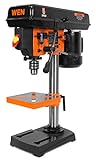
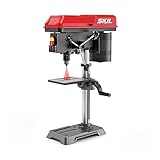
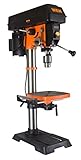

Best budget drill presses at a glance
| Model | Typical market range | Swing | Quill travel | Chuck | Speed range | Approx. weight | Best use |
|---|---|---|---|---|---|---|---|
| WEN 4208T | $120–$160 | 8 in. | 2 in. | 1/2 in. keyed | 740–3,140 rpm, 5 speeds | 31 lb | Small parts and occasional drilling |
| WEN 4212T | $180–$240 | 10 in. | 2.5 in. | 1/2 in. keyed | 530–3,100 rpm, variable | 52 lb | Best compact all-rounder |
| WEN 4214T | $280–$380 | 12 in. | 3-1/8 in. | 5/8 in. keyed | 580–3,200 rpm, variable | 85 lb | Best overall budget choice |
| JET JDP-10 | $500–$650 | 10 in. | 2-1/2 in. | 5/8 in. keyed | 600–2,400 rpm, 16 steps | about 150 lb | Heavier, more stable workshop use |
Specifications and included accessories can change by production year and retailer, so confirm the manual before buying. The table is most useful for comparing machine size and capability, not as a substitute for checking the exact listing.
1. WEN 4214T: best low-cost drill press for accuracy and capacity
The 4214T is the strongest choice when “low cost” still needs to mean capable rather than merely inexpensive. Its 12-inch swing lets you place a hole up to 6 inches from the edge of a workpiece, and its 3-1/8-inch quill travel reduces the need to reposition tall stock. That matters for deep mortises, stacked templates, large Forstner bits, and repeated work.
The 5/8-inch keyed chuck accepts larger shanks than the 1/2-inch chucks on many entry-level presses. Its variable-speed range is also useful for woodworking: high speed suits small twist bits, while the lower end is safer and more effective for larger Forstner bits.
The compromises are size, weight, and budget. This is still a light-duty benchtop press, not a floor-standing production machine. The table and column can flex if the work is pushed aggressively, and the stock table may need careful squaring and a sacrificial plywood surface. Expect to spend roughly $280 to $380, plus the cost of a sturdy stand if you do not already have one.
2. WEN 4212T: best compact all-rounder
The 4212T makes the most sense for a small garage shop, apartment workshop, or beginner who wants more control than a hand drill provides. Its 10-inch swing and 2.5-inch quill travel cover most cabinet hardware, dowel-jig, hinge, and general furniture-drilling tasks. Variable speed avoids the repeated belt-cover adjustments found on five-speed machines.
Its 1/2-inch chuck is adequate for common woodworking bits, though it limits some larger-shank accessories. Runout is the more important question: inexpensive presses can show noticeably more movement at the chuck than at the spindle taper, and a cheap or poorly seated bit magnifies it. For clean holes, use short, straight-shank bits and check the chuck with a dial indicator if precision matters.
At approximately $180 to $240, the 4212T is often the best low cost drill press for someone who uses a machine several times per month but cannot justify the larger 4214T.
3. WEN 4208T: best for occasional, small-hole work
The 4208T is a basic 8-inch benchtop press with a 1/2-inch keyed chuck, 2 inches of quill travel, and five belt-selected speeds. It is a practical upgrade from drilling freehand when the work consists mainly of small holes in thin boards, brackets, handles, and simple jigs.
Its limitations appear quickly with wide panels and large bits. An 8-inch swing only reaches 4 inches from the bit to the column, and the 2-inch quill travel means frequent table or workpiece repositioning. Its lowest speed is also relatively high for large Forstner bits. Use it for bits around 1/2 inch and smaller unless the material and bit manufacturer permit otherwise.
The approximately $120 to $160 price is attractive, but budget for a rigid bench and clamps. A flexible table or lightweight stand can make an inexpensive drill press appear less accurate than it actually is.
4. JET JDP-10: the stability upgrade
The JDP-10 costs considerably more than the WEN machines, but it belongs in this comparison for buyers who value mass and repeatability over the lowest purchase price. Its heavier construction, 10-inch swing, 2-1/2-inch quill travel, and 5/8-inch chuck make it better suited to frequent shop use.
Its stepped speed system is less convenient than variable speed, but mechanical pulley changes can be dependable over time. The additional mass reduces vibration, which is particularly helpful with Forstner bits and larger holes. The disadvantage is clear: at roughly $500 to $650 and about 150 pounds, it is no longer a casual low-cost purchase.
What actually determines accuracy?
Runout
Runout is the amount the bit’s tip wobbles as the spindle rotates. It is affected by the spindle, chuck, arbor, and bit—not just the motor. A press with modest published specifications can drill cleanly with a good chuck, while a nominally precise machine can produce poor holes if the chuck is dirty or the bit is bent.
For woodworking, a practical target is roughly 0.003 to 0.005 inch of runout at the chuck for general work. Budget machines may be less consistent. Check runout with a straight test rod rather than a fluted drill bit, and measure close to the chuck before measuring at the rod’s tip.
Usable quill travel
Advertised travel is not the same as usable drilling depth. The quill may reach its limit before a long bit clears the chuck, and a depth stop can reduce the available range. A 2-inch-travel machine is fine for thin boards; 2.5 to 3-1/8 inches is more comfortable for furniture parts, stacked templates, and deep holes.
Table adjustment
Look for a table that tilts, rotates around the column, and locks firmly. A table that slips under pressure ruins angle accuracy regardless of runout. Before drilling, verify that the table is square to the spindle with a small engineer’s square or a drill-press alignment tool. A plywood insert also prevents tear-out and protects the cast-iron surface.
Speed range
Use speed as a material-and-diameter decision rather than a marketing number. A useful approximate rule for woodworking is:
- 1/8-inch twist bit: about 2,500–3,000 rpm
- 1/4-inch bit: about 1,500–2,500 rpm
- 1/2-inch bit: about 700–1,500 rpm
- 1-inch Forstner bit: about 500–900 rpm
These are starting points, not universal limits. Follow the bit maker’s instructions, reduce speed for hard materials and large diameters, and never force a stalled bit.
Choose by your workshop situation
| Your situation | Best choice | Why |
|---|---|---|
| Under $170, occasional use, little bench space | WEN 4208T | Small footprint and adequate basic capacity |
| $180–$250, beginner or regular hobby use | WEN 4212T | Variable speed and useful 10-inch swing |
| Frequent furniture work and larger bits | WEN 4214T | Longest quill travel and 5/8-inch chuck |
| High frequency, permanent shop installation | JET JDP-10 | More mass and better resistance to vibration |
Setup and ownership details that affect results
Plan on 30 to 60 minutes for assembly and alignment. Bolt the press to a rigid stand, remove shipping grease from the column, clean the chuck jaws, and lightly lubricate the rack-and-pinion mechanism according to the manual. Do not lubricate the belt or spindle taper.
Before the first project, square the table, check the belt tension, and test a straight rod for runout. Mark the table height for common operations. Clamp small workpieces rather than holding them by hand; a spinning board can catch even at modest speed.
The first parts likely to wear are chuck jaws, belts, depth-stop threads, and table-lock hardware. Keep sawdust out of the quill and motor vents, wipe cast iron after use, and replace a glazed or cracked belt instead of increasing tension. A quality brad-point bit often improves hole quality more than upgrading from one budget press to another.
For most buyers, the WEN 4212T is the value sweet spot, but the WEN 4214T is the better long-term purchase if you can accommodate its footprint. The 4208T is a legitimate low cost drill press for limited work; it becomes poor value only when its restricted swing, travel, and speed range force constant workarounds.