
What's inside
- Best Mini Drill Presses of 2026: Precision Drilling for Small Shops
- Compact drill presses compared
- Choose by the work, not the word “mini”
- What accuracy means in a mini drill press
- How to check a press before trusting it with a workpiece
- Speeds, bits, and setup for clean holes
- Ownership details that affect accuracy
- Bottom line
- Related Guides
As an Amazon Associate I earn from qualifying purchases. This post may contain affiliate links at no extra cost to you.
Best Mini Drill Presses of 2026: Precision Drilling for Small Shops
The best mini drill press for most small-shop work is a compact benchtop model with a 1/2-inch chuck, a rigid cast-iron table and base, an adjustable depth stop, and a stated speed range broad enough for both small bits and larger cutters. For pen blanks and models, prioritize low runout and a small footprint; for dowel work, prioritize throat depth and a repeatable stop.
There is no single winner for every bench. Mini presses vary in how much room they need, how far they reach from the column, and how consistently they return to a set drilling depth. The comparison below uses published specifications as a starting point, then explains what to check before buying. Manufacturers do not publish runout figures consistently, so do not assume that a low price or high wattage means better accuracy.
As an Amazon Associate we earn from qualifying purchases at no extra cost to you.



Compact drill presses compared
| Press | Published capacity and speeds | Table and reach | Best fit |
|---|---|---|---|
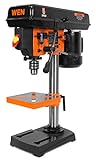
| WEN 4208T | 8-inch swing; 1/2-inch chuck; 5 speeds, 740–3140 RPM | 6.5-inch square table; approximately 23 inches tall | Budget drilling and general small-shop jobs |
| WEN 4210T | 10-inch swing; 1/2-inch chuck; 5 speeds, 600–3100 RPM | 7.5-inch square table; approximately 29 inches tall | More reach and workpiece room without moving to a floor press |
| Proxxon TBM 115 | Approximately 1/8-inch chuck capacity; variable speed, 1,800–8,500 RPM | Compact precision-tool format; small work area | Model parts, small holes, and fine-bit work |
| Eurotool DRL-300.00 | Approximately 1/8-inch chuck capacity; variable speed, up to about 8,500 RPM | Small bench footprint; intended for light-duty work | Jewelry, craft, and miniature-part drilling |
Specifications can change between versions and markets. Confirm the exact model’s manual for dimensions, speed range, chuck capacity, and included accessories before purchase. Swing is twice the distance from the spindle center to the column; it describes the largest workpiece that can fit, not the press’s drilling depth.
Choose by the work, not the word “mini”
- Pen blanks and small hardwood parts: A compact woodworking-style press such as the WEN 4208T offers a 1/2-inch chuck and a useful speed range. Check that the blank and vise fit under the chuck with the table raised to the working height.
- Models and tiny holes: A precision-oriented micro press such as the Proxxon TBM 115 is better suited to small bits and delicate components. Its smaller chuck capacity is a limitation for ordinary woodworking bits, not a defect.
- Dowel holes in wider stock: Favor a larger swing and table, such as the WEN 4210T, and verify the depth stop using a test piece. A small press may be accurate yet unable to reach the hole location or support a long board safely.
- Very occasional use and tight budget: A basic benchtop press can be adequate if you can check spindle play and runout before committing. Budget roughly $100–$200 for entry-level woodworking-style models; compact precision presses often cost more, with prices varying by configuration and region.
What accuracy means in a mini drill press
Chuck runout is the amount the bit’s tip wanders as the spindle turns. It matters most with small bits: a tiny wobble can enlarge a pilot hole or make a fragile bit cut unevenly. Runout can come from the spindle, chuck, dirty tapers, or a bent bit, so an observed wobble is not automatically a flaw in the press itself.
Depth-stop repeatability is how closely the machine returns to the same drilling depth after you raise and lower the quill. It matters for blind holes, batches of dowel holes, and repeated model parts. A stop that slips, has a loose lock, or is difficult to read can undermine accuracy even when the spindle runs true.
Footprint and working envelope are different. The base may fit on a crowded bench, but the column, motor, and handle need clearance, and the workpiece needs room to rotate or slide. Measure the press’s full height and base, then allow space for a vise and the largest piece you expect to drill.
How to check a press before trusting it with a workpiece
- Secure the machine. Bolt it to a stable bench or a heavy board clamped to the bench. Vibration and a shifting base make results harder to judge.
- Clean and seat the chuck. Remove shipping residue and dust from the chuck and spindle taper as the manual permits. A chip between mating surfaces can create apparent runout.
- Check bit-tip movement. Fit a straight, undamaged bit or a smooth test rod. Rotate the spindle by hand and watch the tip against a fixed reference. If available, use a dial indicator against the rod; note that the reading includes the chuck and test rod as well as the spindle.
- Repeat the check. Remove and reseat the test rod, then repeat. If the wobble changes substantially, seating or the test piece may be the cause. Persistent excessive movement is a reason to ask about adjustment or return terms.
- Test the stop in scrap. Set a shallow depth, drill, raise the quill, and repeat several times. Measure the holes with a depth gauge or caliper. Tighten the lock consistently and watch for stop-rod movement.
These checks are useful because published product listings rarely provide comparable runout or depth-stop repeatability measurements. They are not laboratory certification: readings depend on the measuring tool, bit, and setup. For a critical fit, drill a test hole in the same material before working on the final piece.
Speeds, bits, and setup for clean holes
Use the lowest suitable speed for larger bits and harder materials, and higher speeds for very small bits when the machine’s manual and bit maker allow it. A drill press is not a substitute for selecting the right cutter: use sharp bits, back up thin stock to reduce breakout, and clamp the work rather than holding it by hand. A spinning board can injure you or damage the bit.
For repeatable dowel holes, mark the location from a consistent reference edge, clamp a fence or stop block, and confirm the table is square to the spindle. Drill a sample, check its position and depth, and only then move to the project parts. A depth stop controls travel, but it does not keep a workpiece from shifting.
Ownership details that affect accuracy
On a low-cost mini drill press, the first problems are often not motor failure. Dust and resin can collect around the table and column; loose fasteners, a slipping belt, or a dirty chuck taper can add vibration or make adjustments unreliable. Unplug the machine before cleaning or changing belts. Follow the manual for lubrication, belt tension, and permitted chuck removal.
Chucks and small bits are wear items. Keep bits clean and sharp, avoid forcing a small press through work that stalls the motor, and store precision bits where their cutting edges cannot knock together. If the press begins to vibrate, check bit straightness, chuck seating, belt condition, and mounting stability before assuming the spindle is damaged.
Bottom line
For a versatile, affordable woodworking mini drill press, start with the WEN 4208T; choose the larger WEN 4210T when swing and table room matter more than a smaller footprint. For miniature parts and very small holes, consider a precision micro press such as the Proxxon TBM 115 instead. Whichever model you choose, measure runout with a known-straight test rod and verify the depth stop in scrap—the two checks that best reveal whether a compact press suits your work.