
What's inside
As an Amazon Associate I earn from qualifying purchases. This post may contain affiliate links at no extra cost to you.
Best Drill Presses Under $300
The strongest choices among the best drill presses under $300 are the WEN 4214T for variable-speed versatility, the WEN 4208T for basic benchtop work, and the WEN 4212T for a middle ground with mechanical speed adjustment. Check the current price before buying: these models commonly fall below $300, but prices and included accessories can change.
For this budget, prioritize usable speed control, a true 5-inch spindle travel where the work demands it, a rigid table, and accessible replacement parts. Horsepower claims alone tell you little about how steadily a press will drill. The comparisons below use manufacturers’ published specifications; confirm the exact model revision and package contents before ordering.
As an Amazon Associate we earn from qualifying purchases at no extra cost to you.


At a glance
| Model | Type and capacity | Published speed range | Spindle travel | Useful distinction |
|---|---|---|---|---|
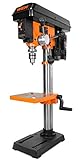
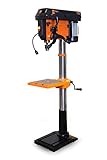
| WEN 4214T | 12-inch benchtop; 5/8-inch chuck | 580–3,200 RPM, variable | 3-1/8 inches | Digital speed readout and variable speed without belt changes |
| WEN 4208T | 8-inch benchtop; 1/2-inch chuck | 740–3,140 RPM, five belt speeds | 2 inches | Compact, simple, and generally the lowest-cost option |
| WEN 4212T | 10-inch benchtop; 1/2-inch chuck | 530–3,100 RPM, five belt speeds | 2 inches | Laser alignment and a larger work envelope than the 4208T |
| JET JDP-8 | 8-inch benchtop; 1/2-inch chuck | Six belt speeds; check the current manual for the exact range | 2 inches | Compact alternative from a brand with a dedicated woodworking and metalworking tool line |
“12-inch” or “8-inch” describes swing: roughly twice the distance from the column to the spindle center. It does not describe drilling depth. Spindle travel is the maximum distance the quill moves in one stroke, and it is often the more relevant number for deep holes.
Which one fits your shop?
Best for frequent speed changes: WEN 4214T
Choose the 4214T if you move between small bits, larger bits, and different materials often. Its variable-speed system and digital readout let you adjust speed without stopping to rearrange belts. The 5/8-inch chuck accepts larger shanks than the 1/2-inch chucks on the smaller presses. That is useful for some woodworking accessories, but it does not make the machine a heavy-duty production press.
Its main trade-off is that variable speed does not remove the need to match RPM to the bit and material. The press also has less than the 5 inches of travel found on some larger machines. Check the workpiece-to-column clearance and travel against your deepest planned holes before buying.
Best low-cost starter: WEN 4208T
The 4208T suits occasional drilling, small projects, and a shop short on space. Its five belt positions are uncomplicated, and the 8-inch swing is adequate for many small parts. The compromises are a 1/2-inch chuck and 2 inches of spindle travel. If your project requires a long bit to reach a deep hole, plan to reposition the work carefully or choose a press with more travel.
Changing belt positions takes longer than dialing a variable-speed model, but it is a reasonable trade for infrequent speed changes. Read the manual for the belt layout and unplug the machine before opening the cover.
Best middle ground: WEN 4212T
The 4212T adds a 10-inch swing and laser alignment to a basic belt-driven layout. It is a sensible pick if the 4208T’s work envelope feels limiting but you do not need the 4214T’s variable-speed convenience. Its two-inch travel remains a constraint, and the laser is an aiming aid rather than a substitute for securing the work and checking alignment.
When to consider the JET JDP-8
The JDP-8 is worth comparing when you want a compact press and prefer to evaluate JET’s support and warranty terms alongside WEN’s. Confirm the exact speed settings, included chuck and accessories, and current warranty coverage from the model’s manual and seller documentation. Do not assume a brand name or price guarantees better runout or greater rigidity; inspect the machine’s specifications and return policy.
Choose by the work, not the headline horsepower
| Your situation | Better fit | Why |
|---|---|---|
| Small shop, occasional holes, tight budget | WEN 4208T | Compact footprint and straightforward belt speeds |
| Mixed bits and frequent speed changes | WEN 4214T | Variable speed avoids repeated belt changes |
| More reach around the column, moderate use | WEN 4212T | 10-inch swing, with a simple belt-drive system |
| Considering a compact alternative with brand support in mind | JET JDP-8 | Compare its current warranty and package details before deciding |
What to check before paying
- Capacity: Confirm swing, chuck capacity, and spindle travel separately. A 5/8-inch chuck only helps if the bits or accessories you use have compatible shanks.
- Speed range: Wood does not have one universal drilling speed. Larger bits generally need lower RPM than small bits; follow the bit maker’s guidance, reduce speed when the cut strains or burns, and secure the work.
- Accessories: Compare the package contents, not just the model name. A chuck, chuck key, table, laser, or work light may be included on one package or revision and absent on another. Budget for a suitable vise or clamps if you do not already have them.
- Warranty: Check the current written warranty for duration, exclusions, and whether registration is required. Keep the receipt and manual. Warranty coverage does not replace safe setup or protection against wear items and misuse.
- Build and fit: A benchtop press needs a stable bench. Check that the column, head, and table lock securely; look for excessive quill play and smooth handle return after assembly. A long, flexible bit or poorly supported table can cause more trouble than the motor’s advertised power.
Setup and ownership realities
Before drilling, bolt the press to a solid bench, assemble and square the table, and verify that the bit is centered over the work. Use a fence or stop block for repeat holes. Clamp small parts rather than holding them by hand: a bit can catch and spin the workpiece. Unplug the press before changing belts, adjusting the table, or removing a chuck key.
On belt-driven models, belt tension and alignment affect noise and speed consistency; follow the manual rather than overtightening. Keep the table and column free of dust and rust, and clean chips from the chuck and quill area. Wood dust can collect around moving parts, so vacuum it regularly with the machine switched off. The chuck, belt, and return spring are wear or service items; inspect them if the press begins to slip, run roughly, or return inconsistently. Persistent vibration may also come from a loose bench, an unbalanced bit, a damaged belt, or a chuck that is not seated correctly.
For a one-time project, a low-cost press can be adequate. For repeated, accurate work, put some of the budget toward a rigid mounting surface, a quality drill-bit set, and workholding—not just a larger motor rating. The best drill press under 300 is the one whose travel, speed control, and support match the holes you actually make.