
What's inside
As an Amazon Associate I earn from qualifying purchases. This post may contain affiliate links at no extra cost to you.
Best Affordable Drill Presses for DIY Workshops
The best affordable drill press for most DIY workshops is a 10- to 12-inch benchtop model with a cast-iron table, a common chuck size, and enough spindle travel for your usual projects; choose a 15-inch floor model only if you regularly drill larger stock and have room for it. For ownership value, prioritize a steady table and usable adjustments over the most speeds or the biggest advertised swing.
Best picks by workshop situation
- For general DIY and limited space: A 10-inch benchtop press is a practical starting point for furniture repairs, brackets, and small woodworking parts. It is easier to place and move than a floor model, but its reach may limit wide panels.
- For larger projects and more reach: A 12-inch benchtop press gives more room between the column and spindle without claiming the floor space of a full-size machine. Check actual spindle travel and table dimensions; “12-inch” describes swing, not the maximum hole depth.
- For frequent work on wide or thick stock: A 15-inch floor press is the better fit if your shop can accommodate its footprint and weight. The stand and larger table can make work easier to position, though a budget floor model is not automatically more precise than a good benchtop press.
- For occasional, light-duty use: Consider a compact benchtop machine, but make sure it has a standard chuck and replacement belts available. The lowest purchase price is less appealing if a worn belt or damaged chuck is difficult to source.
What the size numbers do—and don’t—tell you
Drill-press size is usually stated as swing: twice the distance from the column to the spindle center. A 10-inch press can therefore reach the center of a workpiece roughly 10 inches across when drilling from its edge. It does not tell you spindle travel, throat clearance for awkward stock, or how much room the table provides for clamping.
As an Amazon Associate we earn from qualifying purchases at no extra cost to you.

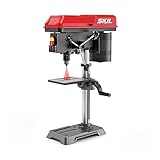


| Common format | Typical swing | Typical spindle travel | Approx. weight range | Useful for |
|---|---|---|---|---|
| Compact benchtop | 8–10 in. | 2–2.5 in. | 35–70 lb | Small parts, pilot holes, light shop tasks |
| General-purpose benchtop | 10–12 in. | 2–3 in. | 55–100 lb | DIY furniture, joinery layouts, routine drilling |
| Floor model | 13–15 in. | 3–4 in. | 150–250 lb | Wider stock, repeated work, more room for setup |
These are broad ranges, not guaranteed specifications for every model. Confirm the manual and manufacturer’s current listing before buying: designs vary, and a machine’s actual table size, chuck capacity, and travel matter more than its category label.
Compare the ownership details before choosing
Adjustment quality matters more than a long speed list
Most affordable belt-driven presses change speed by moving the belt among pulley steps. This is simple and repairable, but changing speeds takes time, and pulley guards can be awkward to open. Check that the belt tensioning mechanism is accessible and locks securely. A depth stop that is easy to set is especially useful for repeat holes; a loose or fiddly stop can erase the advantage of owning a press.
For woodworking, lower speeds are important for larger bits and hole saws, while smaller bits generally suit higher speeds. Look for a published speed range that covers your work rather than paying extra for many settings you will rarely use. A digital speed display can be convenient, but it does not compensate for poor table alignment or a wobbly quill.
Noise and vibration depend on the whole setup
Motor noise is only part of what you hear. Belt condition, pulley alignment, loose hardware, and the surface beneath a benchtop press all affect vibration. A lighter machine bolted to a rigid bench can feel steadier than the same machine sitting unsecured on a flexible top. Before drilling, check that the column, head, table, and base fasteners are tight, and secure the workpiece with a clamp rather than holding it by hand.
Affordable models can have more vibration or a rougher quill feel than heavier industrial machines. If you can inspect a machine in person, lower and raise the quill and feel for binding or excessive side play. If buying unseen, look for a manual that explains adjustment and a parts diagram that identifies belts, chuck, and bearings.
Assembly and usable capacity are part of the price
Benchtop presses commonly need the column, head, table, and handles assembled; floor models add a heavier base and stand. A floor model’s head can be difficult to lift safely, so plan for a helper and a clear assembly area. Allow time to clean shipping residue, square the table to the spindle, and fasten the base or bench. These steps are not optional polish: a misaligned table can make angled or perpendicular holes inaccurate.
Also measure your largest workpiece, not just the machine. Include space for clamps, a vise, and the drill bit, and check whether the table can be lowered or swung aside. A 12-inch swing may still be inconvenient for a bulky panel if the table or column obstructs positioning.
Choose by budget, experience, and use
| Your situation | Best fit | Why |
|---|---|---|
| Tight budget; occasional small jobs | Compact 8–10 in. benchtop | Lower cost and easier storage; accept limited reach and lighter construction. |
| New DIYer; mixed household and woodworking tasks | 10–12 in. benchtop | Useful compromise in reach, setup effort, and shop footprint. |
| Experienced maker; repeated work or larger stock | 12 in. benchtop or 15 in. floor model | Choose by actual throat, travel, table, and workpiece size—not the label alone. |
| Very limited bench space; frequent drilling | Floor model, if there is safe clearance | Preserves bench area, but requires floor space, stable placement, and heavier assembly. |
Budget for parts and upkeep, not just the machine
For a basic benchtop press, general market prices often fall around $150–$350; larger or better-equipped benchtop machines are commonly about $250–$600, while entry-level floor presses may run roughly $400–$900. These are broad U.S. market ranges, not quotes, and promotions, included accessories, and regional availability can shift them.
Before purchase, search the manufacturer’s parts diagram or support pages for replacement belts, chuck keys, chucks, and switches. Standard-sized parts are often easier to replace than proprietary components, but availability varies by brand and model. Worn belts, damaged chuck jaws, and neglected bearings are common reasons an inexpensive machine becomes frustrating. Keep the machine clean, brush dust from the table and column, and avoid letting resin or rust build up on exposed metal.
A chuck’s stated capacity tells you the shank size it accepts, not whether it can hold every woodworking bit securely. For large Forstner bits or hole saws, verify the bit’s shank fits and clamp the work firmly. If the press is used often, a reliable depth stop and readily available belts can save more time over the years than an extra speed setting.
Bottom line
For most DIYers, a well-supported 10- or 12-inch benchtop drill press offers the strongest balance of cost, reach, and manageable assembly. Go smaller only when your work and budget are genuinely limited; go to a floor model when its added reach and stable work area solve a real, recurring problem. Compare the manual, adjustment access, table dimensions, and replacement-part support before deciding—those details determine whether an affordable machine remains useful after the first project.