
What's inside
As an Amazon Associate I earn from qualifying purchases. This post may contain affiliate links at no extra cost to you.
Best Drill Presses for Gunsmithing: Precise Picks for Shop Work
The best drill press for gunsmithing is a rigid, low-runout machine with controlled spindle speed, useful quill travel, and a way to clamp small parts securely. For most home shops, a quality 12- to 15-inch floor or bench press is a more practical choice than a large industrial machine; choose a mill-drill when precise lateral positioning matters as much as drilling.
One important caveat: drill presses are not milling machines. Use them for suitable drilling, countersinking, and reaming operations—not for cutting slots or other operations that place sideways loads on the spindle. For firearm work, consult the relevant manufacturer’s specifications and use a qualified gunsmith for operations that could affect safety or function.
As an Amazon Associate we earn from qualifying purchases at no extra cost to you.


What matters more than the advertised swing
- Runout: Total indicated runout (TIR) measures how much the spindle or a test rod moves as it turns. Check whether a stated figure applies at the spindle, arbor, or chuck; those are not interchangeable. A practical target for careful shop drilling is around 0.003 inch TIR or less at the spindle, with the chuck and tooling adding their own error. Treat figures as meaningful only when the measurement location and method are clear.
- Quill travel: More travel can reduce the need to reposition a workpiece for deep holes, but it does not guarantee accuracy. A quill that gets noticeably looser near full extension can compromise alignment. Use only as much extension as the operation requires.
- Speed control: Gunsmithing may involve small drills and larger cutters, which need different speeds. A variable-speed drive or an easy-to-change belt system is more useful than a high top speed alone.
- Workholding: A drill press vise, clamps, and a correctly supported table matter as much as the motor. Never hold small metal parts by hand; the bit can catch and spin the workpiece.
- Stability and alignment: A heavy base, a square table, and a properly aligned spindle make careful setup easier. A laser or digital display can help with positioning, but neither corrects runout or a flexing setup.
Shortlist by shop situation
| Press or type | Nominal swing | Quill travel | Speed range or control | Best fit | Key trade-off |
|---|---|---|---|---|---|
| JET JDP-15B bench drill press | 15 in. | 3⅛ in. | 16 belt-selected speeds; 200–3,630 rpm | Dedicated bench setup with a broad speed range | Changing speeds requires moving the belt |
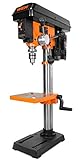
| WEN 4214T benchtop drill press | 12 in. | 3⅛ in. | Variable speed; 580–3,200 rpm | Smaller shops and occasional precision drilling | Less reach than a 15-inch press; verify setup rigidity |
| Grizzly G0758 mill/drill | Not directly comparable to drill-press swing | 2 in. | Variable speed; 50–2,000 rpm | Shop work needing controlled positioning and lower speeds | Shorter quill travel; more machine than a drilling-only setup needs |
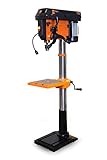
| General-purpose 15-inch floor press, such as a JET JDP-17 | 17 in. | 3⅛ in. | Multiple belt-selected speeds | Frequent use, larger workpieces, or a permanent floor location | Higher cost and space demand; check the exact model’s speed chart |
Specifications can vary by model revision and market. Confirm current manufacturer documentation before buying, especially for runout, spindle taper, chuck capacity, and speed ranges. The table’s dimensions describe machine capacity; they are not accuracy guarantees.
Best for a compact, occasional-use shop: WEN 4214T
A variable-speed benchtop press is convenient when the machine must fit on a sturdy workbench and speed changes are frequent. The 4214T’s 12-inch swing and 3⅛-inch travel suit many small-part drilling jobs. Before committing, check that the bench can be anchored, the table can be locked without shifting, and the spindle remains steady through its travel. It is a sensible choice when space and ease of adjustment outweigh maximum throat depth.
Best for a dedicated bench station: JET JDP-15B
The 15-inch swing provides more reach than a compact benchtop press, while its belt-selected speeds offer a wide range for varied tooling. It suits a shop that can leave the press assembled and aligned. The trade-off is setup time when changing belts; if operations require frequent speed changes, a variable-speed machine may be more convenient.
Best when positioning control is the priority: Grizzly G0758 mill/drill
A mill/drill is worth considering when the work calls for a more controlled way to position a tool over a fixed part. Its lower speed range can also be useful with larger cutters. It costs more, takes more setup and maintenance, and has less quill travel than many drill presses. Buy one for its positioning capability—not as permission to use a drill chuck for milling. For true milling, use appropriate collets or tooling and follow the manufacturer’s limits.
Best for regular work and larger parts: a 15- to 17-inch floor press
A floor press is a practical upgrade when a bench model lacks reach or when the shop needs a permanent, rigid station. For example, JET’s JDP-17 is a 17-inch floor model. Compare the particular version’s runout, quill travel, speed steps, table adjustment, and overall footprint rather than assuming every machine with a similar swing performs alike. A floor press can still need careful tramming and solid anchoring.
Choose by budget, space, and frequency
| Your situation | Good starting point | What to prioritize |
|---|---|---|
| Tight budget; occasional shop use | Quality 12-inch benchtop press | Stable mounting, adjustable speed, a dependable vise |
| Limited floor space; frequent speed changes | Variable-speed benchtop press | Low-speed control, table locking, quill stability |
| Dedicated station; varied drilling jobs | 15-inch bench press | Reach, documented accuracy, speed range |
| Frequent work on larger parts | 15- to 17-inch floor press | Throat depth, rigidity, floor space, secure anchoring |
| Need precise positioning beyond simple drilling | Mill/drill or suitable milling machine | Table movement, rigidity, proper tooling, manufacturer limits |
Measure accuracy before the first job
Machine specs alone cannot tell you how the assembled setup will perform. Check the press with a dial indicator and a smooth test bar, following the machine maker’s procedure:
- Inspect and clean the spindle taper. Dirt or a burr can make an accurate spindle appear misaligned once an arbor or chuck is installed.
- Measure spindle runout. Rotate the spindle by hand and note the indicator’s total movement. Repeat with the arbor and chuck installed to see how much each adds.
- Check the table. Use a square or indicator to assess table alignment to the spindle, then lock the table and confirm it stays put.
- Test at modest quill extension. Compare movement with the quill retracted and extended. Avoid unnecessary extension when drilling.
- Secure the work and test on scrap. Clamp the part or fixture, use a sharp suitable bit, and confirm the hole location and finish before moving to valuable material.
A press with a slightly higher advertised capacity may be a worse precision purchase than a smaller machine with a stable quill, sound spindle, and well-made chuck. If the maker does not publish runout, ask how it is measured or check the machine in person when possible.
Ownership details that affect precision
Chucks, belts, and cutting tools are wear items. A worn chuck can create more runout than the spindle, while dull bits encourage excess pressure and can pull a poorly clamped workpiece. Keep tapers clean and dry, remove chips from the table and column, and check that bolts and table locks remain tight. Use cutting fluid when appropriate for the material and operation, and clear chips with a brush—not fingers.
For gunsmithing, secure the firearm or component in a suitable fixture, protect finished surfaces, and verify that it is unloaded before any work. Do not rely on a drill press to establish critical dimensions or alignment without appropriate measuring tools and a sound procedure. When a modification could affect a firearm’s safety, fit, or function, consult a qualified gunsmith.
Bottom line
For most home shops, start with a rigid 12- to 15-inch press that has useful low-speed control and a quill that stays steady through its working range. Choose the WEN 4214T for compact variable-speed convenience, the JET JDP-15B for a dedicated bench station and broad belt-speed selection, or a floor press when reach and regular use justify the space. Choose a mill/drill only when its positioning capability solves a real need. In every case, secure workholding and measured setup accuracy matter more than swing alone.