
What's inside
- WEN 10-Inch Drill Press Review (2026): Budget Pick or Pass?
- What the 10-inch WEN drill press does well
- Measured-quality questions that matter more than the laser
- WEN 10-inch versus WEN 12-inch drill press
- Decision matrix: which WEN press fits your work?
- Setup that determines whether the holes look professional
- Durability and ownership realities
- Verdict: budget pick or pass?
- Related Guides
As an Amazon Associate I earn from qualifying purchases. This post may contain affiliate links at no extra cost to you.
WEN 10-Inch Drill Press Review (2026): Budget Pick or Pass?
The WEN 10-inch drill press is a reasonable budget pick for occasional furniture work, but it is a pass if your definition of “furniture-grade” includes repeatedly drilling perfectly square, tightly registered holes without measuring and supporting the machine carefully.
Most searches for the WEN 10 drill press, “WEN 10 inch drill press,” or “10 in WEN drill press” refer to WEN’s benchtop models in the 10-inch swing class, particularly versions such as the 4210T. Exact specifications can vary by model and production revision, so check the identification label before ordering accessories or replacement parts.
As an Amazon Associate we earn from qualifying purchases at no extra cost to you.
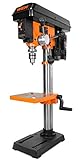

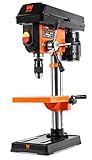
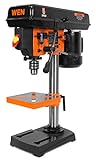
What the 10-inch WEN drill press does well
A 10-inch drill press provides 5 inches of clearance from the center of the spindle to the column. That is enough for drawer parts, table legs, cabinet hardware, small brackets, and most general-purpose shop drilling. The usual package includes a five-speed belt system, a 1/2-inch keyed chuck, a depth stop, a tilting work table, and a laser guide.
Its main advantage is access to controlled vertical drilling at a modest cost. A hand drill can make a clean hole, but it is harder to hold square, repeat a depth, or produce a matching row of holes. The WEN’s depth stop and table make those jobs faster and more consistent.
The limitations are equally important. This is a light benchtop machine, not a floor-standing production press. The column, table support, and belt drive have less stiffness than those of a heavier machine. Large Forstner bits, aggressive feed pressure, and long workpieces can expose that difference quickly.
Measured-quality questions that matter more than the laser
Chuck runout
Runout is the amount the bit’s tip moves off-center as the spindle rotates. It is more meaningful than the advertised motor power when drilling furniture parts. A practical check uses a straight 1/2-inch test rod or a high-quality twist drill and a dial indicator:
- Mount the indicator against the rod about 1 inch below the chuck.
- Rotate the spindle by hand and record total indicated movement.
- Repeat with the rod reseated, because a dirty or poorly seated chuck can imitate spindle runout.
For small woodworking bits, approximately 0.003 to 0.006 inch of total indicated runout is a useful result for this class of machine. Around 0.010 inch is noticeable in small-diameter holes, and more than that can produce visibly oversized or wandering holes. Do not attribute every error to the spindle: bent bits, a dirty taper, chuck jaws, and a misaligned laser can each be responsible.
Table flex under load
The table is more likely to flex than the spindle on a light benchtop press. To evaluate it, place a dial indicator on the table or an accurately supported test block, zero it, and apply a repeatable downward load near the table’s outer edge. A 25-pound load is a useful comparison point for this size of machine.
Deflection of roughly 0.010 inch or less is manageable for ordinary drilling. At approximately 0.020 inch or more, the table can change position as a large bit enters the work, particularly when drilling near the table edge. Tighten the table lock, column collar, and tilt mechanism before every precision setup. Supporting the workpiece directly on the table also prevents it from amplifying vibration.
Laser-guide accuracy
The laser is a positioning aid, not a precision reference. It should be checked with a small drill bit or center punch mark rather than trusted immediately. Lower the quill until the bit nearly touches the work, mark a point, and compare the crossing laser lines with the actual bit center.
A useful acceptance limit is about 1/16 inch of alignment error at the work surface. That is adequate for general hardware and rough layout. For dowels, shelf-pin rows, or visible joinery, mark the center mechanically and use a fence or stop. Vibration, changing table height, and the bit’s actual cutting center can all make the laser appear accurate while the hole lands elsewhere.
WEN 10-inch versus WEN 12-inch drill press
| Characteristic | Typical WEN 10-inch benchtop class | Typical WEN 12-inch benchtop class | What it means in the shop |
|---|---|---|---|
| Swing | 10 inches | 12 inches | The 12-inch version reaches 1 inch farther from the column. |
| Maximum workpiece reach from column center | 5 inches | 6 inches | Useful when drilling the middle of wider cabinet sides or panels. |
| Chuck capacity | Usually up to 1/2 inch | Usually up to 1/2 inch | Neither automatically handles oversized shanks. |
| Speed selection | Commonly five belt-driven speeds | Commonly five belt-driven speeds | Speed changes require stopping and moving the belt. |
| Laser guide | Included on several 10-inch variants | Included on selected 12-inch variants | Helpful for layout, but it does not correct mechanical runout. |
| Space and weight | Smaller footprint; commonly around 60–70 lb | Larger footprint; commonly around 80–100 lb | The larger model needs a stronger bench and more room. |
| Typical market position in 2026 | About $150–$250 | About $250–$400 | Prices vary with version, promotions, and included accessories. |
The WEN 12 drill press is the better choice when the extra reach will be used regularly. It does not automatically provide better hole accuracy: a 12-inch machine can still have table movement, chuck runout, or a poorly adjusted laser. Choose the WEN 12-inch drill press for capacity, not because the larger swing guarantees furniture-grade precision.
Decision matrix: which WEN press fits your work?
| Your situation | Best choice | Reason |
|---|---|---|
| Under $250, occasional holes, limited bench space | 10-inch WEN | Lowest-cost route to depth control and repeatable vertical drilling. |
| First drill press for a new woodworker | 10-inch WEN, with setup time budgeted | Simple controls, but accuracy depends heavily on alignment and clamping. |
| Weekly cabinet work with panels wider than 10 inches | 12-inch WEN or a heavier machine | Extra swing reduces awkward repositioning and overhang. |
| Frequent large Forstner-bit drilling | Heavier 12-inch or floor-standing press | More mass resists vibration and table movement. |
| Visible dowels, precision joinery, or production work | Heavier press or dedicated joinery setup | The WEN can work, but checking each setup becomes part of the process. |
| Mostly metal drilling | Compare a slower, heavier machine | Low-speed torque, rigidity, and secure workholding matter more than laser alignment. |
Setup that determines whether the holes look professional
- Level and reinforce the bench. Bolt the press to a rigid surface. A flexible benchtop transfers movement directly into the table.
- Clean the chuck and spindle taper. Remove packing residue and dust. Even a small particle can tilt the chuck.
- Check the bit before checking the machine. Test with a straight, sharp bit. A bent bit creates a false runout diagnosis.
- Square the table. Use a machinist’s square against a known-straight drill rod, then lock the table firmly.
- Use a sacrificial backing board. It reduces breakout as the bit exits plywood or solid wood.
- Clamp the work. Never hold a small part by hand when a bit can catch it and spin it around the table.
- Set speed to the bit and material. Use slower speeds for large bits and faster speeds for small bits in wood, while following the bit maker’s limits.
- Make a test hole. Check depth, tear-out, and position on scrap before drilling the finished part.
For a 3/8-inch hole, a 1/16-inch position error is about 17 percent of the hole diameter. That calculation explains why a laser that looks “close enough” may not be adequate for exposed joinery. A center punch, brad-point bit, fence, and test piece provide more useful control.
Durability and ownership realities
The first wear points are usually consumables and adjustments rather than the motor: belts can glaze or stretch, chuck jaws can collect dust, the depth-stop threads can become gritty, and the table-lock hardware can lose clamping effectiveness if overtightened. Keep the column and quill clean, brush away dust instead of forcing it into the rack, and apply only a small amount of suitable lubricant where the manufacturer specifies.
Do not run a large bit with excessive feed pressure. A stalled or slipping belt is a warning that the bit is too large for the selected speed, the material is binding, or the machine is being pushed beyond its useful capacity. Let the bit cut instead of forcing it. Store the chuck key attached to the machine or in a dedicated location; operating with it left in the chuck is a preventable hazard.
Verdict: budget pick or pass?
Buy the WEN 10-inch drill press if you need an affordable, compact machine for occasional furniture components, hardware, pilot holes, and moderate Forstner-bit work—and you are willing to square the table, verify the laser, clamp the work, and test important setups on scrap.
Pass on it if you expect production-level rigidity, routinely drill wide panels, use large bits under heavy load, or need every hole to be accurate without adjustment. In those situations, spend more on a heavier 12-inch or floor-standing drill press with a more rigid table and column.
The bottom line: the 10-inch WEN is a capable entry-level tool, not a precision guarantee. Its value comes from controlled drilling at a low market price; its furniture-grade results come from careful setup, sharp bits, solid workholding, and checking the actual hole location rather than trusting the laser alone.