
What's inside
- Best 10-inch drill presses compared
- Our picks by workshop situation
- Head-to-head: what separates these presses?
- How much quill travel do you actually need?
- Runout, speed, and table size matter more than laser guides
- Setup and maintenance that preserve accuracy
- What about an 8-inch or portable drill press?
- Bottom line
- Related Guides
As an Amazon Associate I earn from qualifying purchases. This post may contain affiliate links at no extra cost to you.
The best 10-inch drill press for most woodworkers is the WEN 4210T: it offers useful quill travel, a variable-speed motor, a modest footprint, and enough table area for ordinary furniture and cabinetry work without taking over a small shop.
A 10-inch drill press is sized by swing—the distance from the spindle center to the column, multiplied by two—not by the diameter of the drill bit it can accept. These benchtop machines are a practical middle ground: more stable and accurate than a hand drill with a portable guide, but substantially smaller and less expensive than a floor-standing press.
As an Amazon Associate we earn from qualifying purchases at no extra cost to you.
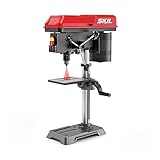

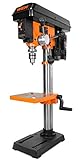

Best 10-inch drill presses compared
| Model | Spindle-speed range | Quill travel | Table size | Published or commonly specified runout | Approximate footprint | Typical market range |
|---|---|---|---|---|---|---|
| WEN 4210T | 600–3,100 RPM | 2.1 in | 9.5 × 9.5 in | About 0.003 in | Approximately 22 × 9 × 28 in | $170–$230 |
| SKIL 3320 | 570–3,050 RPM, 5 speeds | 2.45 in | 7.5 × 7.5 in | Not consistently published | Approximately 19 × 9 × 26 in | $130–$190 |
| Genesis GDP1005A | 620–3,070 RPM, 5 speeds | 2.5 in | 8 × 8 in | Not consistently published | Approximately 23 × 9 × 27 in | $150–$220 |
| Ryobi DP103L | 620–3,100 RPM, 5 speeds | 2.5 in | 8 × 8 in | Not consistently published | Approximately 22 × 9 × 27 in | $170–$250 |
| JET JDP-10 | Approximately 210–3,330 RPM | 2.75 in | 10 × 10 in | Typically specified around 0.003 in | Approximately 23 × 11 × 30 in | $500–$700 |
Specifications can change by production revision, and runout figures are not reported in a consistent way. Treat the table as a comparison starting point, then verify the exact manual for the version being purchased. The footprint excludes the handle sweep and any outfeed support.
Our picks by workshop situation
| Situation | Best fit | Why |
|---|---|---|
| Lowest sensible cost | SKIL 3320 | Good speed range and deep quill travel for occasional drilling. |
| General small-shop use | WEN 4210T | Balanced table size, speed control, laser guide, and availability of parts. |
| Maximum travel under $300 | Genesis GDP1005A or Ryobi DP103L | Both provide about 2.5 inches of quill travel. |
| Frequent furniture and joinery work | JET JDP-10 | Larger table, broader speed range, heavier construction, and better adjustment potential. |
| Very limited bench space | SKIL 3320 | Small table and relatively compact column assembly. |
Head-to-head: what separates these presses?
WEN 4210T: the best all-rounder
The WEN 4210T is the easiest recommendation when the question is simply “what is the best 10 inch drill press for a woodworker?” Its 600–3,100 RPM variable-speed range suits large Forstner bits as well as small twist bits, while the roughly 9.5-inch square table is large enough for drawer parts and cabinet hardware. Its 2.1-inch quill travel is adequate for most woodworking, although thick workpieces may require raising the table and drilling in stages.
Its main limitation is mass. A benchtop press in this class is easier to move than a floor model, but it can vibrate if it is sitting on a flimsy workbench. Bolt it to a rigid surface before judging its accuracy.
SKIL 3320: best budget and occasional-use option
The SKIL 3320 is attractive for a beginner or a shop that drills only a few holes each week. Five pulley speeds cover common woodworking tasks, and its nearly 2.5-inch travel is generous for the price. The smaller table, however, makes it less convenient for wide panels or repeated joinery operations.
This is also a candidate for the best mini drill press when “mini” means compact benchtop rather than a jewelry-scale machine. It is not a true portable drill press: it still needs a stable base, a power outlet, and enough clearance for the quill handle.
Genesis GDP1005A and Ryobi DP103L: similar capability, different ownership priorities
These models occupy the same practical category. Both offer approximately 2.5 inches of travel and five speed settings, making them more versatile than their modest prices suggest. Choose between them based on current warranty terms, local parts availability, and the rigidity of the particular stand or bench where the press will live rather than on small numerical differences in motor rating.
JET JDP-10: the upgrade for frequent use
The JET JDP-10 costs considerably more, but the extra table area, deeper quill travel, wider speed range, and heavier construction matter when the press is used every day. A slower low-end speed is particularly useful with large Forstner bits, hole saws, or sanding drums. It remains a benchtop machine, so it cannot match a full-size floor press for tall workpieces, but it is the strongest choice here for repeated cabinet, furniture, and repair work.
How much quill travel do you actually need?
Quill travel is the maximum distance the spindle can descend in one handle stroke. For a 1-inch-thick board, a press with 2 inches of travel leaves useful clearance for the chuck and bit. For a 2-inch workpiece, a 2.1-inch specification may be technically sufficient but inconvenient because the bit’s cutting length, chuck position, and desired through-hole depth also consume space.
For example, drilling a 1-1/2-inch-deep hole with a 2-inch Forstner bit does not require exactly 1-1/2 inches of travel. Allow roughly 1/4 inch for the bit’s cutting geometry and another 1/4 inch for setup clearance. A press offering 2.5 inches therefore gives a more comfortable margin than one offering 2.1 inches.
Runout, speed, and table size matter more than laser guides
Runout is the amount the chuck and bit wander as they rotate. Low runout produces cleaner holes and reduces chatter, but a published number is meaningful only if the measurement method is stated. Before buying, look for a keyed or keyless chuck that grips small bits evenly, a straight spindle, and a quill that moves without side-to-side play.
For wood, use slower speeds for larger diameters. A practical starting point is about 500–800 RPM for a 2-inch Forstner bit, 1,000–1,500 RPM for a 1-inch bit, and 2,000–3,000 RPM for small twist bits. These are starting values, not universal rules; sharpness, wood species, and bit design all affect the safe speed.
A larger table improves support, but table size is not the same as table quality. Check whether the table tilts, locks firmly, and accepts a fence or sacrificial insert. A small table with a rigid aftermarket fence can be more useful than a larger table that shifts under pressure.
Setup and maintenance that preserve accuracy
- Mount the press to a rigid bench or mobile stand. A simple calculation illustrates why: a 50-pound press on a 20-pound, flexible cart is far more likely to vibrate than the same press bolted to a 150-pound workbench.
- Check the table for square to the spindle before drilling joinery. Recheck it after tilting the table or moving the column assembly.
- Use a sacrificial board under through-holes. It reduces breakout and protects the metal table from the bit.
- Clean dust from the quill, rack, and motor vents. Do not pack abrasive sawdust into the quill mechanism with oily residue.
- Inspect the belts for cracking and correct tension. A loose belt slips and causes speed fluctuation; an over-tight belt loads the bearings.
- Replace dull bits rather than forcing them downward. Excessive feed pressure is a common cause of burning, oversized holes, and premature chuck or spindle wear.
What about an 8-inch or portable drill press?
The best 8 inch drill press is usually the right answer when the shop needs the smallest useful machine for hardware holes, dowels, and light hobby work. Expect a smaller table, less mass, and commonly around 2 inches of travel. It saves space, but it gives up support and vibration resistance.
A portable drill press guide is useful for occasional holes at a jobsite, but a drill guide attached to a hand drill is not equivalent to a benchtop press. It generally has less column rigidity, less accurate depth control, and more sensitivity to the operator’s grip. Choose a portable setup when transporting the tool matters more than repeatable accuracy; choose the WEN, SKIL, Genesis, Ryobi, or JET when the machine can stay mounted.
Bottom line
Choose the SKIL 3320 for infrequent, low-cost work; the WEN 4210T for the best balance of capacity and price; Genesis or Ryobi when extra quill travel is the priority; and the JET JDP-10 when the press will be used often enough to justify heavier construction. Whichever model you select, a rigid mounting surface, accurate table setup, sharp bits, and sensible speed selection will affect woodworking results more than a laser guide or a small difference in advertised motor power.