What's inside
As an Amazon Associate I earn from qualifying purchases. This post may contain affiliate links at no extra cost to you.
A heavy workbench should stay planted while you plane, chop, sand, or tighten a stubborn fitting. But if the bench also needs to move for cleaning or to reach a wall outlet, casters are useful. The right setup is not simply four large wheels. You need enough capacity, a reliable way to lift the bench off the floor, and a mounting system that will not loosen under repeated movement.
As an Amazon Associate we earn from qualifying purchases at no extra cost to you.


What to Look for in Workbench Casters
Start by weighing the complete bench, including the vise, tools, drawers, lumber, and anything normally stored underneath. Add at least 25 percent for uneven loading and shock loads. A 600-pound bench should therefore use a caster system rated for at least 750 pounds, preferably more.
Do not divide the bench weight evenly among four casters and stop there. Floors are rarely flat, and one wheel may carry more than its share. For a heavy bench, use the manufacturer’s total rating conservatively. A set rated for 1,000 pounds is a sensible minimum for many substantial woodworking benches, while a 2,000-pound system gives more margin for steel frames, machines, or packed drawers.
Wheel diameter also matters. Wheels around 2 inches roll acceptably on a smooth concrete floor, but 3 inches or larger handle sawdust, extension cords, floor joints, and small chips better. Hard polyurethane rolls easily and resists wear, while rubber is quieter and provides better grip. Hard nylon is durable but can be noisy and unforgiving on finished floors.
The Main Caster Types
| Type | Best use | Advantages | Limitations |
|---|---|---|---|
| Retractable workbench casters | Benches that must be rigid during work | Wheels lift clear of the floor; good stability | More expensive and requires careful installation |
| Foot-operated lever casters | Heavy benches moved occasionally | Quick engagement and release; usually strong | Levers need clearance and can be a trip point |
| Permanent swivel casters with brakes | Light benches and mobile assembly tables | Simple, inexpensive, easy to replace | Brakes stop rolling but do not make the bench truly rigid |
| Leveling caster systems | Precision benches and machine stands | Combine mobility with adjustable leveling feet | Highest cost and more complicated mounting |
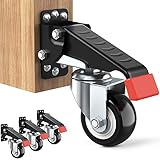
For a heavy workshop bench, retractable or leveling casters are usually the best choice. They let the bench rest on solid feet while you work, then raise it a small amount when it is time to move. This is a major difference from ordinary locking casters: a wheel brake prevents rolling, but it does not prevent the bench from rocking, swiveling, or creeping under hand pressure.
Search for retractable workbench casters if your bench needs to remain stable during hand-tool work. Many kits use a foot pedal or side lever to raise the bench roughly 1/2 to 1 inch. That travel is normally enough, provided the fixed feet are sized and positioned correctly.
Choosing the Right Setup
For a 300- to 500-pound bench used mainly for assembly, four permanent swivel casters with total-lock brakes may be adequate. The cheaper option is fine when the bench is rarely subjected to heavy planing or hammering and the floor is smooth. Fit two fixed casters and two swivels if straight-line movement matters, or four swivels if you need to rotate the bench in a tight space.
For a 500- to 1,000-pound woodworking bench, use retractable casters or a caster-and-leveling-foot system. A typical arrangement has four load-bearing feet and four wheels mounted slightly above the floor. When the wheels engage, the feet lift clear. When they retract, the feet carry the load directly.
For benches carrying a planer, metalworking vise, welding equipment, or dense drawer storage, consider six casters or a purpose-built heavy-duty system. Six wheels spread the load, but they also make uneven floors more troublesome. If the frame twists, one or two wheels may hang in the air. A rigid, square base is more important than simply adding wheels.
Browse heavy-duty leveling casters when you need both mobility and a stable working height. These are particularly useful for a bench that must align with a table saw, outfeed table, or dust-collection connection.
Installation Details That Prevent Problems
Mount the casters to solid frame members, not just the underside of thin plywood. If the bench has a 3/4-inch plywood bottom, add hardwood blocking or a steel mounting plate. Through-bolts with washers are preferable to wood screws for a heavy bench. If bolts cannot pass through the frame, use structural screws of the correct diameter and length, and avoid placing them close to an edge where the wood can split.
Check the caster’s mounting-plate dimensions before buying. A plate that is too large may not fit between legs. Swivel casters also need swing clearance; a wheel can strike a leg or stretcher even when the plate fits. Leave room for the release pedal or lever, and make sure it remains reachable when drawers are open.
Install the system on a level floor, then test the bench unloaded. Engage the wheels and check that all of them contact the floor. Load the bench gradually, watching for frame flex, caster tilt, or a foot that no longer touches down. A heavy bench that rocks after installation usually needs better leveling, a stiffer base, or a different caster arrangement—not tighter wheel brakes.
Safety and Maintenance
Never rely on a caster brake while routing, planing, or using a mallet. For demanding work, retract the wheels fully and let the fixed feet carry the bench. If the bench still moves, add a wall stop, floor pin, or removable brace rather than accepting movement.
Keep casters clear of packed sawdust and metal chips. Debris can prevent a retractable mechanism from reaching its full position, leaving one wheel partly loaded and making the bench unstable. Inspect mounting bolts after the first few weeks, then every few months. Replace wheels with flat spots, seized bearings, cracked brackets, or damaged pedals.
A good caster system should make the bench easier to position without making it feel mobile during work. Spend money on load capacity and a rigid lifting mechanism first. Wheel material, color, and cosmetic features are secondary. For a lighter utility bench, ordinary locking casters may save money; for a genuinely heavy bench, retractable or leveling casters are worth the extra cost because they solve the stability problem rather than merely hiding it.