What's inside
As an Amazon Associate I earn from qualifying purchases. This post may contain affiliate links at no extra cost to you.
Frequently moved dust hoses need a connection that is quick to release without becoming a leak, a trip hazard, or a source of repeated repair work. The two common choices are camlock couplings and friction-fit connections. Friction fit is usually a hose pushed over a tool port or metal tube and held with a clamp, while a camlock uses two hinged levers to lock matching male and female fittings together.
For a hose moved between several machines during the day, the better choice depends on hose diameter, static pressure, how often you disconnect it, and whether the joint will be pulled sideways. A friction fit is inexpensive and works well in a small shop. Camlocks cost more and add hardware, but they make repeated changes faster and more predictable.
As an Amazon Associate we earn from qualifying purchases at no extra cost to you.

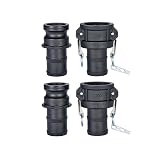
How the Connections Work
A friction-fit connection relies on overlap and surface grip. The hose slips over a dust port, adapter, or hose cuff, usually by 1-1/2 to 3 inches. A worm-drive clamp tightens the hose around the port. Some users omit the clamp because the hose feels tight, but that is risky on a mobile hose that gets dragged or twisted.
A camlock connection has a male adapter on one side and a female coupler on the other. The two cam arms pull the pieces together and compress a gasket. Releasing both arms allows the hose to come free without rotating the hose or loosening a clamp. Many camlock fittings are sold in several materials and styles, so the parts must match by size and coupling pattern. A 2-inch Type C female coupler, for example, will not mate with every fitting that happens to measure close to 2 inches.
Dust collection is not especially demanding in pressure compared with liquid pumping, but the fittings still see vibration and suction. A typical single-tool collector may create roughly 4 to 12 inches of water lift at useful airflow, with higher-pressure systems exceeding that. The practical issue is not pressure bursting the fitting; it is a small air leak reducing airflow at the tool, or a loose connection collapsing or pulling off under movement.
Camlock vs. Friction-Fit at a Glance
| Factor | Camlock | Friction fit |
|---|---|---|
| Connection speed | Very fast after installation | Fast, but may require twisting and clamp adjustment |
| Holding strength | High when correctly sized and locked | Good with sufficient overlap and a clamp |
| Air sealing | Consistent gasket seal | Depends on hose, port, clamp, and fit |
| Cost | Higher; every change point needs compatible parts | Low; often only a clamp or inexpensive cuff |
| Best use | Several daily changes or heavy hose movement | Occasional changes and fixed branch connections |
| Common failure | Unlatched arm, damaged gasket, mismatched parts | Pull-off, leaks, crushed hose, stripped clamp |
When Camlocks Are Worth the Cost
Choose camlocks when one hose serves three or more tools, operators make frequent changes, or the hose is long and heavy enough to pull on its connection. A locked coupling prevents the hose from gradually working loose as it is dragged around a bench or cabinet. It also lets you disconnect without turning the hose, which matters when the hose is stiff spiral-wire PVC or reinforced polyurethane.
Camlocks are especially useful on a mobile hose reel, a boom-mounted hose, or a quick-connect manifold. Put the coupler on the movable hose and use inexpensive male adapters at the machines. This keeps the setup consistent: every tool has the same connection, and the hose can move between them without tools.
Look for 2-inch dust collection camlock couplings with a gasket material suited to the shop environment. For most woodworking dust, an ordinary rubber or elastomer gasket is adequate. Avoid relying on the cam arms to compensate for a poor diameter match. If the hose is nominally 2-1/2 inches but the actual outside diameter is 2-3/4 inches, use a proper reducing cuff or adapter rather than forcing it onto a 2-inch coupling.
Camlocks are not automatically safer. The arms must be fully closed, and they should not be positioned where a bench edge or floor contact can knock one open. A short retaining strap or support near the fitting can prevent the hose weight from hanging directly on the coupling.
When Friction Fit Is the Better Buy
Friction fit is the sensible choice for a hose that is disconnected only a few times per week, a permanent connection behind a machine, or a budget setup with one collector and one main tool. It is also easier to adapt to odd-shaped ports. A 2-1/2-inch dust hose cuff and clamp can solve a connection problem for much less than a complete camlock set.
Do not judge the fit by the outside diameter alone. Measure the port and hose with calipers or a tape measure, and check whether the hose is intended to fit inside or outside the port. Aim for at least 1-1/2 inches of insertion, preferably 2 inches or more on a frequently moved hose. Tighten a correctly sized clamp until the hose cannot rotate or pull off; do not crush a thin-wall hose by overtightening.
A friction joint usually fails gradually. You may see a visible gap, hear a hiss, or notice weaker pickup before it comes apart. A hose that repeatedly pulls off needs a better cuff, more overlap, a second clamp, or a support point. Two clamps can help on a long, heavy hose, but they do not fix a badly mismatched diameter.
Installation and Safety Details
Keep the connection as short and smooth as possible. A sharp internal step can catch chips, while a corrugated hose pushed over a narrow port may leak badly between the ridges. Use conductive or static-dissipative hose where appropriate, and bond the collector, metal ducting, and machine components according to the equipment maker’s instructions. A plastic camlock does not by itself eliminate static concerns.
Support the hose within about 12 to 18 inches of a quick connection if the hose is routinely dragged. This limits bending force at the fitting. Avoid letting a camlock or clamp become the lowest point where it can strike the floor. Inspect gaskets, cam arms, cuffs, and hose ends monthly in a busy shop. Replace a gasket that is hard, cracked, or permanently flattened.
For the most flexible setup, use camlocks at the frequently changed end and friction-fit or clamped connections at fixed machine ports. That hybrid arrangement spends money where it saves time while keeping inexpensive, serviceable joints elsewhere. If you change hoses only occasionally, skip the camlocks and buy better clamps and properly sized cuffs instead.