
Key takeaways
- Compare the best laser measuring tools for Cyber Monday for shop layout, cabinet runs and material estimates, with range, accuracy and display tips.
What's inside
- Quick answer
- Five buying mistakes to avoid first
- Bosch BLAZE GLM165-40 — the balanced shop layout pick
- Leica DISTO D2 — for cut lists that live on a phone
- Klein Tools 93LDM100C — compact measure for indoor shop work
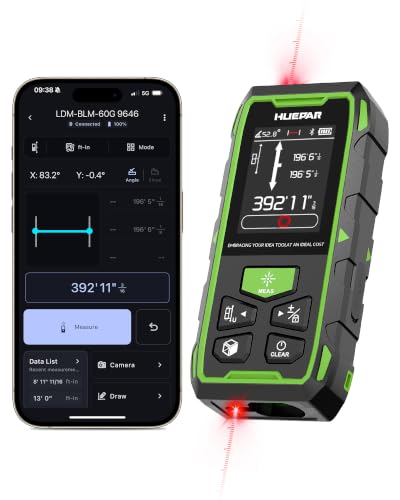
- Huepar Dual Laser Measuring Tool — measure long runs from the middle
- RockSeed S2-50 — straightforward estimating without extras
- How to choose
- Who should skip
- FAQ
- Final verdict
As an Amazon Associate I earn from qualifying purchases. This post may contain affiliate links at no extra cost to you.
A laser distance measure is a classic seasonal-sale purchase in the workshop, and for good reason. It replaces the two-person tape pull across a room, turns shop layout into a one-person job, and makes estimating sheet goods far faster than walking a tape from wall to wall. Cyber Monday concentrates buying into a few rushed days, when measuring tools get bought badly.
The mistakes are predictable. Buyers pay for range they will never use, skim past the accuracy line, ignore whether a model can send measurements to a phone for a cut list, or pick a display that washes out under bright shop lighting. Others expect a laser to replace a tape entirely, then discover it is the wrong tool for short joinery work. This guide starts with those mistakes, then matches five measures to the jobs they fit.
As an Amazon Associate, we earn from qualifying purchases.
Quick answer
For most woodworkers, the Bosch BLAZE GLM165-40 is the balanced pick: honest mid-range reach, a color display that stays readable, and area functions for shop layout. Choose the Leica DISTO D2 when Bluetooth records for cut lists matter, the Klein Tools 93LDM100C for compact indoor work, the Huepar dual laser for long runs measured from the middle, and the RockSeed S2-50 for straightforward room and material estimates.
Five buying mistakes to avoid first
Buying range you do not need. Range is the headline number on every box, so it is the easiest number to overbuy. A measure rated far beyond the longest wall in a home shop adds cost and size without adding usefulness. Map the longest distance actually measured — room diagonals, cabinet runs, a lumber wall — and buy a class that covers it with room to spare.
Ignoring accuracy specs. Two models with the same range can state accuracy very differently. Some makers state a tighter tolerance only over the first stretch of distance, then a looser one beyond it. For cabinet runs, that difference decides whether a filler strip fits or a cut list needs padding. Treat the stated tolerance, and the distance it applies to, as a core spec.
Skipping Bluetooth and app features that would actually get used. A measure that stores readings only on its own screen forces a second step with a notebook. Models with Bluetooth send measurements to a phone app, where a layout or board estimate can be labeled and kept with the project. The feature earns its place only when measurements regularly become cut lists or material orders.
Choosing a hard-to-read display for a bright shop. Skylights, open doors, and strong overhead lighting punish dim screens and faint laser dots. A backlit color display, a reverse-contrast screen, or a green beam can be the difference between reading a number at a glance and shading the screen with a hand.
Forgetting it does not replace a tape. A laser excels from a few feet outward, across rooms and along walls. Below that, a tape or steel rule is faster, hooks onto an edge, and marks directly. A laser also needs a target surface, so measuring to the edge of a board in open space still calls for a tape, a square, or a target card.
Bosch BLAZE GLM165-40 — the balanced shop layout pick

The Bosch BLAZE GLM165-40 answers the first two mistakes directly. Its reach covers home shops, garages, and most room-layout work without stepping into oversized survey territory, and its stated accuracy suits cabinet runs where a small error compounds across a cut list.
The color backlit display addresses the bright-shop problem: readings stay legible under strong light, and the screen shows recent measurements together, which helps when recording a room before planning bench placement. An automatic square-footage function speeds up area estimates, and the unit stores recent measurements for recall at the bench. It runs on replaceable AAA batteries, so a flat battery never waits on a charge cycle.
Choose this model for room measurement, cabinet runs, and estimating. Skip it when measurements must flow into a phone-based cut list, since this is a device-memory tool rather than an app tool.
Leica DISTO D2 — for cut lists that live on a phone

The Leica DISTO D2 takes the Bluetooth mistake seriously. It pairs with a phone app, so measurements taken around a room can be organized into a project record instead of being copied by hand. For woodworkers who measure a kitchen, then build the cabinet cut list from those numbers days later, that record-keeping is the real feature.
Its range reaches well beyond a typical house, making it the long-measurement option here for site work, outbuilding layout, and measuring across a yard to a detached shop. A multifunctional end piece flips out for measuring from edges and corners, the detail that matters when a measurement starts inside a cabinet opening rather than on a flat wall. Area, volume, and indirect height functions cover estimating, and the housing carries dust and splash protection.
Choose the DISTO D2 when documentation matters as much as the measurement itself. Buyers who write one-off measurements on the workpiece gain little from its connectivity.
Klein Tools 93LDM100C — compact measure for indoor shop work

The Klein Tools 93LDM100C is the honest answer to overbuying range. Its reach is sized for indoor work: rooms, cabinet walls, closet build-outs, and shop interiors, where the longest pull rarely approaches its limit. Keeping the range modest keeps the tool small and easy to carry in an apron pocket.
Its accuracy statement is a good lesson in reading specs carefully: the maker states a tighter tolerance for the first stretch of distance and a looser one out to full range, and most furniture and cabinet measurements fall in that tighter zone. The reverse-contrast display puts light digits on a dark background, which reads well under shop lighting, and the housing carries dust and splash protection. Single and continuous modes handle both fixed layout points and scanning for a longest diagonal.
Choose the 93LDM100C when nearly all measuring happens indoors and portability matters. It is the wrong pick for outdoor site measurement or long runs between buildings.
Huepar Dual Laser Measuring Tool — measure long runs from the middle
The Huepar dual laser design changes how a long cabinet run gets measured. Instead of firing in one direction only, it measures from both ends at once, so standing in the middle of a long wall returns the distances to each end together. For wall cabinets, a long bench wall, or a room where furniture blocks a clear shot from one corner, that bilateral approach saves repositioning and second measurements.
Its total reach is the longest in this group, which also makes it the outdoor and site candidate: a slab footprint, a deck, or distances across a work yard. A built-in angle sensor supports indirect measurements, the battery is rechargeable, and a magnetic back helps the tool stay put on steel framing while a reading settles.
Choose this model when long runs and two-direction measurements are routine. For simple room dimensions, a single-direction measure is simpler to read.
RockSeed S2-50 — straightforward estimating without extras

The RockSeed S2-50 covers the estimating jobs that fill a project notebook: room dimensions, wall lengths for storage planning, and area and volume figures for working out sheet goods, boards, and finish quantities. It offers the standard calculation set — distance, area, volume, and indirect measurement — plus memory for stored readings, so a full room can be measured before anything gets written down.
Two small bubble levels built into the housing help keep the tool aligned on long pulls, where a tilted measure quietly inflates a reading. The backlit screen keeps numbers visible in dim corners and inside cabinets, and unit switching between meters, inches, and feet suits mixed plans. It runs on AAA batteries that are easy to keep in a drawer.
Choose the S2-50 for honest room measurement and material estimating rather than app records or extreme range. Buyers who want measurements sent to a phone should look at the Leica model instead.
How to choose
Start with the longest real measurement. Room layout and cabinet work sit comfortably in the mid-range class, while detached buildings, slabs, and yard distances justify a longer-range or bilateral model. One class above the longest job is sensible headroom; several classes above it is wasted budget.
Next, read the accuracy statement in full, including the distance it covers. Layout tolerates a standard tolerance, while cabinet runs that feed a cut list reward the tightest stated figure. Then decide how measurements get recorded: device memory suits quick jobs, while Bluetooth and an app suit projects where measurements become labeled cut lists.
Check the display against the shop. Color backlit and reverse-contrast screens read best under strong light, and a green beam is easier to follow in bright conditions than a red dot. Confirm the included functions — area, volume, indirect or Pythagorean measurement, continuous scanning, addition and subtraction — because those functions do the estimating work. Finally, weigh battery style: replaceable cells swap mid-project, while rechargeable models need a charging habit.
Who should skip
Anyone whose work is almost entirely short should skip a laser measure for now. If nearly every measurement is under a few feet — joinery, box making, fitting drawers, marking parts at the bench — a tape, a steel rule, and a marking knife are faster and more precise, and a laser adds a step.
A laser is also a poor buy when there is nothing to aim at. Open-frame work, measuring single boards in space, and tasks that need a hook on an edge all favor a tape. Buyers who need layout lines rather than distances need a different tool category, since a distance measure returns numbers, not lines. Anyone expecting one tool to cover both bench joinery and whole-room layout will likely be disappointed, which is why most shops keep both tools within reach.
FAQ
Does a laser measure replace a tape measure in a woodworking shop?
No. A laser is faster for room dimensions, wall runs, and estimating, but a tape or steel rule remains better for short joinery measurements, hooking an edge, and marking directly on stock. Most shops use both, choosing by distance.
How accurate does a laser measure need to be for cabinets?
Look for a stated tolerance and note the distance it applies to, since some models state a tighter figure only at shorter range. For cabinet runs that feed a cut list, choose the tightest stated tolerance in the class being considered.
Is Bluetooth worth choosing on a laser measure?
Bluetooth is worth choosing when measurements regularly become cut lists, room plans, or material orders kept on a phone. When measurements are occasional and written straight onto a workpiece or notebook, on-device memory covers the need.
Can a laser measure be used outdoors?
Longer-range models with a bright or green beam and a clear display handle outdoor site measurement best, especially with a solid target surface. Bright sunlight shortens usable distance for any model, so shade, a target card, or lower light improves results.
Final verdict
Match the tool to the mistake it avoids. The Bosch BLAZE GLM165-40 is the default for balanced shop layout work, the Leica DISTO D2 suits documented projects and long site measurements, the Klein Tools 93LDM100C keeps indoor measuring compact, the Huepar dual laser handles long runs from the middle, and the RockSeed S2-50 covers everyday estimating. Deals change, so check the current price and offers on the Amazon product page before buying.
Related guides
More from Amazon
Programs that pair well with the guide above. Offers and eligibility are set by Amazon and may change.
Send a Prime gift membership to someone who would use free shipping and Prime Video.
Gift Amazon PrimeGive audiobooks to someone who loves to listen. Plans and prices are set by Amazon.
Gift AudibleA free business account with business pricing and bulk-buying tools for work, shop or home office.
Create a business accountFree shipping on eligible items, Prime Video and more. Eligible new members can start with a free trial.
Start a Prime free trialAs an Amazon Associate we earn from qualifying purchases.


