What's inside
As an Amazon Associate I earn from qualifying purchases. This post may contain affiliate links at no extra cost to you.
A changing shop layout makes every installation decision harder. A tool bolted in place can be efficient for years, or it can become an obstacle the first time you add a larger workbench, rearrange a dust collector, or need room for a new machine. Mobile bases offer flexibility, but they also add height, movement, and another thing that can fail.
As an Amazon Associate we earn from qualifying purchases at no extra cost to you.


The Real Cost of Fixed Placement
Fixed placement works best for equipment with a stable job and a permanent utility connection. A table saw near the center of the shop, a planer beside a dust-collection line, or a wall-mounted sharpening station can make the workflow predictable. You do not spend time unlocking casters, squaring a machine, or reconnecting hoses.
The main benefit is stability. A machine sitting directly on the floor is less likely to shift during a cut. This matters with table saws, drill presses, bandsaws, and jointers, where even slight movement can affect accuracy or create a safety problem. Fixed tools also occupy less vertical space and usually cost less than the same tool on a quality mobile base.
The drawback is that the floor plan becomes difficult to change. A machine with a 6-foot outfeed requirement may effectively consume a 12-foot-long path once in use. If you install it without allowing that space, the tool may technically fit while remaining impractical. Bolting equipment down before testing its working clearance is a common and expensive mistake.
When Mobile Bases Pay Off
A mobile base is most useful for machines that need to move occasionally, not constantly. A planer, spindle sander, dust collector, or contractor-style table saw can be a good candidate. Moving one machine to open a clear assembly area may be worth more than the small loss in setup time.
Look for a base rated at least 25 percent above the loaded machine weight. A 400-pound tool should not sit on a base rated for exactly 400 pounds; stored accessories, vibration, and uneven floors consume that margin. Four-inch casters are a practical minimum for many shops, while larger casters roll more easily over cords and floor joints.
Do not assume “mobile” means easy to move. Low-quality casters can swivel under load, collect dust, or develop flat spots. Lift mechanisms can also wear until one corner remains slightly off the floor. That creates rocking, inaccurate cuts, and a machine that creeps during use. Before operating, all leveling feet should be engaged and the wheels should be unloaded when possible.
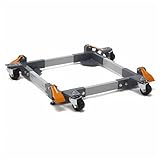
heavy-duty mobile tool bases are a reasonable category to compare, but check the actual minimum and maximum footprint. A universal base that is too wide can interfere with a machine’s stand or dust port.
Fixed Tools vs Mobile Bases
| Factor | Fixed placement | Mobile base |
|---|---|---|
| Stability | Best, especially when anchored or leveled directly on the floor | Good only when locking and leveling hardware is engaged |
| Layout changes | Slow and physically demanding | Fast for occasional rearrangement |
| Cost | Lowest | Usually adds cost and installation time |
| Dust collection | Easier to hard-pipe and seal | Requires flexible hose and extra slack |
| Floor clearance | Lowest overall height | May raise the work surface 2 to 4 inches |
| Best use | Permanent workflow and high-precision tools | Shared floor space and changing work zones |
Plan Dust Collection First
Dust collection often determines whether a mobile layout remains practical. A fixed machine can use a short, rigid branch with fewer leaks. A mobile machine needs enough flexible hose to move without kinking, but excess hose becomes a trip hazard and reduces airflow.
Keep flexible hose runs as short as possible. For a typical single-machine setup, 2 to 4 feet of flexible hose is easier to manage than a loose 10-foot coil. Support overhead hose with a ceiling drop if the machine moves within a defined zone. Use blast gates where branches meet, and seal joints with foil HVAC tape or purpose-made clamps rather than relying on friction alone.
Choose dust collection fittings around the machine’s actual port size. A 2-1/2-inch hose may suit a sander or router table, but it will not capture chips from a planer as effectively as a 4-inch line. A mobile collector also needs a parking location that does not block exits, electrical panels, or the path to the main workbench.
4-inch dust-collection hose and blast gates are inexpensive compared with rebuilding a poorly routed system later.
Storage and Workbench Flexibility
Storage is usually better fixed. Wall cabinets, French cleats, lumber racks, and shallow shelves do not need to move, and anchoring them prevents tipping. Keep frequently used hand tools between waist and shoulder height. Heavy items should stay below chest level, with the heaviest storage close to the floor.
Mobile storage makes sense for consumables and project-specific tools. A rolling cabinet can follow a carcase around the shop, while a narrow cart can hold sanding supplies or measuring tools. Keep carts no deeper than necessary; a 20-inch-deep cart is much easier to park than a 30-inch one in a crowded shop.
For workbenches, consider a hybrid arrangement. A heavy primary bench should remain fixed so planing and chiseling do not make it walk. A lighter assembly table can use locking casters or retractable wheels. If a bench is mobile, test it under force from several directions. Casters that lock only the wheel but not the swivel may still allow the bench to rotate.
Lighting and Safety in a Movable Layout
Fixed overhead lighting should illuminate the whole shop rather than one machine’s original position. Aim for roughly 50 to 75 foot-candles at detailed work surfaces, with task lighting added for sharpening, carving, and finish inspection. A mobile machine should never move into its own shadow or force you to work with a bright fixture directly behind your eyes.
Use cord reels, ceiling drops, or wall outlets positioned around the work zones, but do not let cords cross aisles. Leave at least 36 inches for a normal walking path; 42 to 48 inches is more comfortable around a machine where boards must be carried. Mark a clear route to the exit and keep it free of carts, hose loops, and offcuts.
Mobile bases should not be used to avoid proper anchoring on tall, narrow, or top-heavy equipment. Secure shelving, lumber racks, and cabinets to wall studs. If a machine rocks, rolls when pushed, or requires a loose block under one caster, stop using it until the base is repaired or replaced.
A Practical Buying Rule
Keep high-use, high-force tools fixed unless the shop layout truly requires movement. Put occasional-use machines, dust collectors, and secondary work surfaces on quality mobile bases. Before buying, tape the machine footprint and its full operating envelope on the floor for a week. If that taped layout repeatedly blocks another task, mobility is justified. If it does not, the cheaper fixed setup is usually the better tool.
For machines that must move, choose a base with a published load rating, positive leveling feet, replaceable casters, and a footprint that fits without modifying the machine stand. Spend the savings on better lighting, dust sealing, or electrical access before buying mobility you will rarely use.