What's inside
As an Amazon Associate I earn from qualifying purchases. This post may contain affiliate links at no extra cost to you.
What You Are Choosing
For long workshop sessions, the choice is usually between individual floor mats and a continuous anti-fatigue runner. Both reduce strain compared with standing directly on concrete, but they solve different layout problems.
A floor mat works well at a single station: a workbench, drill press, assembly table, or sharpening area. An anti-fatigue runner covers a longer working line, such as a bench with a grinder, vise, and small parts storage. The right choice depends less on the label and more on how you move through the shop, what falls on the floor, and how often you need to clean around the setup.
As an Amazon Associate we earn from qualifying purchases at no extra cost to you.

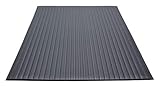


How Anti-Fatigue Mats Work
Standing on concrete for hours creates pressure points under the heels and forefoot. A resilient mat allows small shifts in your feet and ankles, which reduces the feeling of locked knees and tired calves. It should compress slightly under your weight, then recover instead of staying flattened.
Do not assume that the softest mat is the most comfortable. Very soft foam can make you work harder to stay balanced, especially when using a hand plane, pushing stock through a saw, or turning a heavy vise handle. A dense rubber or rubber-foam mat with moderate give is usually a better workshop choice than a thin, spongy kitchen mat.
For most benches, look for at least 3/8 inch of thickness. Around 1/2 to 3/4 inch is more forgiving on hard concrete, but thicker is not automatically better. A tall edge can become a trip hazard, and a thick mat can interfere with rolling stools, carts, or cabinet doors.
Floor Mats Versus Runners
| Feature | Individual floor mat | Anti-fatigue runner |
|---|---|---|
| Best use | One defined workstation | Long bench or repeated work positions |
| Typical width | 2 to 3 feet | 2 to 3 feet |
| Coverage | Usually 3 to 6 feet long | Often 6 to 12 feet long |
| Cleaning | Easy to lift and move | More surface area and more awkward to handle |
| Cost control | Buy only where needed | Efficient for a continuous work line |
| Main failure mode | Sliding or curling at the edge | Trapping dust, chips, and spilled liquid underneath |
A mat is the cheaper option when your shop has separate stations or when you are still rearranging the layout. You can put one in front of the main bench and add another later at the planer or assembly table. A runner makes more sense when several tools share one fixed counter and you regularly shift from one task to the next without stepping away.
Measure the standing zone, not the entire bench. A mat extending 6 to 12 inches beyond the normal toe position is usually enough. Extending too far into an aisle increases the chance of catching a boot or cart wheel.
Material and Surface Details That Matter
Closed-cell foam resists absorbing water and glue, and it is easy to wipe clean. Rubber is heavier, more durable, and generally better around metalworking debris, but some rubber mats have a strong odor when new. PVC mats can be inexpensive and easy to wash, though thin versions may crack or curl in cold shops.
Choose beveled edges on every exposed side. A square-edged mat can catch a boot when you approach from the side, particularly if sawdust hides the transition. A textured top helps with traction, but deep grooves can hold sanding dust and metal chips. For a mixed woodworking shop, a shallow texture is easier to maintain than an aggressive anti-slip pattern.
Perforated mats are useful in areas where liquid spills are common, but they are not ideal directly below a workbench covered in fine dust. Small chips and sanding debris collect below the mat and can be difficult to remove. Solid mats are simpler for most woodshops. If you work with coolant, cutting oil, or frequent wet cleanup, consider oil-resistant rubber anti-fatigue mats.
Dust, Debris, and Cleaning
A mat does not replace dust collection. Fine dust still settles on the surface and can make it slippery, while larger chips can hide along the edge. Vacuum the mat during normal floor cleaning and lift it at least weekly in a busy shop. Inspect the concrete underneath for dampness, grit, and trapped fasteners.
Runners need extra attention because they cover more floor and are harder to move. A 10-foot runner may require two people to roll without folding or dragging it. Dragging can push grit underneath and scratch sealed floors. If your shop produces heavy shavings, a shorter mat at each station is often safer and easier to clean than one continuous runner.
Keep mats away from floor drains unless they are designed for wet areas. Water trapped underneath can damage wood subfloors and encourage mildew. Let a washed mat dry completely before putting it back down.
Safety and Workstation Fit
Anti-fatigue mats can improve comfort, but they can also introduce hazards. A mat that slides when you step on its edge is not acceptable near a table saw, router table, or drill press. Look for a heavy backing and test it on your actual floor. Dust, concrete sealer, and oil can make even a grippy backing slide.
Do not place a raised mat where a rolling tool chest or mobile workbench must cross. Wheels can stop abruptly at the edge, tipping a loaded cart or causing a tool to fall. Likewise, a mat under a stationary machine can make leveling harder and may interfere with vibration control. Keep the machine feet on the concrete unless the manufacturer permits a resilient base.
At a hand-tool bench, a mat around 2 by 3 feet is usually sufficient. For a long assembly bench, a beveled-edge anti-fatigue floor runner can cover the full standing line. Leave clear access to drawers, electrical outlets, and emergency shutoffs.
What to Buy for Common Shops
If you have one primary workbench and a limited budget, start with one dense, beveled mat rather than covering the entire room. A basic heavy-duty rubber workshop floor mat is fine for occasional weekend work, provided it lies flat and does not slide.
For eight-hour sessions at a fixed woodworking bench, buy a thicker closed-cell mat or runner with sealed edges. For a metalworking area, prioritize oil resistance and easy cleanup over maximum softness. If the shop layout changes often, use two or three mats instead of a fitted runner. That costs more per square foot but avoids replacing a large piece every time you move a bench.
Before buying, measure the floor, check door and drawer clearances, and inspect the backing material. Comfort matters, but a mat that stays flat, stays put, and can be cleaned without a fight is the one that will still be useful after months of workshop dust.