What's inside
As an Amazon Associate I earn from qualifying purchases. This post may contain affiliate links at no extra cost to you.
Horizontal Lumber Storage vs Vertical Rack Storage in a Small Shop
Lumber storage gets awkward as soon as a small shop holds more than a few boards. Eight-foot studs, cabinet plywood, trim, and short hardwood offcuts all need different support. The two practical approaches are horizontal storage on wall-mounted arms or a low rack, and vertical storage in a bin or rack where boards stand on edge.
Neither is automatically better. Horizontal storage is usually safer for long, straight boards and sheet goods. Vertical storage uses less wall length and makes short pieces easy to see. The right choice depends on the stock you buy, your ceiling height, and how much floor space you can give up.
As an Amazon Associate we earn from qualifying purchases at no extra cost to you.

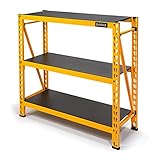
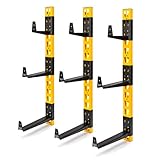
When horizontal storage works best
Horizontal racks support lumber along its length, usually with steel arms attached to wall studs or a freestanding rack with multiple levels. They are a good fit for 6- to 10-foot boards, plywood, molding, and material that you want to keep flat.
The main advantage is reduced sag. A 1-by-8 board supported at only one end can bow or twist surprisingly quickly, especially in a warm, damp shop. A wall rack with supports spaced 24 to 36 inches apart gives long stock a much better chance of staying straight. For boards longer than 8 feet, use at least three support points; for heavy hardwood or stacked sheet goods, four or more is better.
Horizontal storage also makes loading predictable. Put the heaviest material on the lowest level, keep each arm within its rated capacity, and leave enough clearance to slide boards in without lifting them over other stock. A 12-inch-deep rack may hold ordinary dimensional lumber, but 16 to 18 inches of usable depth is more comfortable for mixed boards and plywood.
The drawbacks are wall space and access. A rack holding 8-foot boards may consume an entire wall, and the bottom board in a dense stack is inconvenient to retrieve. Boards stored against an exterior wall can also pick up moisture or develop uneven movement if air cannot circulate. Leave roughly 1 inch between the rack and the wall when possible, and do not store damp lumber tightly against painted drywall.
For a wall-mounted system, find the studs rather than relying on drywall anchors. A loaded rack can weigh several hundred pounds once hardwood and sheet goods are included. Use structural screws or lag screws long enough to get solid penetration into the studs, follow the rack maker’s fastener requirements, and add a front lip so boards cannot slide off.
When vertical storage makes more sense
Vertical racks hold lumber upright, either leaning slightly against a back rail or standing in individual compartments. They are especially useful for short boards, cabinet parts, plywood strips, trim, and offcuts that disappear in a horizontal pile.
The big benefit is visibility. A rack divided into 3- to 6-inch-wide slots lets you separate hardwood, construction lumber, trim, and usable scraps. You can pull out one board without unloading a stack. Vertical storage also preserves wall length: a rack 24 inches wide can hold material several feet long, although the stock still needs adequate ceiling clearance.
Stability is the failure point. A tall, narrow bundle can tip forward when one piece is removed. The rack should have a deep, heavy base, a back support, and positive attachment to a wall stud or floor. For boards stored vertically, a base depth of about 12 to 18 inches is a useful starting point. Add dividers so a few remaining boards cannot fall sideways into the aisle.
Do not stand long, flexible boards perfectly upright unless the rack is designed for them. They can bow, slide out, or strike a light fixture. A slight lean into a securely fastened back rail is safer, but the top must still be contained. Keep the rack below doors, windows, electrical panels, and overhead garage-door hardware.
Vertical storage is often cheaper to build. A plywood base, a solid back rail, and a set of dividers may cost less than a commercial steel rack. The cheaper option is fine for short, lightweight material if it is screwed together securely and cannot tip. Avoid the common shortcut of leaning boards in a corner; one loose board can start a chain reaction and block an exit.
Which system fits your shop?
| Factor | Horizontal rack | Vertical rack |
|---|---|---|
| Best material | Long boards, plywood, molding | Short stock, offcuts, trim, narrow strips |
| Space used | More wall length; little floor depth | Little wall length; uses floor depth and height |
| Retrieval | Good for top boards; poor at the bottom of a stack | Fast, especially with divided slots |
| Risk | Overloaded arms or boards sliding forward | Tip-over, bowing, and falling boards |
| Installation | Must attach securely to studs or a structural frame | Needs a stable base and anti-tip attachment |
| Typical cost | Moderate to high for steel systems | Low to moderate if shop-built |
What to buy or build
A small shop that uses both hardwood and construction lumber will usually benefit from a hybrid setup: horizontal storage for full-length boards and sheets, plus a compact vertical bin for short pieces. This avoids forcing every board into a single inefficient system.
For long stock, compare the rack’s actual load rating per arm, not just its total advertised capacity. A rack rated for 1,000 pounds may assume the load is evenly distributed across every level. Concentrating heavy boards on one arm can overload the welds or pull fasteners from the wall. A heavy-duty wall-mounted lumber rack is sensible when you regularly store hardwood, but a simple two-level rack is enough for a modest collection of pine and trim.
For offcuts, look for or build a vertical lumber storage rack with dividers and a broad base. Individual compartments should be wide enough that boards do not jam. Extremely narrow slots encourage you to force material in, which can damage edges and make removal unsafe.
Clearance, dust, and daily safety
Keep stored lumber out of the working envelope of the table saw, miter saw, and jointer. A rack that saves space but forces you to carry boards across a cutting area is a poor trade. Maintain a clear path at least 36 inches wide around the rack, and more where you regularly handle full sheets.
Dust collection matters too. Fine dust settles on horizontal stacks, especially near a planer or sander. A cover can help, but do not wrap damp lumber in plastic; trapped moisture encourages mold and staining. Sweep or vacuum storage areas regularly using a shop vacuum with a fine-dust filter, and keep combustible dust from building under the rack.
Finally, inspect fasteners and supports every few months. Look for bent arms, split wall studs, loose screws, and boards leaning farther than they did when stored. If lumber is growing into an unstable pile, the fix is not another strap or bungee cord; reduce the load, improve the rack, or use less stock. In a small shop, safe access is worth more than squeezing in one extra board.