What's inside
As an Amazon Associate I earn from qualifying purchases. This post may contain affiliate links at no extra cost to you.
Choosing lighting for a workbench is less about picking the brightest fixture and more about putting useful light where your hands and eyes need it. LED shop lights are a good way to illuminate a whole bay. Linear task lights put focused light on a bench or machine. Many shops benefit from both, but a small shop or a tight budget may only need one type.
As an Amazon Associate we earn from qualifying purchases at no extra cost to you.

![hykolity 4FT LED Shop Light, 42W [250W Equivalent],4400LM,5000K Daylight](https://m.media-amazon.com/images/I/31OHKTx7DoL._SL160_.jpg)

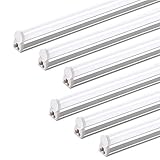
What counts as a shop light or task light?
LED shop lights are typically long, surface-mounted or suspended fixtures that spread light across a broad area. Common lengths are 4 feet, with shorter versions for compact spaces. They’re meant to light walkways, storage, and multiple work areas—not just one benchtop.
Linear task lights are also elongated, but they’re positioned close to a particular work surface. They may mount under a shelf, on a wall, or directly above a bench. Their job is to improve visibility at the work, especially for detail tasks, without requiring the whole shop to be brightly lit.
The labels aren’t standardized. Check the fixture’s dimensions, light output, mounting method, and intended environment rather than relying on its name.
Side-by-side comparison
| Factor | LED shop light | Linear task light |
|---|---|---|
| Coverage | Broad; useful for a room or shop bay | Focused on a bench or machine |
| Typical placement | Ceiling, often centered over an aisle or work zone | Above or just behind the work surface |
| Best for | General cleanup, moving tools, and seeing across the shop | Fine assembly, layout, sanding checks, and bench work |
| Common drawback | Can leave shadows under cabinets or when you lean over the bench | Can leave the rest of the shop dim; may create glare if placed poorly |
| Installation concern | Ceiling height, spacing, and secure suspension | Mounting clearance, cord routing, and protection from impact |
When to choose LED shop lights
Choose shop lights when the problem is general visibility. If you can’t easily find a dropped screw, read labels on nearby storage, or see the floor while carrying stock, a task light over the bench won’t solve it. Put broad fixtures over the main work area and walkways, with enough overlap to avoid dark gaps.
For planning, compare lumens and beam spread rather than buying by wattage alone. As a rough starting point, a modest one-car shop might use several thousand lumens of general lighting, then add task light where precision matters. The right amount depends on ceiling height, wall color, fixture spacing, and how reflective the surfaces are. Dark ceilings and dusty, matte walls absorb more light than white ones.
A ceiling fixture can still leave a strong shadow when your body blocks the light. Position fixtures to the sides of a bench or use more than one light direction if you do detailed work. Check the actual beam pattern: two fixtures with the same lumen rating can distribute light quite differently. For broad overhead coverage, compare 4-foot LED shop lights by output, mounting hardware, and whether they can be linked safely as intended.
When a linear task light makes more sense
Choose a task light when the rest of the shop is adequately lit but the work surface is not. It’s particularly useful for measuring, marking, wiring, sharpening, or inspecting a finish. A linear fixture spreads light along a longer section of the bench than a small desk lamp and is less likely to leave the far end in darkness.
Mount it high enough that it doesn’t interfere with stock or tools, but not so far away that its focused light becomes ineffective. Watch for reflections off glossy paint, metal, or a polished benchtop. A light directly in your line of sight can be more distracting than helpful; a slightly forward or offset position often works better. Under-shelf task lighting can also be a practical choice when a shelf already sits above the bench, provided the fixture won’t be hit by clamps or long workpieces.
Look for a diffuser or lens if visible LED points cause glare, and check that the switch is easy to reach. Some fixtures have a cord and plug; others require fixed wiring. Don’t assume a fixture is suitable for a dusty shop just because it has an LED label. Check its listed environment and keep it clear of sawdust buildup. For a dedicated bench, consider LED linear workbench task lights with a mounting style that suits your shelf or wall.
Color, flicker, and glare matter
Color temperature affects how the shop feels and how clearly you distinguish materials. Around 4000K is a neutral starting point; 5000K looks cooler and may feel crisp for inspection. Neither temperature guarantees good color rendering. If matching stain, wire colors, or paint matters, check the color-rendering specification and, where available, try the light before installing several fixtures.
Flicker can be uncomfortable and may make moving blades or rotating parts appear to slow or stop. Don’t use a flickering fixture near machinery. If a light pulses, buzzes, or behaves inconsistently, check the driver, dimmer compatibility, and wiring. Avoid putting shop lights on an incompatible household dimmer just because the switch fits.
Mounting and shop safety
Secure ceiling fixtures to structure using suitable hardware, not just drywall anchors. Leave room for garage doors, lumber racks, and raised equipment. Route cords away from walkways and sharp edges, and don’t daisy-chain fixtures unless the manufacturer specifically permits it. Keep lights clear of dust collection ducts and other equipment that could block the beam or vibrate the mounting.
In a dusty shop, clean lenses periodically with the fixture switched off and cool. A layer of dust cuts output and can make a weak lighting layout worse. Keep the light itself out of the way of sanding and cutting debris when possible; lighting does not replace appropriate dust collection or protective equipment.
A practical buying approach
If the shop is dim overall, start with broad overhead lighting. If the room is already bright but the bench is shadowed, buy a task light first. For a new setup, install general lights across the work area, then test the bench with your body in the normal working position. Mark the darkest spots and add focused lighting only where needed.
The cheaper option is often fine in a small, low-ceiling shop where one or two fixtures cover the space and the work is mostly rough assembly. Spend more attention on placement than on buying the highest lumen number. A bright fixture in the wrong spot can produce glare, sharp shadows, and poorly lit corners; a modest fixture placed well can be easier to work under.