
What's inside
- Ryobi wood planer versus DeWalt: the useful numbers
- What the Ryobi does well
- Real depth-per-pass on oak: what to expect
- Snipe on a six-foot board
- ONE+ battery drain per board-foot
- Which planer fits your situation?
- Ownership costs and common failure points
- Verdict: budget buy or false economy?
- Related Guides
As an Amazon Associate I earn from qualifying purchases. This post may contain affiliate links at no extra cost to you.
The Ryobi wood planer is a sensible low-cost choice for occasional DIY work, but it becomes a false economy if you regularly flatten wide hardwood boards: its lower purchase price is offset by slower cuts, more battery management, and less predictable snipe than the step-up DeWalt models.
This comparison focuses on the Ryobi ONE+ 18V cordless thickness planer, commonly sold as the P610, alongside the corded DeWalt DW734 and DW735 series. Exact kits and included accessories vary by market, so check the model plate before buying. The key question is not whether the Ryobi can plane wood—it can—but whether its capacity and operating cost fit the work you actually do.
As an Amazon Associate we earn from qualifying purchases at no extra cost to you.

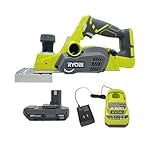


Ryobi wood planer versus DeWalt: the useful numbers
| Feature | Ryobi ONE+ P610 | DeWalt DW734 | DeWalt DW735 |
|---|---|---|---|
| Power source | 18V ONE+ battery | 120V corded | 120V corded |
| Maximum board width | 12.5 in | 12.5 in | 13 in |
| Maximum stock thickness | Approximately 6 in | 6 in | 6 in |
| Maximum depth per pass | Up to 1/16 in, depending on stock and battery | 1/8 in on narrower stock; less on wide hardwood | 1/8 in on narrower stock; less on wide hardwood |
| Cutting-head width | 12.5 in class | 12.5 in | 13 in |
| Typical tool weight | About 50 lb with stand and battery, depending on configuration | About 80 lb | About 92 lb |
| Knives | Reversible disposable knives | Reversible disposable knives | Reversible disposable knives |
| Dust ejection | Fan-assisted; collection is strongly recommended | Fan-assisted | Fan-assisted with adjustable chip-ejection features |
Depth figures are maximum ratings, not sensible everyday settings. On oak, a 1/16-inch cut is an aggressive request for a compact cordless planer, particularly across most of its width. A more realistic starting point is 1/32 inch, followed by lighter finishing passes. The DeWalt machines maintain cutter speed more effectively under the same load, especially on 8- to 13-inch-wide oak.
What the Ryobi does well
The Ryobi’s main advantage is portability. Without a power cord, it is easier to use beside a driveway, at a job site, or in a small workshop where the planer normally lives on a shelf. Owners already invested in the ONE+ battery system may also avoid buying a separate battery platform.
Its capacity is adequate for common furniture stock. It can process a 12-inch panel, though wide hardwood should be reduced in thin stages rather than treated like soft pine. Reversible knives keep replacement cost reasonable: when one edge becomes dull or chipped, the knife can be turned over instead of immediately discarded.
For a beginner, the Ryobi is also less intimidating to move than a heavier stationary planer. That benefit matters if the alternative is leaving a large machine unused because setting it up is inconvenient.
Real depth-per-pass on oak: what to expect
Oak exposes the difference between a portable planer and a heavier corded model. Its density increases motor load, and reversing the grain can produce tear-out even when the machine has enough power.
- Ryobi: begin at 1/32 inch on oak. Use 1/16 inch only on narrower, straight-grained boards when the battery is well charged and the feed is steady.
- DeWalt DW734: 1/16 inch is a more practical general-purpose setting, with lighter passes for wide or figured oak.
- DeWalt DW735: the two-speed feed system makes it easier to choose a faster dimensioning pass or a slower finish pass, although it does not eliminate tear-out caused by bad grain direction.
Do not judge capacity by the depth dial alone. A planer removes material from the highest points; it does not correct a board that is bowed or twisted. Flatten one face on a jointer or sled first, then plane the opposite face. Feeding a twisted board directly into any thickness planer can create inconsistent thickness and unsafe rocking.
Snipe on a six-foot board
Snipe is the shallow dip often found at the leading or trailing end of a board as it enters or leaves the cutter head. Six-foot boards are long enough to reveal it, but length itself is not the cause. The problem comes from the board tipping slightly when only one roller is supporting it.
The Ryobi can produce measurable snipe at either end if the infeed and outfeed surfaces are not aligned. DeWalt machines are not immune; their greater weight and more substantial tables can make setup easier, but a poorly supported board can still dip.
How to minimize it
- Align the planer table with level infeed and outfeed extensions. A low extension encourages the board to pivot.
- Support a six-foot board before it reaches the cutter head and continue supporting it after it exits.
- Keep the board flat against the table without lifting its front or rear edge.
- Make a light final pass rather than removing the full remaining allowance in one cut.
- Mark the first and last several inches as waste when the project permits, then crosscut them away.
For a 72-inch board, allowing 3 inches of sacrificial length at each end is often cheaper than repeatedly fighting snipe on a visible finished edge. If every inch matters, a heavier planer with accurately aligned support tables is the safer purchase, but setup still determines the result.
ONE+ battery drain per board-foot
There is no dependable universal battery-per-board-foot number for the Ryobi. Battery drain changes with species, width, moisture, starting thickness, depth of cut, knife sharpness, feed rate, and whether the board is being dimensioned or merely skimmed. A claim such as “one battery handles a fixed number of board-feet” is therefore misleading.
A useful planning calculation is:
Board-feet = thickness in inches × width in inches × length in feet ÷ 12.
For example, a 1-inch-thick, 8-inch-wide, 6-foot oak board contains 4 board-feet. If it requires six 1/32-inch passes plus a final skim, the planer removes about 0.20 inch across 48 square inches of surface. That is substantially more work than taking two light passes from already-flat stock.
As a practical budgeting rule, a compact cordless planer should be treated as a small-batch tool: keep a charged 4Ah or 6Ah ONE+ battery available, expect lower output on wide oak, and stop when the tool slows audibly. Continuing through a depleted pack can leave a rough surface and encourages overheating. The corded DeWalt models avoid this uncertainty, which is their biggest advantage for repeated production work.
Which planer fits your situation?
| Your situation | Best fit | Why |
|---|---|---|
| Occasional shelves, repairs, and small furniture parts | Ryobi ONE+ P610 | Lower entry cost and cordless portability outweigh slower production. |
| Already own several ONE+ batteries | Ryobi ONE+ P610 | The bare tool can be economical if your batteries and charger are already paid for. |
| Frequent oak or maple work | DeWalt DW734 or DW735 | More consistent feed performance and no battery interruption. |
| Mostly wide boards and long batches | DeWalt DW735 | Its 13-inch capacity and selectable feed rates suit repeated dimensioning. |
| Small workshop with limited storage | Ryobi, if a stable stand is available | Portability helps, but the machine still needs safe support and dust control. |
| Beginner buying one planer for years of furniture work | DeWalt DW735 | Higher initial cost buys more headroom and fewer compromises as projects grow. |
Ownership costs and common failure points
Knives are the first consumable to budget for. Nail strikes, embedded grit, glue squeeze-out, and planing dirty reclaimed lumber can nick an edge immediately. Rotate or replace knives as a matched set; mixing heavily worn and new edges can affect cut quality.
Dust buildup is the next issue. Clear chips from the cutter-head housing and fan path, keep the bed waxed with a suitable paste wax, and inspect the rollers for resin. Never reach near the cutter head while the machine is connected to power or while a battery is installed. A restricted chip path increases clogging and can mark the workpiece.
Common mistakes include taking maximum cuts on wide hardwood, forcing a board faster than the feed rollers want to carry it, planing end grain, and using a planer to flatten a twisted board. These errors cost more in knives and ruined stock than the original price difference between the Ryobi and DeWalt.
Verdict: budget buy or false economy?
Buy the Ryobi wood planer when portability, occasional use, and existing ONE+ batteries are central to the decision. It is capable of useful work, especially on narrower boards and moderate cuts, but you must plan around battery capacity, support tables, and conservative depth settings.
Choose the DeWalt DW734 for a serious corded thickness planer at a lower step-up cost, or the DW735 when wide boards, oak, and repeated batches justify its extra capacity and feed control. The Ryobi is not a bad planer; it is simply the wrong economy for a shop that will regularly process six-foot hardwood boards. For that workload, paying more once is likely cheaper than paying in time, batteries, extra passes, and discarded stock.